Digital Shelves Trade-Offs
A digital shelf is a catalog surface, not just a product page. See how planogram logic maps to search and filters, a worked example, and a test.
Retail teams talk about the digital shelf as if it were a website problem, but it is a placement problem in disguise. On a physical shelf, space is scarce and position is decided by a planogram. Online, space feels abundant, yet visibility is still rationed by ranking, filters, and content completeness. The real problem is that abundance hides the same trade-offs rather than removing them.
Direct answer: A digital shelf is the set of positions where a product can be seen, compared, and selected in an online catalog, and it inherits the placement logic of a physical planogram. The planogram concept treats shelf space and adjacency as deliberate choices, while merchandising covers assortment, presentation, and promotion. Use the digital shelf as a placement decision, not as a page-design task.
Delta: This article adds a decision framing beyond the sources: it maps planogram and merchandising concepts to the specific choice of which products to feature, how deep to make an assortment, and where to spend content effort, with claim status explicit.
The mechanism
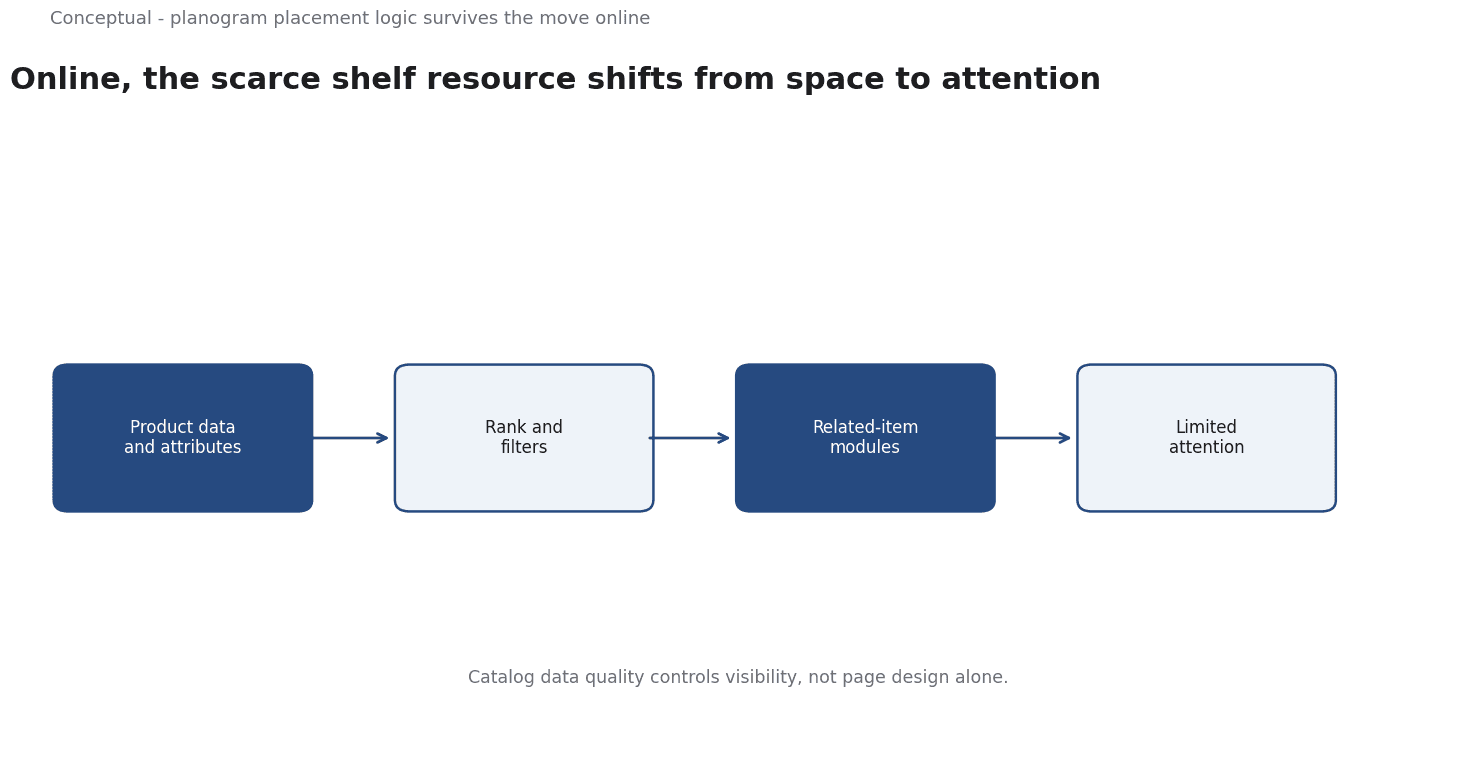
The starting concept is the planogram, a visual diagram of where products sit on a shelf and how many facings each receives. Its purpose is to make placement a deliberate choice rather than a default, because position and neighbours influence what shoppers notice and buy. The practical consequence for a digital shelf is that the equivalent decisions still exist: a product's rank in a category, its appearance in related-item modules, and its position in filtered results all play the role that facings and adjacency play in store. Calling these simply search results hides the fact that someone chose them.
Merchandising broadens the frame to include the assortment, its presentation, its pricing, and its promotion. Those functions have to work together: a well-ranked product with an incomplete description or a poor image still fails to convert, and a deep assortment that no shopper can navigate adds cost without adding choice. The practical consequence is that digital shelf work is a coordinated merchandising task. Optimizing a single lever, such as adding more products, can make the whole surface less useful if the other levers are left behind.
The key difference is the scarce resource. A physical planogram rations finite shelf space, so every facing given to one product is taken from another.
Online, listing space is effectively unlimited, but attention is not; the scarce resource shifts from space to discoverability.
The practical consequence is that the trade-off does not disappear when the shelf grows, it moves. A larger catalog makes the placement decision more important, because more products now compete for the same limited positions at the top of a results page.
Finally, digital placement is mediated by data. Ranking and filters depend on product attributes, category assignments, availability, and media, so a product with incomplete or inconsistent data is effectively absent even when it is technically listed. The practical consequence is that merchandising quality becomes information quality. The team that controls the catalog fields controls visibility, which means the planogram of the digital shelf is written as much by data hygiene as by any design choice.
A worked example
The following is hypothetical and illustrative. An online retailer is considering adding fifty products to a growing category and changing which items appear first. Three checks decide the move. First, the findability check: do the currently top-ranked products have complete attributes, category assignments, and images, or are they visible only by accident? Second, the adjacency check: do related-item modules surface the intended complements and substitutes, or simply the items that already sell most? Third, the attention check: does a deeper assortment push higher-margin items below the fold and fragment the filters into narrow, empty choices? The outcome is a decision rule rather than a verdict. If the catalog data is clean and the deeper range improves comparison without burying core items, adding products is reasonable. If findability is already weak, fixing attributes and placement beats expanding the range.
Evidence status
| Claim | Status | Source | Verified | Recheck when |
|---|---|---|---|---|
| A planogram specifies product placement and adjacency to influence sales | source-reported | Planogram - Wikipedia | 2026-11-18 | Retail layout practice changes in the source |
| Merchandising covers assortment, presentation, promotion, and pricing | source-reported | Merchandising - Wikipedia | 2026-11-18 | Scope of merchandising changes in the source |
| Digital placement shifts the scarce resource from space to attention | inferred | Derived from the sources | 2026-11-18 | New evidence on search ranking and attention dynamics |
The two reported claims are descriptions taken from the reference entries and can be relied on as stated. The attention claim is an inference that follows from applying the placement concept to a catalog where listing space is not finite, and it is the part that carries the decision. It should be revisited if ranking systems change in ways that alter how visibility is actually allocated.
What it cannot do
The analogy to a physical shelf has a limit. A store shelf is a single surface that a shopper walks past, while a digital shelf is made of several surfaces: category pages, search results, filters, recommendations, and promoted placements. There is no one planogram to open and adjust. The limit matters because a team can optimize one surface and degrade another without noticing, for example by improving a category page while breaking the attributes that feed filters. The framework helps ask placement questions, but it does not provide a single object that can be managed from one place.
The hidden cost is maintenance at scale. Digital visibility depends on product data that must be kept accurate, complete, and consistent across every item. Adding products is cheap; keeping their attributes, images, and availability current is not. The cost is operational and continuous, and it grows with the size of the catalog. A plan that treats content as a launch task rather than an ongoing responsibility will see visibility decay as data goes stale. The honest accounting is that the digital shelf is a system that needs a data owner, not a one-time design decision.
When a team learns which signals lift placement, it can produce titles and attributes that score well but read badly, or feature products that rank highly yet fail to satisfy the intent that brought the shopper in. Availability creates a related failure: a product placed prominently but out of stock turns a good position into a bad experience. The mechanism fails when the proxy for visibility is mistaken for the goal of visibility, which is a choice that serves the shopper.
There are boundaries where this framing does not apply cleanly. On a marketplace, the platform controls the ranking rules and the retailer can influence them only indirectly, while on a first-party site the team controls both the shelf and the data. Considered purchases with long research cycles also behave differently from routine restocking, because the shopper is not scanning a single page. In these settings the levers and the relevant outcomes differ, and importing a planogram mental model without adjusting for them produces a plan aimed at the wrong surface.
Finally, the digital shelf needs scheduled review because ranking systems and shopper behaviour change. A placement that works today can lose visibility when the rules shift or when competitors improve their data. The practical requirement is to check the surfaces on a fixed cadence, verify that attributes are still complete, and record which decisions relied on which reading. Without that discipline, the shelf becomes something people assume rather than something they inspect, and the trade-offs quietly return in a form nobody is watching.
The counterargument that the digital shelf is too fluid for planogram thinking is fair on marketplaces with opaque ranking and incomplete for first-party catalogs, where placement and data are both controllable decisions.
A decision test
- State the placement decision and the surface it concerns.
- Identify which products currently occupy the visible positions.
- Check whether product attributes, categories, and media are complete.
- Test whether related-item modules show useful adjacency.
- Compare the cost of adding products with the cost of maintaining their data.
- Check availability so that featured items can actually be bought.
- Record the decision and set a date to recheck the surface.
The test is passed when a reader can see where a product sits, why it sits there, and what would move it, and failed when visibility is treated as a technical accident. The steps are a way of making the placement choice explicit, which is the whole point of a planogram. For further reading, see Marketing Dashboards.
References & Further Reading
- Wikipedia contributors, 2026. Planogram - Wikipedia — The placement of products on shelves.
- Wikipedia contributors, 2026. Merchandising - Wikipedia — Presentation and promotion of products in retail.