Discounted Cash Flow: Common Questions
DCF turns future cash into a present value through discounting. See how growth and discount rate map to valuation decisions, with claim status explicit.
Discounted cash flow is often presented as a single number that settles a valuation debate, which invites false precision. The real problem is that the output depends entirely on input choices: cash flow estimates, a discount rate, and a terminal value, any of which can be inconsistent with the others. A model that ignores that dependency can rank investments confidently for the wrong reasons.
Direct answer: Discounted cash flow values an asset by summing future cash flows divided by one plus a discount rate raised to each period. Damodaran's materials stress that cash flows and the rate must share the same measurement basis. The bounded claim: a valuation is a conditional estimate, and its decision value lies in the sensitivity of the result to those inputs.
Delta: This article adds an assumption-to-sensitivity mapping beyond the sources: it maps each model input to the decision it drives, with claim status explicit.
The mechanism
Discounted cash flow rests on the idea that money available now is worth more than the same amount later, so future cash flows are reduced to a present value. Wikipedia describes it as a method of valuing a project, company, or asset using the concepts of the time value of money. The standard form divides each expected cash flow by one plus the discount rate raised to the period number, then sums the results. The practical consequence is that the output is only as good as the cash flow estimates and the rate applied to them. A change in either input changes the answer, sometimes substantially.
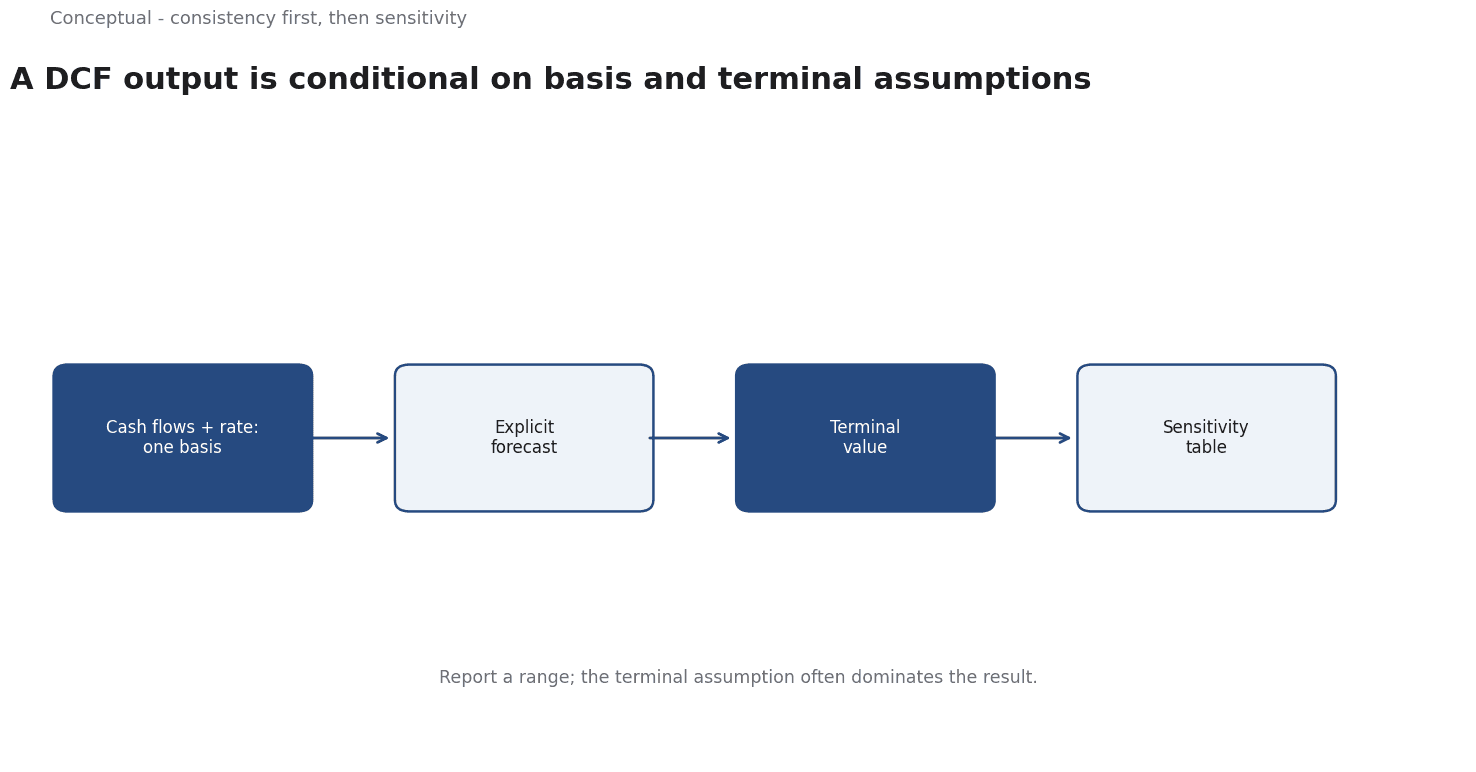
Damodaran's online materials place unusual weight on internal consistency between the cash flows and the discount rate. Cash flows and the rate must be measured on the same basis: nominal with nominal, real with real, the same currency, and a perspective that matches, whether that is equity or the whole firm. Discounting firm-level cash flows at an equity cost of capital mixes incompatible measures and produces a number that looks precise but is structurally wrong. The practical consequence is that a valuation can fail on consistency before anyone debates whether the growth forecast is optimistic. Consistency is a prerequisite, not a refinement.
A discounted cash flow analysis usually splits into an explicit forecast period and a terminal value that stands for all cash flows beyond it. Because the terminal value is computed far out and then discounted back, it can still account for a large share of the total. That means distant assumptions carry disproportionate influence over the final figure, even though they are the least observable. Neither source tells a team the right forecast horizon or terminal growth rate; those are local choices that must be marked as inferred.
The honest output is a range of values under different assumptions, not a single point presented as a fact.
The useful output is a small table pairing each input with its measurement basis and its sensitivity. It records what happens to value if the discount rate moves, if growth slows, or if the terminal assumption is trimmed. That table, rather than a single computed value, is the decision instrument. It shows which assumptions actually drive the answer and makes the rationale reviewable, because basis and sensitivity are recorded together. A team that writes them down can later explain why a valuation moved, instead of treating the new number as inexplicable. It also keeps the conversation on the assumptions where it belongs.
A worked example
The following is hypothetical and illustrative. A team uses a ten-year discounted cash flow to value a division before an internal capital allocation decision. Three checks shape the review. First, are the projected cash flows and the chosen discount rate on the same basis, meaning the same treatment of inflation, the same currency, and the same perspective of firm or equity? Second, what share of the total value comes from the terminal value, and is its growth assumption modest relative to the long-run economy? Third, how far does the value move if the discount rate changes by a plausible margin rather than a trivial one? The review finds a basis mismatch and a terminal value that dominates the result. The team rebuilds the model on a consistent basis, reduces the terminal growth assumption, and reports a range instead of a point. The outcome is a valuation whose drivers are visible. The figures are hypothetical; the decision method is the contribution.
Evidence status
| Claim | Status | Source | Verified | Recheck when |
|---|---|---|---|---|
| DCF reduces future cash flows to present value using the time value of money | source-reported | Discounted cash flow, Wikipedia | 2026-11-18 | Method definition revised |
| Cash flows and discount rate must share one measurement basis | source-reported | Damodaran Online | 2026-11-18 | Guidance updated |
| Forecast horizon and terminal growth are local, not source-supplied | inferred | Derived from the sources | 2026-11-18 | Model inputs change |
The first two rows report what the reference article and the valuation guidance state. The third is an inference about which choices remain local, because neither source fixes a horizon or a terminal growth rate for a particular company. Recheck the source rows when the method description or guidance is revised, and the inferred row whenever the business or its inputs change materially.
What it cannot do
A discounted cash flow does not produce a fact. It produces a number conditional on assumptions, and small changes in the discount rate or terminal growth can move the answer enough to reverse a decision. Treating the output as a precise estimate confuses a model with a measurement. What the model can report is what must be true about future cash flows for a given price to be justified. It cannot confirm that those conditions will hold, and it cannot substitute for judgment about whether the forecast is believable in the first place.
The hidden cost is that a defensible valuation takes more work than a spreadsheet. Estimating cash flows from a business plan, choosing a rate that matches their basis, constructing a terminal value, and running sensitivities all require effort and domain knowledge that a single base case avoids. That asymmetry is why teams lean on one number and defend it. The cost is paid in model documentation, in the discipline to revisit assumptions when the business changes, and in the willingness to present a range that is harder to summarize in a meeting. Skipping that work does not remove the assumptions; it only hides them.
A model that discounts real cash flows at a nominal rate, or an equity rate against firm cash flows, is wrong before any debate about growth begins. Equally damaging is a terminal value that carries most of the result while resting on the weakest evidence. A team that reports the total to several decimal places implies a confidence the inputs cannot support. The question worth asking is which single assumption, if wrong, would change the decision, because that is where review effort should go. A model that cannot answer that question is a calculation, not an analysis.
There is a boundary around the method. It covers valuation by discounting expected cash flows, not market pricing, not liquidity, and not macroeconomic forecasting. It cannot value strategic options, execution risk, or management quality unless those are translated into cash flows or reflected in the rate. It does not supply the correct discount rate; it shows the consequences of the rate chosen. It is a framework for making assumptions explicit and testing their effect, which is narrower than the authority a single output number is often given in investment conversations.
Because inputs drift as a business evolves, the model needs a refresh. Each assumption should carry its measurement basis and a recheck condition, and the terminal value should be treated as a local decision rather than a standard value. Without that record, a future reviewer cannot separate a deliberate assumption from an inherited default. The cash flows will still be forecastable next quarter; the rationale for why they were forecast that way is what makes the valuation reviewable. For further reading, see Cash Flow Forecasting: A 13-Week Operating Model.
A decision test
- Define the asset being valued and the perspective, firm or equity.
- Forecast cash flows on a stated basis, real or nominal.
- Choose a discount rate measured on that same basis and currency.
- Set an explicit forecast horizon.
- State the terminal value method and its growth assumption.
- Run sensitivities on the rate and on growth.
- Record each assumption with its basis and a recheck condition.
A discounted cash flow is useful only when its inputs and their sensitivities are both visible. The test turns a single number into a sequence of decisions with an explicit rationale, so a reviewer can see which assumption carries the result and whether it is consistent with the others. The model will always depend on judgment; the value of the exercise is that the judgment becomes inspectable rather than implicit.
A counterargument
A reasonable critic can argue that the article's sensitivity discipline does not reach the hardest problem. Both sources describe the mechanics and supply inputs: Wikipedia defines the method, and Damodaran publishes the industry averages and WACC data that feed the discount rate. Neither shows how to judge whether the forecast itself is believable, which the article concedes but then sets aside. There is also a circularity the framing understates: if the discount rate comes from the same market data the valuation is meant to interrogate, presenting a range of outcomes can look like rigour while importing the market's own assumptions.
The objection is not that consistency and sensitivity are wrong; it is that they are necessary without being sufficient.
Under conditions where the terminal value dominates, the range may simply widen the interval of an unsupported guess rather than resolve it.
References & Further Reading
- Wikipedia contributors, 2026. Discounted cash flow - Wikipedia — The structure and use of discounted cash flow analysis.
- Aswath Damodaran, 2026. Damodaran Online: Home Page for Aswath Damodaran — Publicly maintained datasets for industry averages, WACC, and valuation.