Display Advertising Explained
Display advertising buys attention, not guaranteed attention. Read how it works, a worked example, and why an impression is not an outcome.
Display advertising is often measured by impressions, which describes delivery rather than effect. The display-advertising entry describes graphic ads on digital channels, and Google's measurement documentation covers conversion credit. The question is what an impression tells you.
Direct answer: Treat an impression as evidence of delivery, then measure the outcome the campaign exists for with a comparison where possible. The sources describe the channel; the rule is a synthesis.
Delta: This article adds a claim-status table and a worked example, separating documented delivery from local judgements about effect.
The mechanism
The first point is delivery. The display-advertising entry describes ads placed on digital properties, which means an impression records that an ad could be seen. It does not record that a person noticed it, understood it, or changed a decision.
The second point is credit. Google's measurement documentation describes how conversions are attributed, which depends on rules. A conversion after a display ad may have been caused by something else, and the credit rule does not settle the question.
The third point is the outcome. A campaign for awareness and a campaign for direct response need different measures, and a single report cannot serve both. Naming the outcome before launch is the decision that makes measurement possible.
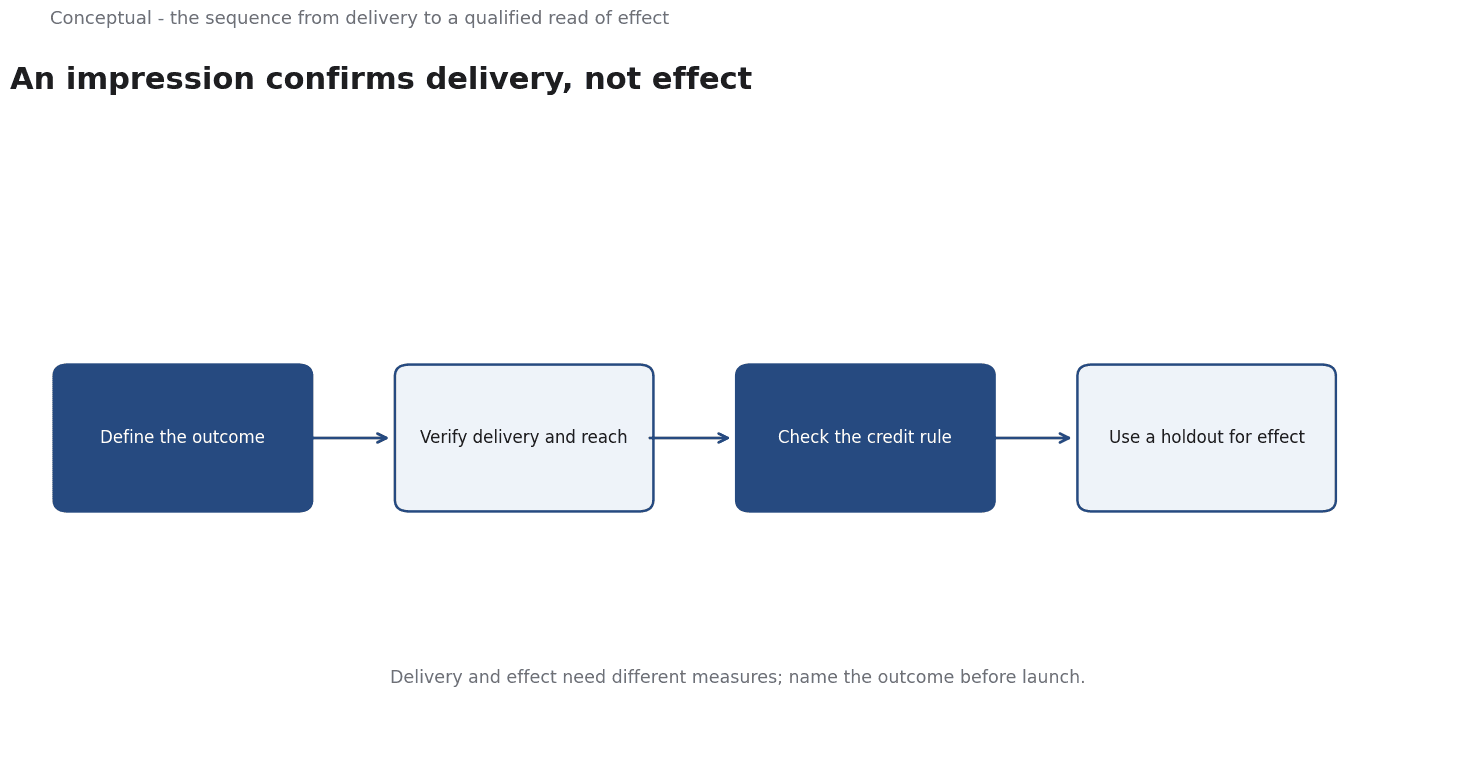
The sequence is: define the outcome, verify delivery, check the credit rule, then use a comparison for effect. The choices are local, so the conclusions are inferred; the channel is source-reported.
A worked example
Illustrative. A campaign delivers a million impressions and reports a strong click-through rate.
Three checks decide. First, did the campaign reach the intended audience, or only a large one? Second, does the reported conversion represent the outcome the campaign exists for? Third, is there a holdout or another comparison that separates the campaign from background demand?
The outcome is a qualified reading of delivery and effect. The scenario is hypothetical; the method is the contribution.
Evidence status
| Claim | Status | Source | Verified | Recheck when |
|---|---|---|---|---|
| Display ads are delivered on digital channels | source-reported | Wikipedia, Digital display advertising | 2026-11-18 | Definition changes |
| Platforms document conversion credit | source-reported | Google Ads measurement docs | 2026-11-18 | Product changes |
| Separate delivery from effect | inferred | Derived from both | 2026-11-18 | Goals change |
Why an impression is not an outcome
An impression records that an ad was served. The business cares whether a person noticed it and acted, which is a different observation, and the gap is where reporting becomes misleading.
A further consideration is viewability.
Checking the conditions of delivery is part of evaluating the channel.
The campaign also has a frequency dimension. The same person may see an ad many times, and a count of impressions can look large while the reached audience is small. Reporting reach and frequency together is the correction.
The third limitation is that credit rules favour some channels. A platform that reports conversions within its own system will attribute more to itself, which is a reason to use a comparison rather than relying on a single report. The discipline is the same as for any measured channel.
An impression records delivery, which is different from being noticed or remembered.
Reach and frequency should be reported together, since a large count can come from one person.
Credit rules favour some channels, which is a reason to use a comparison rather than a single report.
Viewability conditions determine whether an impression could have been seen at all.
The outcome should be defined before launch, since delivery and effect need different measures.
A holdout separates the campaign from demand that would have existed anyway.
A large impression count can come from repeated exposure of one person, which is why reach matters.
A reported conversion is credit under a rule, not proof of a caused outcome.
A campaign should be judged on the decision it exists to change, not on delivery alone.
Frequency without reach can be a small audience seeing the same ad repeatedly.
A delivery figure is not an outcome, and the report should say which one it is describing.
Reach and frequency together tell a different story from an impression count, which is why both belong in the view.
A decision test
- Define the outcome.
- Verify reach and frequency.
- Check viewability conditions.
- Read the credit rule.
- Use a comparison for effect.
- Record the result and recheck date.
For the comparison, see Incrementality.
A counterargument
A reasonable critic can push back that the article's central prescription - use a comparison to separate effect from delivery - is a synthesis its sources do not supply. The display-advertising entry describes the channel, and Google's attribution documentation explains credit rules inside a platform; neither establishes that a holdout is available or necessary. For awareness campaigns, where effects accrue slowly and a short holdout may show nothing, the insistence on a comparison quietly privileges direct-response measurement.
The objection is not that impressions are being conflated with outcomes; it is that the article offers one instrument, the comparison, without the conditions in which it works.
Where a holdout is infeasible or too noisy, the framework leaves the practitioner with delivery data and a warning, which is less than the decision rule it promises.
References & Further Reading
- Wikipedia contributors, 2026. Digital display advertising - Wikipedia — Graphic advertising delivered on digital channels.
- Google Ads Help, 2026. About attribution models - Google Ads Help — First-party documentation of attribution models and their limits.