Diversification at Scale
Diversification reduces specific risk, not all risk. Read how it works at scale, a worked example, and why more holdings can mean less understanding.
Diversification is often presented as adding holdings until risk disappears. The Wikipedia entry describes risk reduction through a mix of holdings, and Damodaran's framework insists on explicit assumptions. At scale, the problem is that the holdings begin to share the same underlying risks.
Direct answer: Diversify against the risks you can identify, then check how the holdings behave together under stress. The source defines the concept; the stress check is a synthesis.
Delta: This article adds a claim-status table and a worked review, separating the documented concept from the local judgement about which risks are actually independent.
The mechanism
Three points matter:
- Specific versus common risk. The Wikipedia entry describes diversification as risk reduction. It works best against risks unique to a holding and poorly against risks that affect all of them.
- Correlation rises in stress. Assets that look independent in calm periods can move together when liquidity tightens. This is the limit the concept does not remove.
- Understanding is a constraint. A portfolio of many holdings can be less understandable than a smaller one, which matters when a decision is needed quickly.
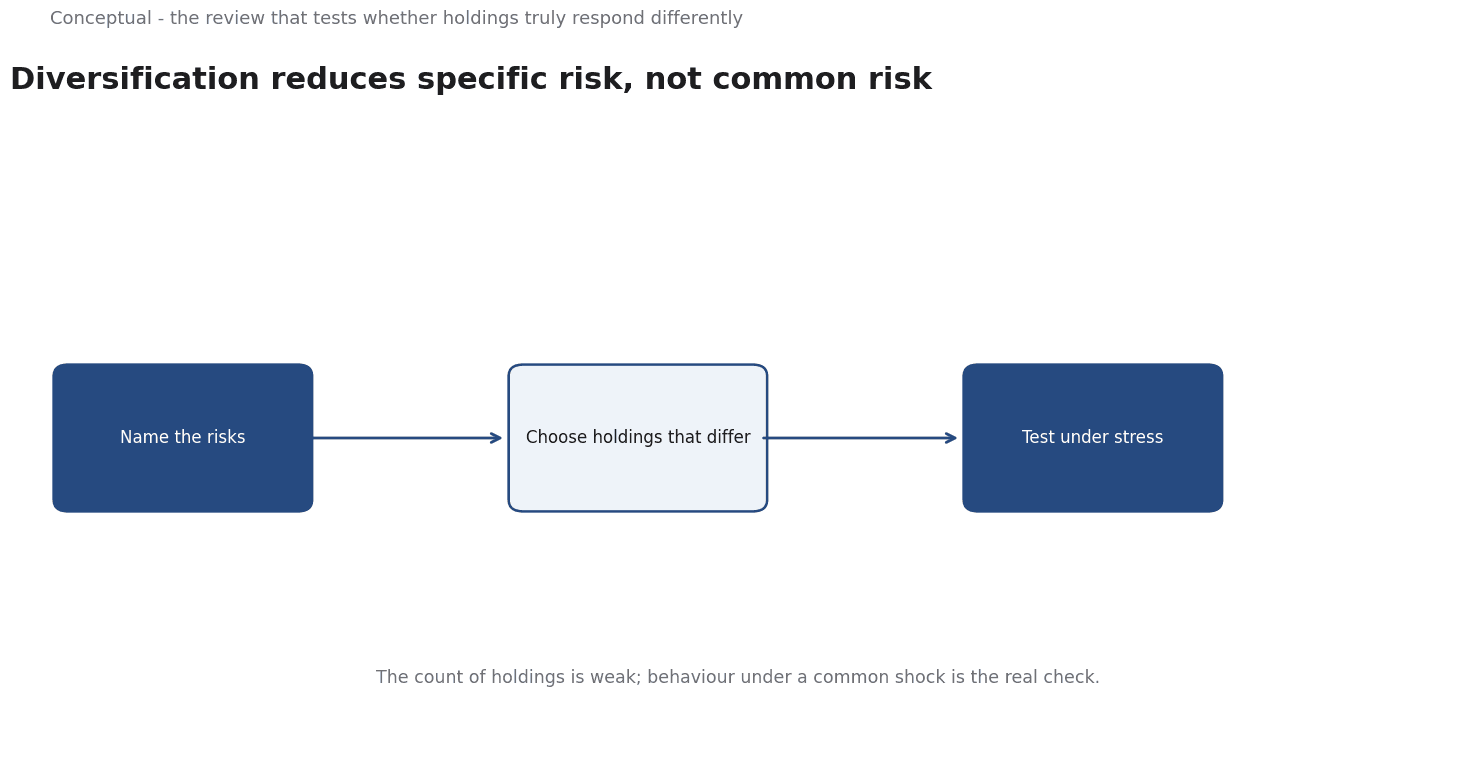
The sequence is: name the risks, choose holdings that respond differently, then test the combination under stress. Naming the risks is judgement, so it is inferred; the concept is source-reported.
A worked example
Illustrative. A portfolio holds ten funds across different sectors.
Three checks decide. First, do the funds share an underlying factor, such as interest-rate sensitivity? Second, what happened to the combined position during a previous stress period? Third, does the extra diversification improve the outcome enough to justify the reduced understanding?
The outcome is a evaluated structure, not a count of holdings. The numbers are hypothetical; the review method is the contribution.
Why independence is the scarce thing
Adding holdings is easy; finding holdings that respond differently is not.
Two funds in different sectors can both fall when rates rise, and a portfolio that looks diversified by name can be concentrated by factor. The count of positions is therefore a weak measure of diversification, while the behaviour under a common shock is a strong one.
A stress review uses a period when correlations changed. It asks which positions fell together and whether the combined loss was larger than expected from their individual behaviour. The result is often uncomfortable, because it shows that the protection was weaker than the structure implied. That discomfort is useful: it identifies the risk before the next period does.
Why understanding is part of risk
A portfolio that is hard to explain is hard to change quickly. When a shock arrives, the manager must decide what to reduce, and a structure built from many overlapping positions takes longer to reason about. Simplicity is not a guarantee of safety, but it is a condition for acting deliberately under pressure.
Evidence status
| Claim | Status | Source | Verified | Recheck when |
|---|---|---|---|---|
| Diversification reduces risk through a mix of holdings | source-reported | Wikipedia, Diversification | 2026-11-18 | Definition revised |
| Valuation requires explicit assumptions | source-reported | Damodaran Online | 2026-11-18 | Framework updated |
| Test correlations under stress | inferred | Derived from the concept's limits | 2026-11-18 | Market regime changes |
Why more holdings can be worse
Adding a holding that shares a risk with the existing portfolio does not diversify; it adds complexity. The number of positions is a poor proxy for independence. A stress test is a more direct check because it asks what happens when the common factor moves.
A further constraint is that the data used to judge diversification is historical. A period of low correlation does not guarantee low correlation in the future, particularly when the next shock has a different source.
Recording when the observation was made is a small discipline that keeps the conclusion honest.
The practical response is to revisit the structure rather than to assume it. A review that asks which risks are now shared, and which positions would behave alike under a new kind of shock, keeps the portfolio's logic visible. It is less precise than a model and more useful when the model's assumptions no longer hold.
The review should be dated so that its conclusion can be questioned later.
A structure that cannot be explained is difficult to defend when conditions change quickly.
What it cannot do
It cannot remove market-wide risk. It does not guarantee a better return. And it cannot replace an understanding of what is actually held.
The counterargument that a larger portfolio is always safer is fair for specific risk and incomplete for common factors.
A decision test
- Name the risks you want to reduce.
- Check whether holdings respond differently.
- Test under a past stress period.
- Count the cost of complexity.
- Use dated data.
- Record the decision and the recheck condition.
For the horizon context, see Asset Allocation.
References & Further Reading
- Wikipedia contributors, 2026. Diversification (finance) - Wikipedia — Risk reduction through a mix of holdings.
- Aswath Damodaran, 2026. Damodaran Online: Home Page for Aswath Damodaran — Publicly maintained datasets for industry averages, WACC, and valuation.