Dividend Policy Best Practices
A distribution is a choice between paying out and reinvesting. Read the practices, a worked example, and why a high yield can be a signal of weakness.
Dividend policy is often treated as a simple shareholder reward, which misses the choice underneath it: cash paid out cannot be reinvested. The dividend-policy entry describes how firms decide distributions, as Damodaran's framework insists on explicit assumptions, as the free-cash-flow article distinguishes generated cash from accounting profit, as the cash-flow article requires for the cash, as the valuation article treats conditional claims, as the publication standard forbids guaranteed outcomes.
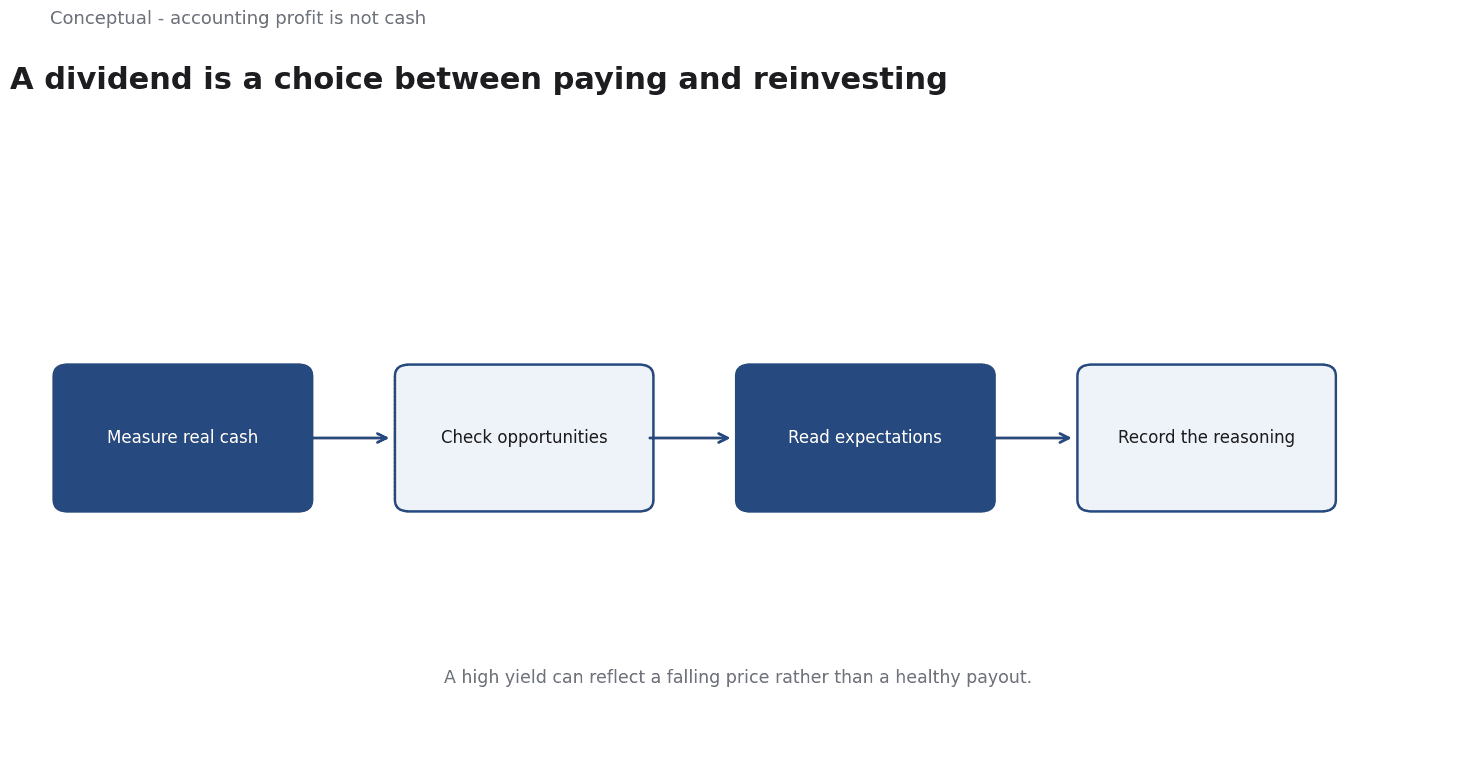
Direct answer: Set dividend policy from the cash the business actually generates, the opportunities it has, and the expectations it has created, then record the reasoning. Wikipedia's dividend-policy entry provides the context, and Damodaran's work provides the valuation discipline. The boundary: this is educational orientation, not personalised advice — tax treatment is jurisdiction-specific, as the tax article requires a dated check, as the publication standard forbids guaranteed outcomes.
The practices
Start with cash. A distribution should be covered by recurring cash flow, which the free-cash-flow article explains, as the cash-flow article requires, as the earnings-quality article warns about accruals, as the data-governance article requires dated figures, as the risk article requires residual risk, as the decision-memo article requires for a record.
Compare with reinvestment. Cash paid out is cash not invested, which the dividend-policy entry treats, as the valuation article requires for a conditional claim, as the DCF article treats assumptions, as the WACC article treats the cost of capital, as the scenario-analysis article requires conditional thinking, as the rubric article requires concrete criteria.
Read the signal carefully.
Be consistent with expectations. Cutting a dividend can be costly, which the dividend-policy entry describes, as the reputation article treats a public record, as the crisis article treats recovery, as the decision-memo article requires a reversal condition, as the monitoring article advises for review, as the governance checklist requires an owner.
Three consequences follow. The cash check comes first, as the free-cash-flow and cash-flow articles advise, as the earnings-quality article warns, as the data-governance article requires dated figures, as the risk article requires residual risk, as the decision-memo article requires for a record, as the valuation article treats conditional claims, as the DCF and WACC articles advise, as the scenario-analysis article requires conditional thinking, as the rubric article requires criteria, as the dividend-policy entry treats expectations, as the reputation and crisis articles advise, as the governance checklist requires an owner.
A worked example
The following is hypothetical and illustrative. A company considers raising its dividend after a strong accounting year.
Three checks decide. First, is the payout covered by recurring cash flow, as the free-cash-flow and cash-flow articles require, with dated figures, as data governance requires? Second, what opportunities are forgone, as the dividend-policy and valuation articles ask, with a conditional claim, as the DCF and WACC articles advise? Third, what would a cut cost later, as the dividend-policy and reputation articles advise, with a reversal condition, as the decision-memo article requires, as the risk article requires residual risk?
Three conclusions follow.
Accounting profit is not cash, which the first check reveals.
Reinvestment is the alternative, as the valuation article advises. And the decision should be recorded, as the decision-memo article requires.
What dividend policy cannot do
It cannot create cash, which the free-cash-flow and cash-flow articles advise, as the publication standard forbids guaranteed outcomes, as the risk article requires residual risk. It does not guarantee a return, which the investor-education material states, as the valuation article treats conditional claims, as the benchmarks article warns about broad results, as the decision-memo article requires a reversal condition. And it cannot remove tax obligations, which the tax article makes jurisdiction-specific, as the legal article requires a dated check, as the governance checklist requires an owner.
The counterargument that a higher payout always helps shareholders is fair for income needs and incomplete when it starves reinvestment, which the worked example shows, as the dividend-policy and valuation articles advise, as the risk article requires residual risk.
A decision test
- Check cash coverage, as the free-cash-flow article requires.
- Compare with reinvestment, as the dividend-policy entry advises.
- Read the yield as a question, as the dividend-policy entry advises.
- Use dated figures, as data governance requires.
- Treat forecasts as conditional, as the valuation article requires.
- Check tax treatment, as the tax article requires.
- Record the decision and residual risk, as the decision-memo and risk articles require.
For the instrument, see Dividend Policy; for the measures, see What Dividend Policy Measures.
References & Further Reading
- Wikipedia contributors, 2026. Dividend policy - Wikipedia — How firms decide on distributions to shareholders.
- Aswath Damodaran, 2026. Damodaran Online: Home Page for Aswath Damodaran — Publicly maintained datasets for industry averages, WACC, and valuation.