Asset Allocation for Long Horizons
The mix of assets matters more than the choice within them. Read how to set a target, a worked example, and why the horizon decides the rule.
An investor choosing between two technology funds is making a small decision compared with the choice between equities, bonds, and cash. Asset allocation — the mix of broad asset classes — explains much of the variation in portfolio outcomes, which is why it deserves more attention than security selection. It is also a decision about the investor, not just about the market.
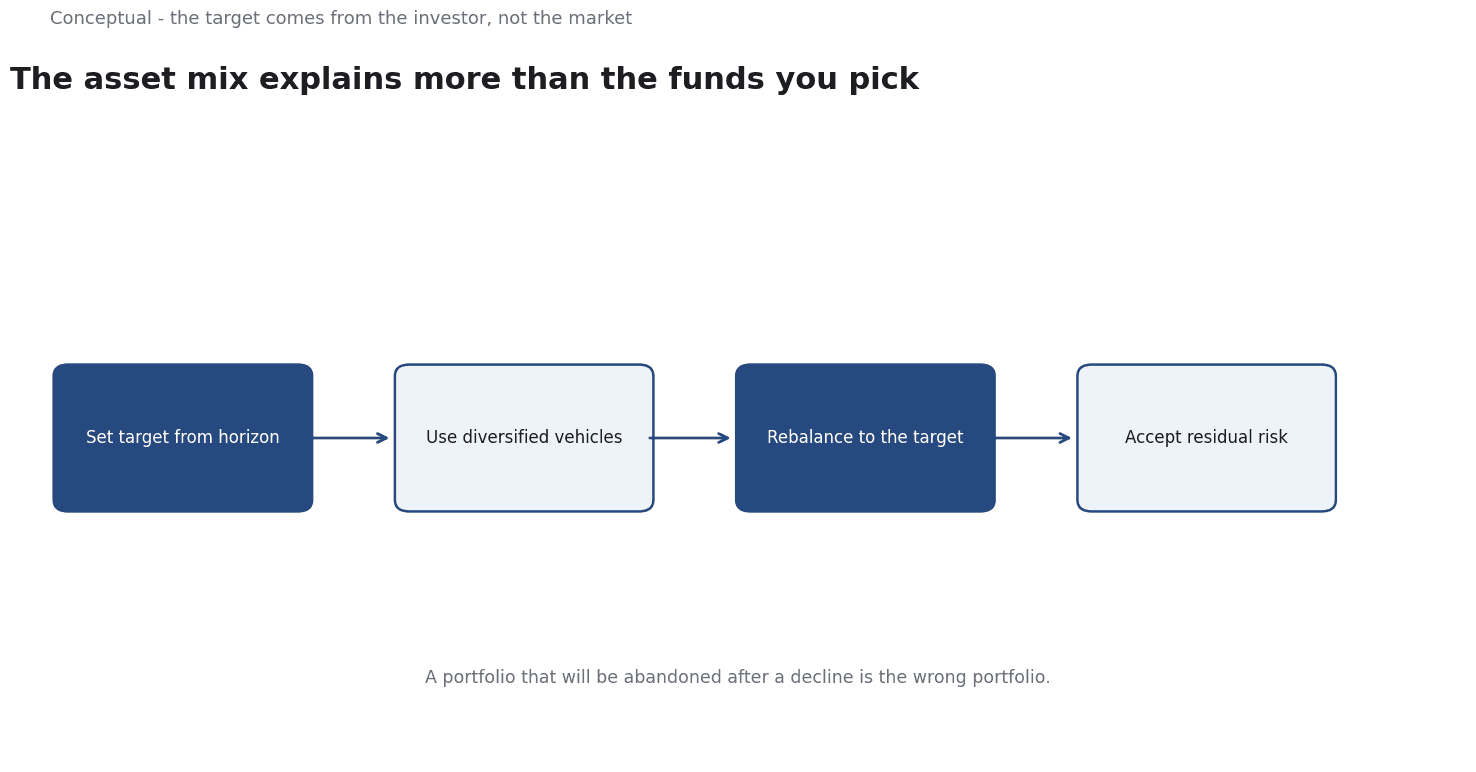
Direct answer: Set a target mix from the investor's horizon, need for liquidity, and tolerance for loss, then implement it with low-cost, diversified vehicles and rebalance to it. Investor education emphasises that all investments carry risk and returns are not guaranteed, and the rebalancing article explains how to maintain the target. The boundary: allocation cannot remove market risk, and a target based on an estimated expected return is a conditional choice, as the factor-investing article treats the assumptions behind return premia.
What sets the mix
Horizon. Money needed in two years belongs in different assets from money needed in thirty, as the personal-finance article treats liquidity needs as the first constraint. The long-horizon case for equities rests on their historical return premium, which the compound-interest article illustrates with dated assumptions and a stated caveat.
Tolerance for loss.
A portfolio that will be abandoned after a decline is the wrong portfolio, whatever the model says.
The behavioural-finance article treats temperament as a real constraint on investment decisions, which the emergency-fund article handles by keeping near-term money separate.
Liquidity needs. Expected withdrawals determine how much must be held in stable assets, which the cash-flow article addresses for a business and applies here to a household.
Three consequences follow. The first decision is about the investor, not the assets, which the value-proposition article analogises to starting with the buyer.
And the target needs an owner and a review trigger, as the governance checklist requires for any maintained standard.
A worked example
The following is hypothetical and illustrative. An investor has a twenty-year horizon, no near-term withdrawal need, and a stated tolerance for a 30% decline without selling. A starting mix of 80% equities and 20% bonds is tested against history and scenario analysis, as the scenario-analysis article recommends for non-linear outcomes.
Three checks decide whether it fits. First, does the downside in a severe scenario stay within tolerance, which the financial-crises article treats as a question of mechanism rather than a single historical episode? If a 50% equity fall produces a 40% portfolio fall, the mix is too aggressive. Second, can the investor hold through it, which the behavioural-finance article treats as observable temperament rather than stated willingness? Third, are the assets diversified, as the ETF article explains for broad exposure across a market?
Three conclusions follow. The mix is chosen for the investor, not for the market forecast, as the factor-investing article argues against timing based on expected returns. Rebalancing maintains it, as Portfolio Rebalancing: Rules, Costs, and Taxes explains. And the target is reviewed when the horizon or need changes, which the monitoring article treats as a change trigger.
What allocation cannot do
It cannot guarantee a return, which investor education states explicitly. It cannot protect against every adverse scenario, which the crisis article treats as a question of tail risk. And it cannot substitute for a clear goal: a target mix without a defined purpose is a collection of percentages, as the value-proposition article argues for stating what the investor is trying to achieve.
The counterargument that a simple allocation is too passive is a preference, not evidence.
The compound-interest article shows how a modest, consistent return over a long horizon can produce a substantial result, which is the arithmetic behind a disciplined mix.
A decision test
- State the horizon and any withdrawal need, as the personal-finance article requires.
- Define a loss tolerance you can actually hold, as the behavioural-finance article advises.
- Choose a target mix and test it across scenarios, as the scenario-analysis article recommends.
- Implement with diversified, low-cost vehicles, as the ETF article advises.
- Rebalance according to a rule, as Portfolio Rebalancing: Rules, Costs, and Taxes explains.
- Record the reasoning, as the decision-memo article requires.
- Review on a change in horizon or need, as the monitoring article advises.
For the maintenance, see Portfolio Rebalancing; for the behavioural context, see Behavioral Finance.
References & Further Reading
- U.S. Securities and Exchange Commission (Investor.gov), 2026. Introduction to Investing — Primary regulator guidance on market mechanics and investor protection.
- Wikipedia contributors, 2026. Valuation (finance) - Wikipedia — Overview of absolute and relative valuation approaches; secondary reference.