Duration Risk Mistakes to Avoid
Duration measures sensitivity to rate changes, not a guarantee of price behaviour. Read the mistakes, a worked example, and where convexity matters.
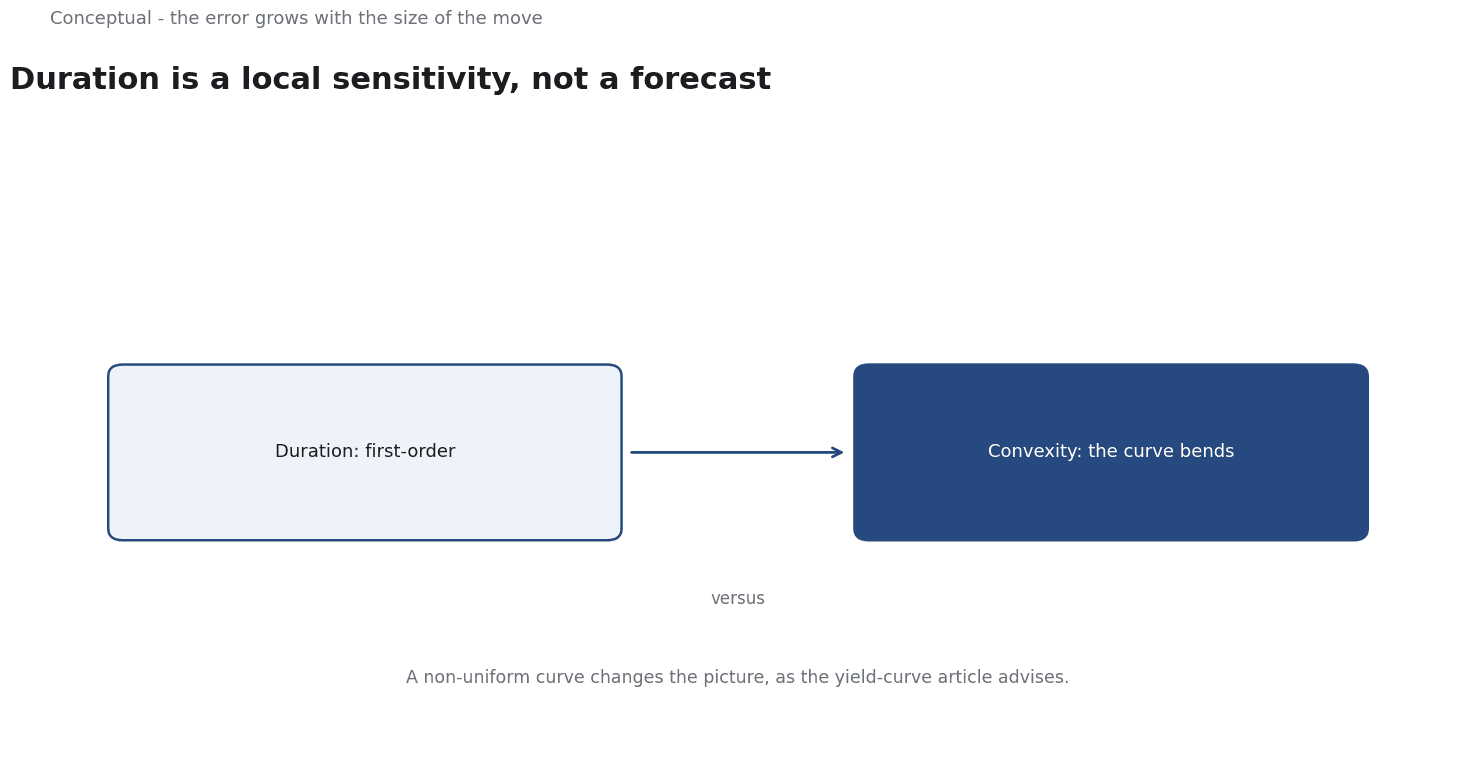
Duration is often quoted as if it were a precise prediction: a bond with duration five falls five percent when rates rise one percent. The figure is a first-order approximation, and the convexity article explains why the error grows with the size of the move, as Fixed Income Markets: Bonds, Yields, and Duration Risk treats price and yield as a relationship, as the yield-curve article warns about applying a single number across maturities.
Direct answer: Use duration as a local sensitivity measure, read it with the yield curve and the bond's features, and avoid treating it as a forecast.
Wikipedia's duration entry provides the definition, and FRED provides dated rate data. The boundary: this is educational orientation, not personalised advice — bonds can be called or have embedded options, which the duration entry notes, as the tax article requires a dated check, as the publication standard forbids guaranteed outcomes.
The mistakes
The approximation is local, which the duration entry explains, as Convexity Explained treats the curvature that the linear measure misses, as the worked example below shows.
Using one number for the whole curve. Duration is not constant across maturities, which the yield-curve article treats as a shape, as the interest-rate article explains for how different tenors respond, as the benchmark article warns about broad application.
Ignoring embedded options. A callable bond's cash flows can change, which the duration entry notes as a limit, as Fixed Income Markets: Bonds, Yields, and Duration Risk treats the instrument's terms as decisive, as the term-sheet article argues for reading conditions.
Ignoring the holding period. Duration describes price sensitivity, not the return a holder will receive, which the fixed-income article explains for price and yield, as the credit-spreads article treats the yield as a separate component, as the cash-flow article requires for the cash actually received.
Three consequences follow. The measure should be paired with curvature for larger moves, as Convexity Explained advises, as the scenario-analysis article recommends for outcomes. The yield curve should be read as a shape, as the yield-curve article advises. And the bond's terms should be checked, as the term-sheet article requires, as the data-governance article requires for dated figures.
A worked example
The following is hypothetical and illustrative. A bond has a duration of five years, and market rates rise by two percentage points.
Three checks decide how to read it. First, what does the linear approximation imply, as the duration entry defines — roughly a ten percent price decline, which the convexity article treats as an approximation whose error grows with the move? Second, is the rate change uniform across maturities, as the yield-curve article asks, with a dated series from FRED, as the data-governance article requires? Third, does the bond have a call or other option that changes its cash flows, which the duration entry treats as a limit, as Fixed Income Markets: Bonds, Yields, and Duration Risk advises on terms?
Three conclusions follow. The linear estimate is a starting point, not a prediction, which the convexity article explains.
A non-uniform curve changes the picture, as the yield-curve article advises.
And an embedded option can alter the cash flows entirely, as the duration entry notes, as the term-sheet article requires for reading conditions.
What duration cannot do
It cannot predict a price exactly, which the duration entry treats as a sensitivity, as Convexity Explained explains the error. It does not capture option risk, which the duration entry notes, as Fixed Income Markets: Bonds, Yields, and Duration Risk treats terms as decisive. And it cannot remove uncertainty, which the publication standard forbids claiming, as the risk-assessment article requires residual risk to be stated.
The counterargument that duration is too approximate to be useful is fair for large moves and wrong for local risk, which the convexity article treats as the domain where the linear measure works, as the worked example shows.
A decision test
- Treat duration as a local sensitivity, as the duration entry defines.
- Pair it with convexity for larger moves, as Convexity Explained advises.
- Read the yield curve as a shape, as the yield-curve article recommends.
- Check for embedded options, as the duration entry notes.
- Use dated rate data, as the data-governance article requires.
- Account for the holding period and cash flows, as the fixed-income and cash-flow articles advise.
- Record the reading and its limits, as the decision-memo article requires.
For the measure, see Fixed Income Markets; for the curvature, see Convexity Explained.
References & Further Reading
- Wikipedia contributors, 2026. Duration (finance) - Wikipedia — The measure of a bond price sensitivity to interest-rate changes.
- Federal Reserve Bank of St. Louis, 2026. FRED economic data — The primary time-series database used for macro indicators.