E-commerce Operations Pitfalls
A storefront is the visible part of a larger operation. Read the pitfalls, a worked example, and why a good site can still fail at fulfilment.
E-commerce is often evaluated by the storefront, which hides the operations that determine whether an order arrives. The Census e-commerce series provides channel context, and the reverse-logistics entry covers the return flow. The pitfalls sit between the click and the delivery.
Direct answer: Manage e-commerce as a chain from order to delivery to return, with a measure at each stage. The sources describe the channel; the method is a synthesis.
Delta: This article adds a claim-status table and a worked example, separating documented channel facts from local choices about measurement.
The mechanism
The Census data describes sales activity, but a sale is a commitment to deliver, not a completed outcome. A storefront that records orders accurately can still fail if the warehouse does not.
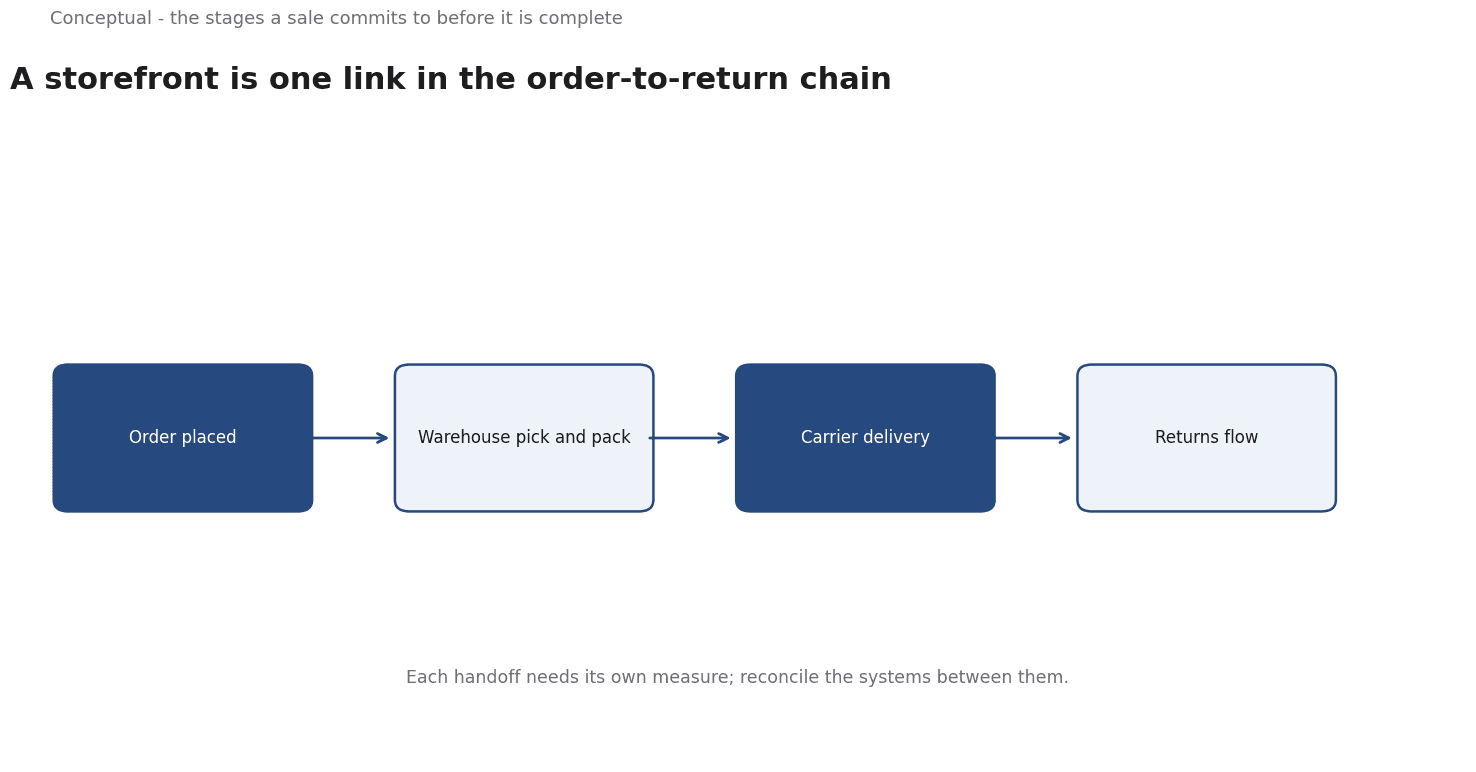
The second pitfall is ignoring the return flow. The reverse-logistics entry describes goods moving back from customers. Returns are a second operation with their own cost, and a business that measures only outbound fulfilment will misunderstand its true cost.
The third pitfall is a measurement gap between systems. The storefront, the warehouse, and the carrier each hold part of the story, and a number in one system may not match the others. Reconciliation is the work that makes a measurement trustworthy.
The sequence is: map the stages, measure each, reconcile the systems, then investigate where the chain breaks.
The mapping is local, so the conclusions are inferred; the channel facts are source-reported.
A worked example
Illustrative. An online store reports strong sales but rising complaints.
Three checks decide. First, which stage produces the complaints — picking, packing, or delivery? Second, do the order system and the warehouse agree on what was shipped? Third, what do returns show, and is the reason recorded in a way that can be acted on?
The outcome is a located failure rather than a general review. The scenario is hypothetical; the method is the contribution.
Evidence status
| Claim | Status | Source | Verified | Recheck when |
|---|---|---|---|---|
| E-commerce activity can be measured at channel level | source-reported | U.S. Census Bureau | 2026-11-18 | New data released |
| Returns are a reverse flow of goods | source-reported | Wikipedia, Reverse logistics | 2026-11-18 | Definition changes |
| Measure each stage and reconcile | inferred | Derived from the chain | 2026-11-18 | Systems change |
Why the storefront is not the business
A good site can increase orders faster than operations can fulfil them, which turns a success into a source of complaints. The operation is the constraint, and it should be measured with the same care as the storefront.
A further pitfall is measuring each team separately. The storefront, warehouse, and carrier may each meet their own targets while the customer experiences a delay, because the handoff between them is unowned. Measuring the whole chain is harder than measuring each part, and it is the only view that reflects the promise made to the customer.
The data also has a timing problem. An order can appear complete in one system before the goods have moved, which makes a status report optimistic. Reconciling at the end of the day rather than in real time gives a more honest picture, though a slower one.
Seasonality is another trap. An operation that works at ordinary volume can fail during a peak, and a test at low volume says little about that condition. Planning for the peak is a separate exercise, and it belongs in the same review as the daily metrics.
A chain is only as reliable as its least measured handoff, which is where most customer problems begin.
The return rate should be read by product, since a category-level average can hide a specific failing item.
A strong sales report cannot compensate for a fulfilment process that breaks its promises.
The handoff between teams deserves its own owner, because a gap there is felt by the customer before it appears in any report.
A measurement that spans the whole chain is harder to build but more useful than one that stops at the order.
What it cannot do
It cannot guarantee delivery. It does not remove the need for accurate inventory. And it cannot fix a product that does not match its description.
The counterargument that sales are the main signal is fair for demand and incomplete for the promises made to customers.
A decision test
- Map the order-to-return chain.
- Measure each stage.
- Reconcile the systems.
- Locate the failing stage.
- Record the reason codes from returns.
- Set a recheck condition.
For the returns side, see Reverse Logistics.
References & Further Reading
- U.S. Census Bureau, 2026. Quarterly Retail E-Commerce Sales — The official definition and estimates for retail e-commerce sales.
- Wikipedia contributors, 2026. Reverse logistics - Wikipedia — Overview of product returns, reusable packaging and unsold-goods flows; secondary reference used with NRF and Census data.