Editorial Calendars Checklist
An editorial calendar coordinates decisions, not just dates. Read the checklist, a worked example, and why a full calendar can still be unhelpful.
An editorial calendar is often treated as a schedule of publication dates, which ignores that its value lies in coordinating the decisions around content. The marketing-communications entry covers how messages are received, and re:Work treats team practices as something to examine. The checklist starts with the decisions the calendar should support.
Direct answer: Build a calendar around the audience's needs, the resources available, and the decisions that must be made before publication. The sources describe communication and teams; the method is a synthesis.
Delta: This article adds a claim-status table and a worked example, separating documented context from local choices about ownership.
The mechanism
The first consideration is purpose. The marketing-communications entry treats a message as something received, which means a calendar should reflect when the audience can use the content, not only when the team can produce it. A schedule built around internal convenience misses that.
The second consideration is capacity. The re:Work material treats teams as practices with constraints, and a calendar that promises more than the team can produce creates rushed work or unfilled slots. Both are worse than a smaller, realistic plan.
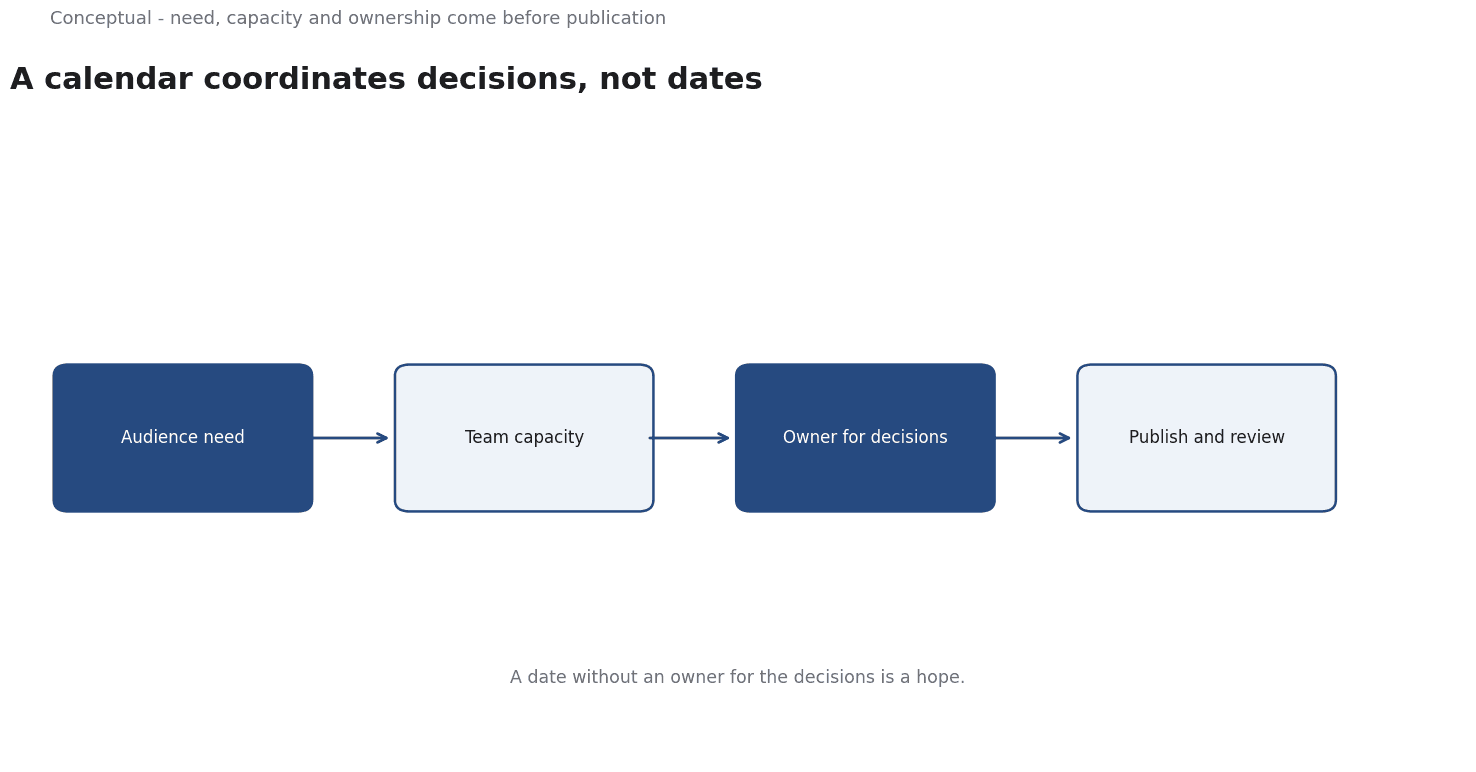
The third consideration is ownership. A date without an owner for the decisions behind it is a hope. Each entry should state who is responsible for the content and who approves it, which turns the calendar into a coordination tool.
The sequence is: define the audience need, match it to capacity, assign owners, then publish and review. The choices are local, so the conclusions are inferred; the context is source-reported.
A worked example
Illustrative. A team fills a calendar with twelve posts a month and consistently publishes late.
Three checks decide. First, do the planned posts address needs the audience actually has, or fill slots? Second, does the capacity match the plan, including review time? Third, does each entry have an owner for the decisions, not just a writer?
The outcome is a smaller calendar that is actually followed. The scenario is hypothetical; the method is the contribution.
Evidence status
| Claim | Status | Source | Verified | Recheck when |
|---|---|---|---|---|
| Messages are received by an audience | source-reported | Wikipedia, Marketing communications | 2026-11-18 | Practice changes |
| Teams have practices and constraints | source-reported | Google re:Work | 2026-11-18 | Practice changes |
| Plan around need, capacity and ownership | inferred | Derived from both | 2026-11-18 | Team changes |
Why a full calendar can fail
A smaller plan that is consistently delivered supports trust with an audience better than an ambitious one that is not.
A further issue is that a calendar can hide the work that is not on it. Maintenance, corrections, and responses to current events consume capacity, and a plan that assumes every slot is available for planned content will be disrupted. Leaving room for unplanned work is part of a realistic calendar.
The calendar should also distinguish between publishing and distribution. A date marks when content is ready, but the audience may need to hear about it through other channels, which takes additional work. Treating publication as the end of the process produces content that exists but is not found.
Finally, review should happen after publication, not only before. A plan that never examines what performed will repeat the same assumptions, which is why the calendar should include a regular look at what the audience actually used.
A calendar should leave room for unplanned work, since that is where much of the real capacity goes.
The plan should be reviewed against what the audience used, not only what the team shipped.
A date without an owner for the decisions is a hope rather than a plan.
The calendar should reflect when the audience can use the content, not only when it is finished.
Review should look at what the audience used, not only what the team managed to publish.
What it cannot do
It cannot create an audience. It does not guarantee that content is useful. And it cannot remove the need to review what worked.
The counterargument that consistency matters most is fair for trust and incomplete when the consistent output is not needed.
A decision test
- Define the audience need.
- Match the plan to capacity.
- Assign owners for decisions.
- Publish on a realistic schedule.
- Review what worked.
- Record the plan and recheck date.
For the process, see Content Operations.
References & Further Reading
- Wikipedia contributors, 2026. Marketing communications - Wikipedia — The coordination of messages across channels and the distinction between consistent and identical communication.
- Google, 2026. Google re:Work — A large company's published people practices, including hiring and growth frameworks.