Embedding Model Selection: A Task-Driven Evaluation
A leaderboard rank is not a choice. Read how to evaluate an embedding model on your retrieval task with a worked example.
Embedding models are often chosen by leaderboard position. That is a reasonable shortlist, not a decision, because a benchmark averages across tasks and your application has one. The MTEB benchmark exists precisely because different models excel at different things — no single model wins everything.
Direct answer: Select an embedding model by measuring retrieval quality on your own queries and documents, with a defined metric and a fixed corpus. MTEB provides the broad comparison; the SBERT paper established the bi-encoder pattern most retrieval embeddings use. The boundary: a model that wins on a public benchmark may underperform on your domain, language, or document length — the only direct evidence is your own evaluation.
What the benchmark tells you
MTEB evaluates embedding models across many tasks — retrieval, semantic similarity, classification, and others. Three lessons follow:
Different tasks, different winners. A model optimised for symmetric similarity may be poor at asymmetric retrieval, where a short query must match a long document.
Averages hide domains. Performance on general text says little about legal contracts, medical notes, or code.
The benchmark is a snapshot. New models appear, and a rank from an older evaluation may be outdated.
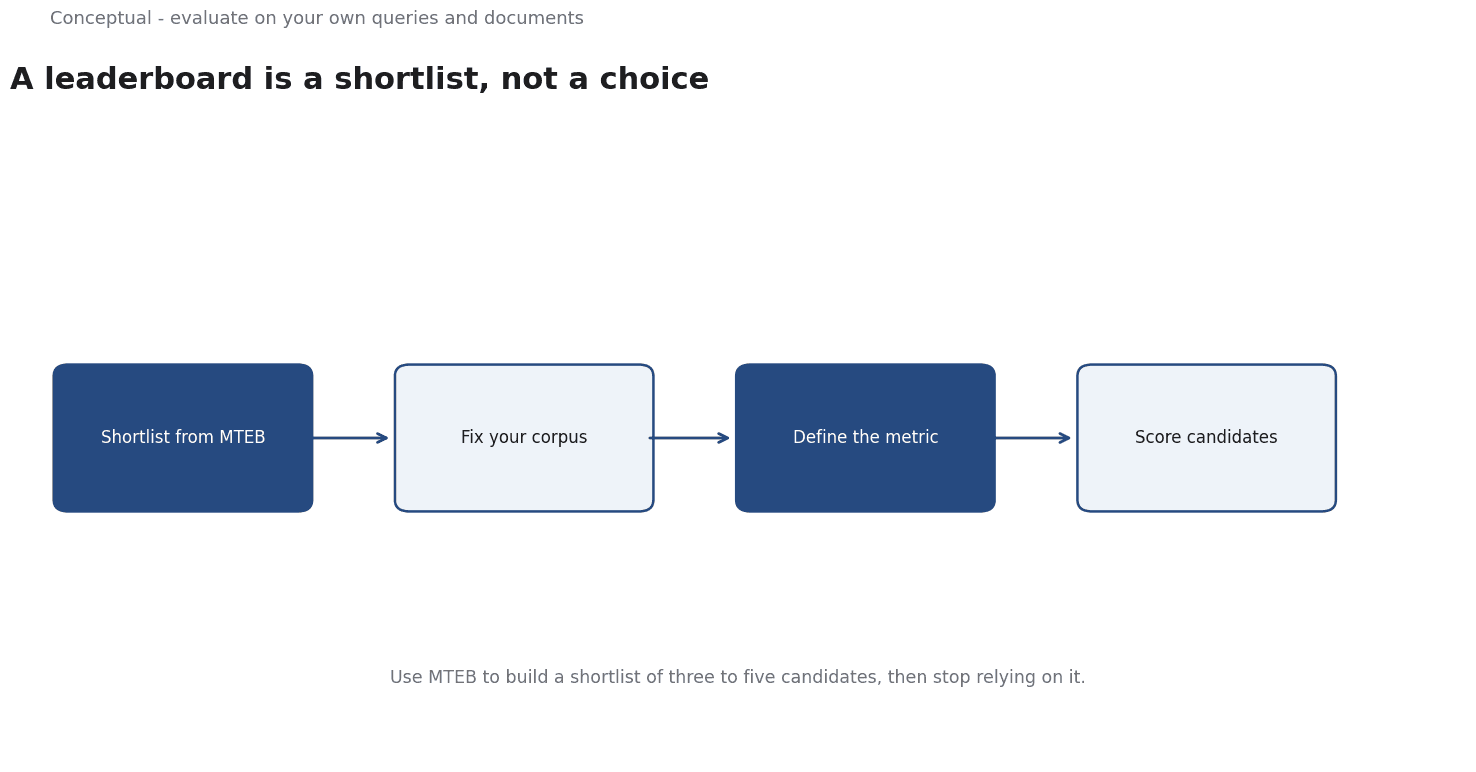
Use MTEB to build a shortlist of three to five candidates, then stop relying on it.
A worked evaluation
The following is hypothetical and illustrative.
A company has 20,000 internal documents and 300 real user queries with known relevant documents. It compares three embedding models on the same corpus and the same queries.
Metrics:
- Recall@10 — is the relevant document in the top ten?
- MRR — how high does it rank?
- Latency — milliseconds to embed a query and search the index.
- Cost — per million tokens embedded.
Three results:
- Model A: Recall@10 92%, MRR 0.71, 40 ms, highest cost.
- Model B: Recall@10 88%, MRR 0.65, 15 ms, medium cost.
- Model C: Recall@10 84%, MRR 0.60, 12 ms, lowest cost.
Three decisions follow:
- If recall@10 is the priority, Model A wins, and the cost may be justified by fewer retrieval misses — as the RAG article explains, a miss cannot be fixed by the generator.
- If latency dominates, Model B offers a middle ground with a small recall loss.
- The gap between A and C is only eight points on this set. If the set is small or the labels noisy, that difference may not be stable — repeat with more queries before deciding.
Three cautions apply: the 300 queries must represent real traffic, not convenient examples; the relevant-document labels must be agreed by someone who knows the domain; and the index configuration (distance metric, chunking) must be identical across models.
What to hold constant
Chunking strategy. A different chunk size changes the corpus, which changes the result. Use the same chunks for all candidates.
Distance metric. Cosine similarity is common, but if a model expects a different metric, document that and apply it consistently.
Query preprocessing. If you expand or rewrite queries, do so identically for all models.
The evaluation set. Keep a held-out portion that is not used for any tuning. A model tuned on the full set will score well there by construction, as the evaluation article warns.
Building the evaluation set
The quality of the decision depends on the quality of the queries and labels. Three practices make the set defensible:
Sample from real traffic. Take queries from logs or support tickets, with sensitive details removed.
Agree on relevance before scoring. Two reviewers will disagree about whether a document answers a query. Define a rule — this document contains the answer, not merely a related topic — and resolve disagreements before comparing models.
Keep a held-out portion. Reserve a share of queries that is not used for any tuning or threshold choice. A model selected on the full set has been optimised on the test, which inflates the result — the same leakage problem the data-pipeline article warns about.
A set of 200 well-labelled queries is more useful than 2,000 careless ones. The effort spent on labels is repaid every time a model or index configuration changes.
What evaluation cannot tell you
It does not measure the full system. A better embedding model with a poor reranker or prompt may produce worse answers than a worse model in a better pipeline. The reranking article covers the next stage.
It does not guarantee transfer. A model chosen for English queries may behave differently in another language, even if the benchmark includes multilingual tasks.
It goes stale. Documents and queries change. Re-run the evaluation when the corpus or the traffic changes materially.
The counterargument — that a public benchmark is good enough for most teams — is fair when the task is generic and the stakes are low.
It stops being fair when retrieval quality determines whether the system can answer at all.
A decision test
- Collect real queries with known relevant documents.
- Build a shortlist from MTEB, not a winner.
- Hold corpus, chunking and metrics constant across candidates.
- Measure recall and ranking quality plus latency and cost.
- Keep a held-out set for final confirmation.
- Evaluate the full pipeline, not only retrieval.
- Re-run on change in corpus, language, or traffic.
For the retrieval system, see Vector Databases; for the next stage, see Reranking.
References & Further Reading
- Niklas Muennighoff et al., 2022. MTEB: Massive Text Embedding Benchmark — A broad benchmark of embedding models across retrieval and semantic tasks, showing that no single model wins everything.
- Nils Reimers and Iryna Gurevych, 2019. Sentence-BERT: Sentence Embeddings using Siamese BERT-Networks — The bi-encoder recipe behind modern semantic search and RAG retrieval.