Emergency Fund: How Much You Actually Need
The right reserve depends on income stability and likely expenses, not a rule of thumb. Read a worked sizing method and what to keep liquid.
"Three to six months of expenses" is the standard answer to the emergency-fund question. It is a starting point, not an estimate. The right number depends on how stable your income is, how much of your spending is fixed, and how quickly you could reduce it if needed.
Direct answer: Size an emergency fund from your actual monthly essentials and the length of time you could plausibly need them, then adjust for income stability and household concentration. Investor.gov's investor education emphasises that all investments involve risk and that planning starts with understanding your finances. The boundary: a reserve that is too large has an opportunity cost, and one held in volatile assets is not a reserve — it is a bet.
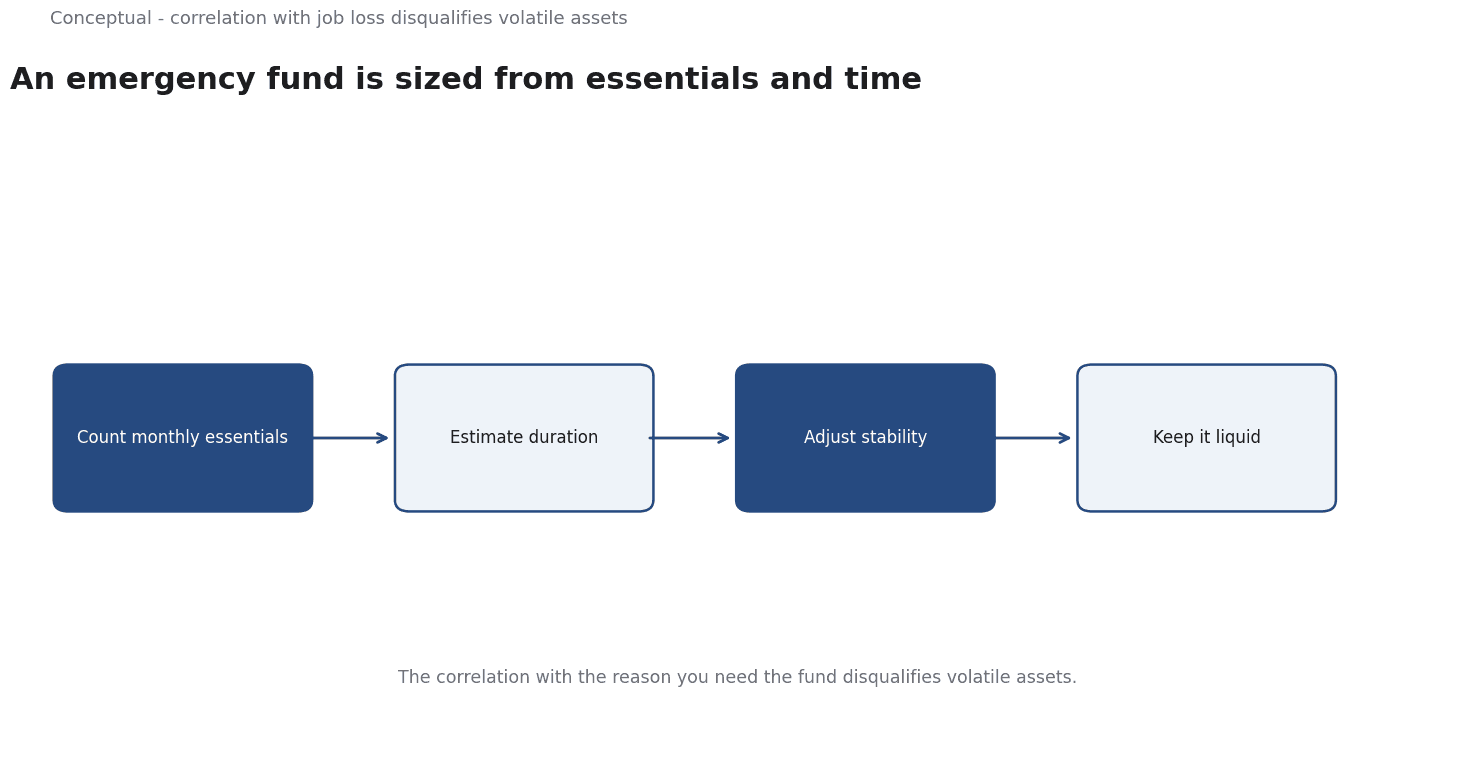
A sizing method
1. Define essentials. Rent or mortgage, utilities, food, transport, insurance, and minimum debt payments. Exclude discretionary spending, because the fund's job is to cover survival, not lifestyle.
2. Estimate the duration. Ask how long it would realistically take to replace income after a job loss, an illness, or a major repair. A stable public-sector role and a commission-based sales role are different cases.
3. Adjust for concentration. A single-income household with dependants needs more than a dual-income household with no dependants. A person with a supporting network may need less than one without.
4. Add known one-off risks. A older car, a home with an aging boiler, or a chronic health expense are predictable in kind if not in timing.
5. Decide where to hold it. The fund must be accessible and low-volatility. A cash account or a government money-market vehicle is typical; equities are not a reserve because their value falls precisely when jobs are scarce.
A worked example
The following is hypothetical and illustrative.
A household has monthly essentials of 3,000, including rent, food, transport, and minimum debt payments. One earner's income covers 70% of the total; the other is stable but insufficient alone.
- Base estimate: 3,000 × 6 = 18,000.
- Concentration adjustment: the dominant earner's role is in a cyclical industry with an estimated six-month search. Add two months: 24,000.
- Known one-offs: a car likely to need 2,000 of work within two years. Add it: 26,000.
Three decisions follow:
- The number is derived, not conventional. It came from actual expenses and a realistic search time, not from a rule.
- The one-off addition is explicit. Adding it prevents the car repair from becoming an "emergency" that consumes the income-replacement fund.
- The fund has a review trigger. A change in employment, a new dependant, or a refinancing changes the inputs, so the target should be recalculated.
Three cautions apply: the six-month search is an assumption that can be checked against local data; the car cost is an estimate that should be replaced with a quote when possible; and the household should decide whether the full 26,000 must be in cash or whether the one-off portion can be a shorter-term holding.
Where to keep the money
The right location for a reserve is boring by design. Three properties matter more than the headline interest rate:
Accessibility. The money must be available within a day, not after a notice period or a sale. An account that restricts withdrawals fails at the moment it is needed.
Low volatility. A reserve held in assets that fall during a market decline may be worth less precisely when income stops.
The correlation with the reason you need the fund is what disqualifies volatile assets, not their long-run expected return.
Separation from everyday spending. A reserve kept in the same account as daily spending tends to be spent. A separate account, even at the same institution, creates a small friction that protects the balance.
Some savers split the fund into a fully liquid portion for immediate needs and a slightly less liquid portion for longer-term income replacement. That is reasonable provided the second portion is still low-risk and available within the stated timeline.
What the fund cannot do
It cannot cover a long-term income loss. Six months is a bridge, not a replacement. Longer risks are an insurance question.
It cannot be invested for growth. The trade-off is deliberate: you accept a lower expected return for availability.
It cannot fix a cash-flow problem. If monthly essentials exceed income, a larger reserve delays the problem rather than solving it. The spending side needs attention first.
The counterargument — that holding cash is wasteful when returns are high — ignores the asymmetry.
The fund's value is in being there when other assets or income are unavailable.
Its cost is the difference between cash returns and what the money could have earned, which is a price worth paying for a defined risk.
A decision test
- List essentials from actual spending, not estimates.
- Estimate the replacement time for your specific situation.
- Adjust for concentration and dependants.
- Add known one-off risks by name and amount.
- Choose low-volatility, accessible holdings.
- Review on change — employment, household, or major assets.
- Keep a separate plan for risks longer than the fund's horizon.
For the wider plan, see Personal Finance for Professionals; for inflation-adjusted planning, see Real Interest Rates.
References & Further Reading
- U.S. Securities and Exchange Commission (Investor.gov), 2026. Introduction to Investing — Primary regulator guidance on market mechanics and investor protection.
- Federal Reserve Bank of St. Louis, 2026. FRED economic data — The primary time-series database used for macro indicators.