Enterprise Marketing at Scale
At scale, demand generation and CRM fail at the handoff. Read how to define a qualified lead, assign ownership, and test the boundary before adding volume.
Enterprise marketing at scale fails when demand generation and customer relationship management run as separate machines: one produces leads that nobody owns, the other stores records that nobody uses. The demand generation entry describes the work of building awareness and pipeline; the CRM entry describes how organizations manage interactions with current and prospective customers. The question is where the handoff between them breaks.
Direct answer: At scale, demand generation creates qualified interest and CRM turns that interest into a managed relationship with ownership and history. Treat them as one system with a single definition of a qualified lead and a single record of what happened next. The boundary is that a larger process does not fix a missing definition: volume without a shared handoff only moves the confusion downstream.
Delta: This article adds a claim-status table and a decision test beyond the sources: it maps each stage of the funnel to the ownership decision it requires, with claim status explicit.
The mechanism
Demand generation is the set of activities that create awareness and interest and ultimately build sales pipeline. The important concept is that it is a system of repeatable programs rather than a single campaign. At scale the constraint is rarely the creativity of one campaign; it is whether the program can be repeated with consistent measurement. Each program should therefore have a defined input, a defined output, and a defined handoff to the next stage. A program whose success is measured only by activity counts cannot be compared with another program, and the comparison is where scaling decisions are made.
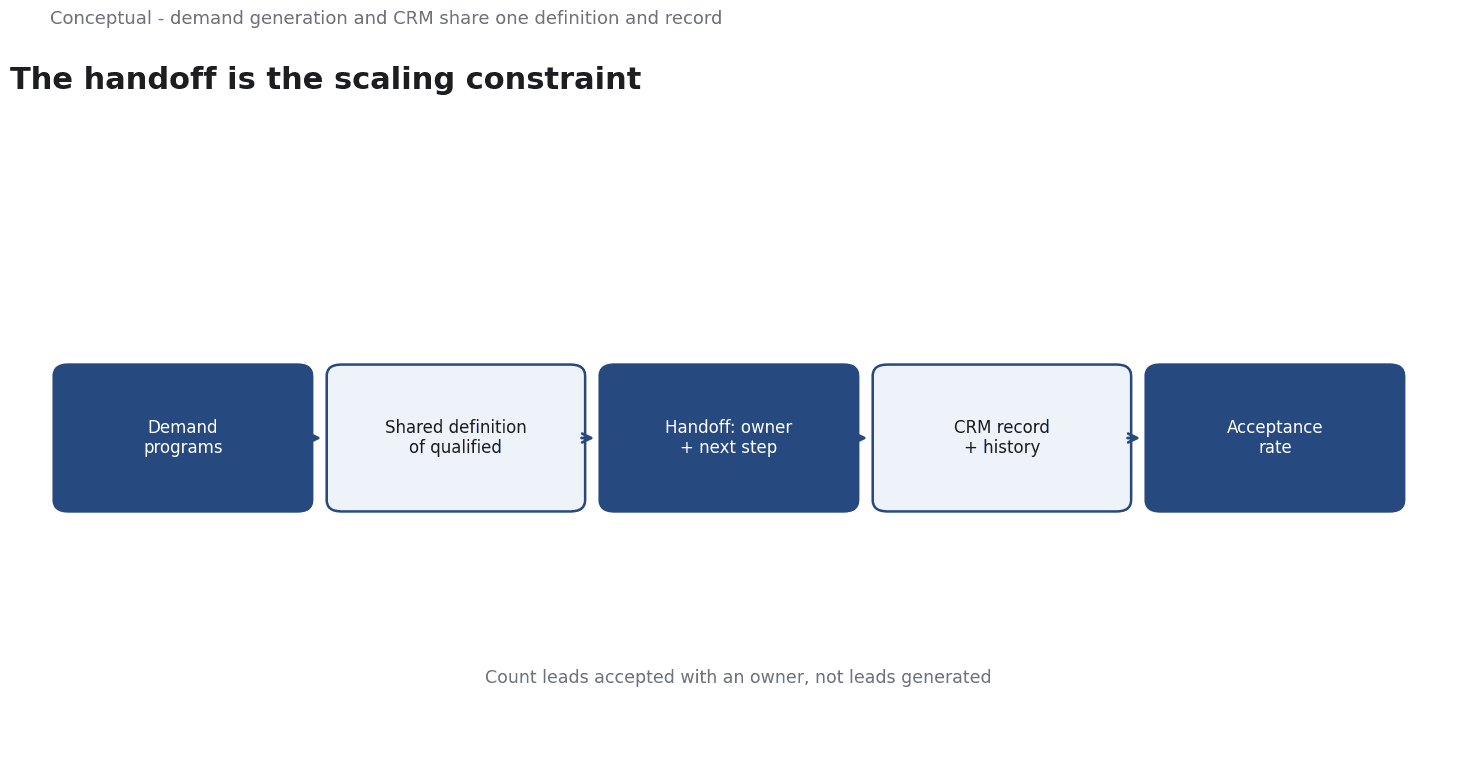
CRM is the system of record and process for managing interactions with current and prospective customers. It holds the history of who was contacted, what was said, and what the next step is. The practical consequence is that a lead which emerges from demand generation and never lands in CRM with an owner is lost, not captured.
The handoff, rather than the campaign, is the unit of analysis.
If the record of what happened next is missing, the organization cannot tell whether a program produced revenue or merely noise, no matter how large the top-of-funnel number appears.
The scaling consequence is that the handoff becomes the bottleneck as volume rises. A definition of qualified that marketing uses and a definition that sales uses will diverge unless they are written down and shared. The practical discipline is to write one definition, instrument the transition between the systems, and measure conversion at the boundary rather than the volume on either side. Counting leads generated is a measure of effort; counting leads accepted with an owner is a measure of the system working. The second number is the one that improves when the handoff is fixed.
The final step is to keep documented description separate from local diagnosis. The accounts of demand generation and of CRM are source-reported. The claim that the handoff is the scaling constraint is inferred from how the two functions depend on each other. Making that status explicit prevents an organizational judgment from being presented as something the sources asserted.
A worked example
The following is hypothetical and illustrative. A large firm runs several demand programs and a CRM shared by two sales teams. Three checks decide whether the system can scale. First, does every program use one written definition of a qualified lead that both teams accept, rather than a definition that shifts by team or by campaign? Second, when a lead is accepted, are ownership and the next step recorded in CRM within a fixed window, so that nothing sits in an unowned queue? Third, is conversion measured at the handoff boundary rather than by counting leads generated? The outcome is a short record naming the definition, the time to ownership, and the acceptance rate by program. If the definition differs by team, the same lead is counted differently and the dashboard cannot be trusted; fix the definition before adding volume.
Evidence status
| Claim | Status | Source | Verified | Recheck when |
|---|---|---|---|---|
| Demand generation builds awareness and sales pipeline | source-reported | Wikipedia Demand generation | 2026-11-18 | Definition revised |
| CRM manages interactions with current and prospective customers | source-reported | Wikipedia CRM | 2026-11-18 | Definition revised |
| The handoff is the scaling constraint is inferred | inferred | Derived from the sources | 2026-11-18 | Process changes |
Two rows restate documented descriptions of the two functions. The third row is a synthesis about where the system fails, which the sources do not claim. Recheck the documented rows when the reference definitions change and the inferred row when the ownership process or the team structure changes.
What it cannot do
A scaled marketing process cannot manufacture demand. It can move a lead from an advertisement to an owned record efficiently, but it cannot make an unattractive offer attractive. A well-run handoff with a weak value proposition simply delivers rejection faster and with better documentation. This matters because teams often respond to a falling acceptance rate by adding more automation to the handoff, when the underlying constraint is that the message gives the buyer no reason to continue. Process discipline is a necessary condition for scale, not a substitute for a reason to buy.
The hidden cost is maintenance. A shared definition of qualified must be kept current as products, segments, and pricing change. CRM hygiene requires ongoing work: contacts change roles, records go stale, and fields that were once filled reliably begin to decay. Instrumentation at the handoff must be checked when any part of the stack changes. These costs are invisible in a launch plan, which is why a program can look efficient at hundreds of leads and become unmanageable at tens of thousands. The marginal cost of scale is not in the campaign; it is in keeping the record trustworthy.
Marketing optimizes the number of leads generated, while sales optimizes the close rate on the leads it receives. Each function can hit its own target while the boundary between them fails, because neither owns the conversion at the handoff. A related failure is gaming the definition: if acceptance is the measured target, a team can lower the bar until the number rises and the pipeline quality falls. The defense is to measure both acceptance and downstream outcome, so that a definition change cannot improve one without damaging the other.
There is a boundary in what the sources cover. They describe demand generation as a function and CRM as a way of managing customer interactions; they do not prescribe an organizational design. Decisions about span of control, territory structure, compensation, and which system is authoritative are not settled by those descriptions. A team that treats a CRM entry as an org chart will import assumptions that the source never made. Those decisions belong to the people who own the process, and they should be recorded alongside the definition of qualified.
Finally, the definitions need scheduled review. What counted as qualified at one stage of a company's growth may be too loose or too strict at the next. The review should ask not only whether the definition still filters well but whether the handoff it governs still matches the way buyers actually arrive. Without that review, a system that once scaled well becomes a set of rules protecting an obsolete picture of the customer.
Counterargument: "The counterargument that a single shared database solves this is fair for small teams with one sales motion, and incomplete for enterprises where ownership, timing, and definitions differ by segment."
A decision test
- Name the decision the funnel is meant to support, such as budget allocation across programs.
- Write one definition of a qualified lead and get both functions to accept it.
- Identify where a lead passes from generation into the CRM record.
- Assign an owner and a next step at that boundary within a fixed window.
- Measure acceptance at the handoff rather than lead volume at the source.
- Track a downstream outcome so a looser definition cannot hide a quality drop.
- Set a review date for the definition, the instrumentation, and the ownership rule.
The test keeps the focus on the boundary where scale actually fails. A team that can name the owner of a lead at the moment of acceptance has a system it can grow; a team that can only report leads generated has a volume number. Recording acceptance and outcome together makes the handoff auditable over time. For further reading, see Marketing dashboards without the hype.
References & Further Reading
- Wikipedia contributors, 2026. Demand generation - Wikipedia — An overview of demand generation as a marketing discipline distinct from lead generation; secondary reference used with the lead-generation entry.
- Wikipedia contributors, 2026. Customer relationship management - Wikipedia — Systems for managing customer relationships.