Entrepreneurship Costs Explained
Entrepreneurship costs are more than expenses. Read how one-time, ongoing, and opportunity costs interact with debt and equity financing, plus a decision test.
Founders often describe the cost of a new venture as a list of expenses. The real problem is that the commitments made before revenue is certain are not all expenses, and the source of money changes what a dollar actually costs. A plan that looks affordable on a spreadsheet can be expensive in cash flow or in ownership given up.
Direct answer: Entrepreneurship is the process of creating and running a new venture under uncertainty, and small business financing describes how such ventures are funded through debt and equity with different obligations.
Read together, these sources show that the cost of a venture depends on timing and on the instrument used to fund it.
The boundary is that neither source supplies a cost schedule for a particular business.
Delta: This article adds a financing decision beyond the sources: it maps the venture definition and the funding options to a way of classifying costs, with claim status explicit.
The mechanism
The entrepreneurship entry describes the creation and operation of a new venture, typically involving uncertainty, innovation, and risk-bearing. The mechanism relevant here is commitment before confirmation: a founder organizes resources and accepts risk before knowing whether customers will pay. The practical consequence is that cost is not merely an outflow recorded later. It is a commitment made on expectation, and the structure of those commitments determines how much uncertainty the founder personally absorbs.
The small business financing entry describes the ways ventures obtain funds, including debt such as loans and lines of credit, and equity that trades ownership for capital. The mechanism is the obligation attached to each source. Debt requires repayment on a schedule regardless of the outcome, while equity shares the risk but dilutes ownership and control. The practical consequence is that two equal amounts of money carry different real costs: one is priced in interest and covenants, the other in ownership and future decisions.
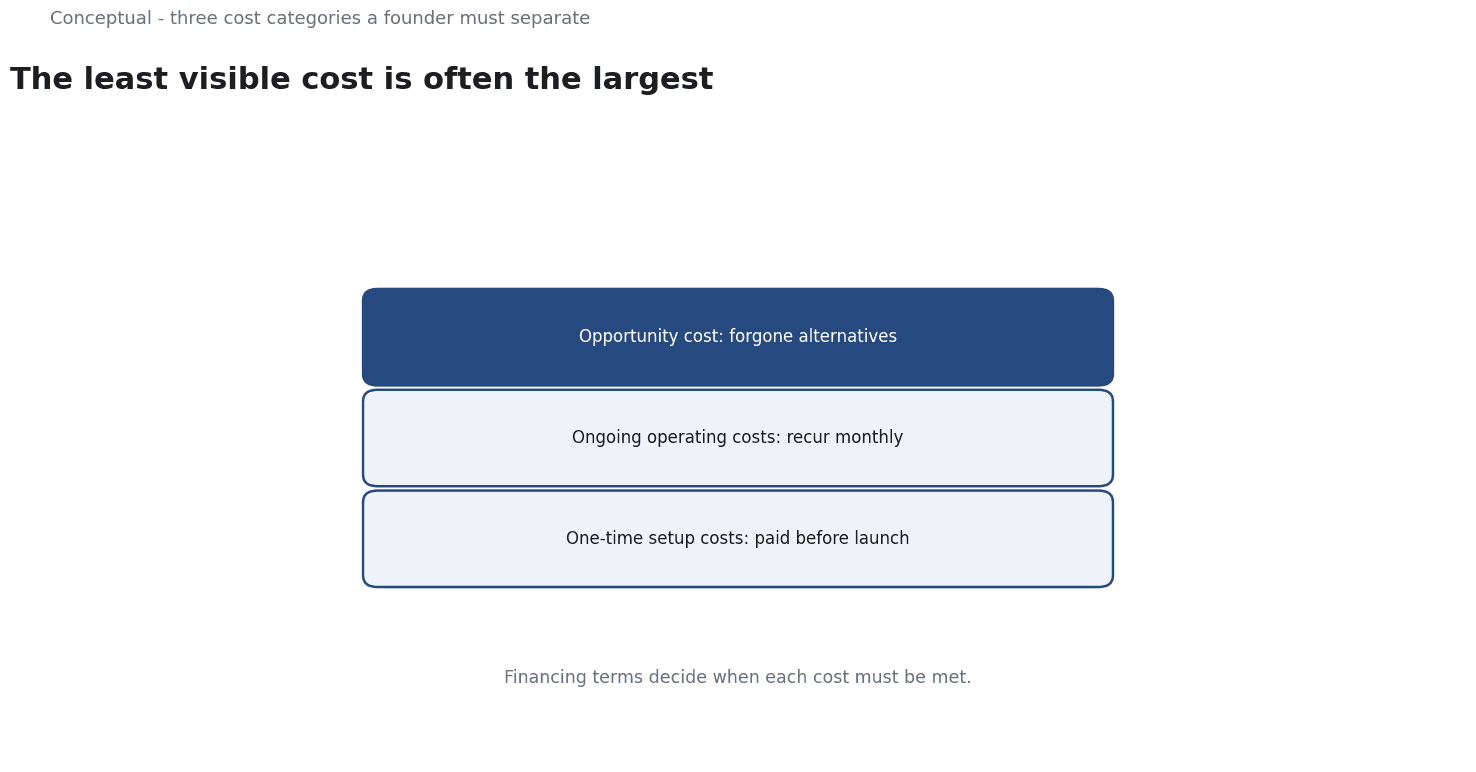
Combining the sources suggests three cost categories that a founder should separate. One-time setup costs are paid to get the venture running. Ongoing operating costs recur to keep it running. Opportunity costs are what the founder gives up by committing time and capital here rather than elsewhere. The practical consequence is that a venture cheap in cash can still be expensive in forgone alternatives, and a debt-heavy plan can be cheap in interest yet painful in the months when cash is slow.
The decision that follows concerns matching the instrument to the cost profile. A business with steady, predictable costs can often carry scheduled debt service. One with a long gap before revenue may need capital that does not demand early repayment, even at the price of dilution. The mechanism is the same in each case: financing terms determine when costs must be met, and timing is often more decisive than the headline amount.
A worked example
The following is hypothetical and illustrative. A founder is launching a small service business and wants to know what the venture will truly cost. Three checks structure the analysis. First, the timing check: which costs must be paid before the first customer pays, separating one-time setup from recurring monthly commitments? Second, the obligation check: if funding is needed to cover the gap, does the instrument require repayment regardless of revenue, or does it trade ownership instead? Third, the opportunity check: what alternative use of the founder's time and savings is being given up? The outcome is a choice to use personal savings plus a modest line of credit, preserving ownership because upfront costs are contained. The limitation is that a slower ramp to revenue would have made the repayment obligation risky, and that assumption needs its own test.
Evidence status
| Claim | Status | Source | Verified | Recheck when |
|---|---|---|---|---|
| Entrepreneurship involves creating and running a venture under uncertainty and risk | source-reported | Entrepreneurship - Wikipedia | 2026-11-18 | the entry's definition is revised |
| Small businesses fund operations through debt and equity with different obligations | source-reported | Small business financing - Wikipedia | 2026-11-18 | financing categories in the entry change |
| Separating one-time, ongoing, and opportunity costs clarifies the financing choice | inferred | Derived from the sources | 2026-11-18 | the venture's revenue timing changes |
The first two rows report what the sources state directly and can be checked against them. The third is an inference: it follows from combining uncertain commitments with funding instruments that carry different obligations, but neither source offers this classification as a rule. Recheck conditions point back to the sources or to changed circumstances, keeping each row's status explicit.
What it cannot do
These sources cannot produce a cost figure for a specific venture. They describe a process and a set of funding options at a general level; they do not price a particular setup, forecast a particular revenue curve, or identify which instrument suits a given sector. Any numeric budget built from them would be an invention. What they provide is a way of thinking about the kinds of commitments a founder takes on, not a substitute for a venture-specific plan.
The hidden cost is that the most important expenses are the least visible. Opportunity cost and founder time rarely appear in a budget, yet they can exceed the line items that do. Financing also carries non-price terms: covenants, personal guarantees, reporting duties, and loss of control all have value even when the interest rate looks attractive. A comparison that counts only the stated price of money misses these terms and understates what the founder is actually paying.
A venture can show sales on paper while the money has not arrived, and scheduled debt does not wait for payment to clear. Underestimating the time to first revenue is the classic error: the plan assumed a short gap, the gap stretched, and repayment obligations arrived before cash did. The same failure appears when a founder treats a one-time setup cost as recurring, or a recurring cost as one-time, because both mistakes distort the run rate.
The boundary of the sources is narrow in another way. They are general references, not advice about a particular case. Whether debt or equity is appropriate depends on the stage, the sector, the founder's credit, and the stability of cash flow. Claiming that the sources favor one instrument overstates them; they set out the options and their obligations, leaving the judgment to the person who knows the venture.
Because assumptions change, the cost picture needs scheduled review. Revenue timing shifts, a supplier raises prices, and financing terms are renegotiated; a plan built on earlier assumptions goes stale quietly. A practical cadence is to revisit the cost categories and the funding obligations whenever the revenue timeline moves materially, and to record which assumption changed. Without that review, the founder is steering by a plan that no longer describes the business.
The counterargument that detailed cost planning is wasted on an uncertain venture is fair for an early experiment and incomplete once real commitments and financing terms are at stake, where the obligations are concrete even if the revenue is not.
A decision test
- List the one-time setup costs required to launch.
- List the recurring operating costs and the run rate they imply.
- Identify which costs must be paid before first revenue.
- State the opportunity cost of the founder's time and savings.
- Compare funding options by obligation, not just by price.
- Test whether repayments can be met under a slower revenue timeline.
- Set a review point tied to a change in revenue timing or financing terms.
These steps turn a vague sense of expense into a decision with visible obligations. The mapping from the venture definition and funding options to cost categories is what makes the choice reviewable. A passed test leaves a clear account of what must be paid, when, and with what claim on the founder's future.
For further reading, see Cash Flow Forecasting: A 13-Week Operating Model.
References & Further Reading
- Wikipedia contributors, 2026. Entrepreneurship - Wikipedia — The process of starting and growing a business with limited resources.
- Wikipedia contributors, 2026. Small business financing - Wikipedia — Sources of funding for small businesses including internal funds.