Factor Investing Costs Explained
A factor tilt has costs beyond the expense ratio. Read what they are, a worked example, and why a backtest is not a promise.
Factor investing is often presented as a way to capture a premium with a rules-based fund, which makes the approach sound mechanical. The factor-investing entry describes the strategy, as the valuation framework insists on explicit assumptions, as the benchmarks article warns about applying broad results, as the cost estimator requires for any recurring expense, as the publication standard forbids guaranteed outcomes.
Direct answer: Count the full cost of a factor tilt — expense ratio, turnover, tracking difference, and the risk of a long dry spell — before assuming a premium. Wikipedia's factor-investing entry provides the context, and Damodaran's work provides the valuation discipline. The boundary: this is educational orientation, not personalised advice — a historical premium is not a forecast, as the time-series article warns about non-stationarity, as the publication standard forbids guaranteed outcomes.
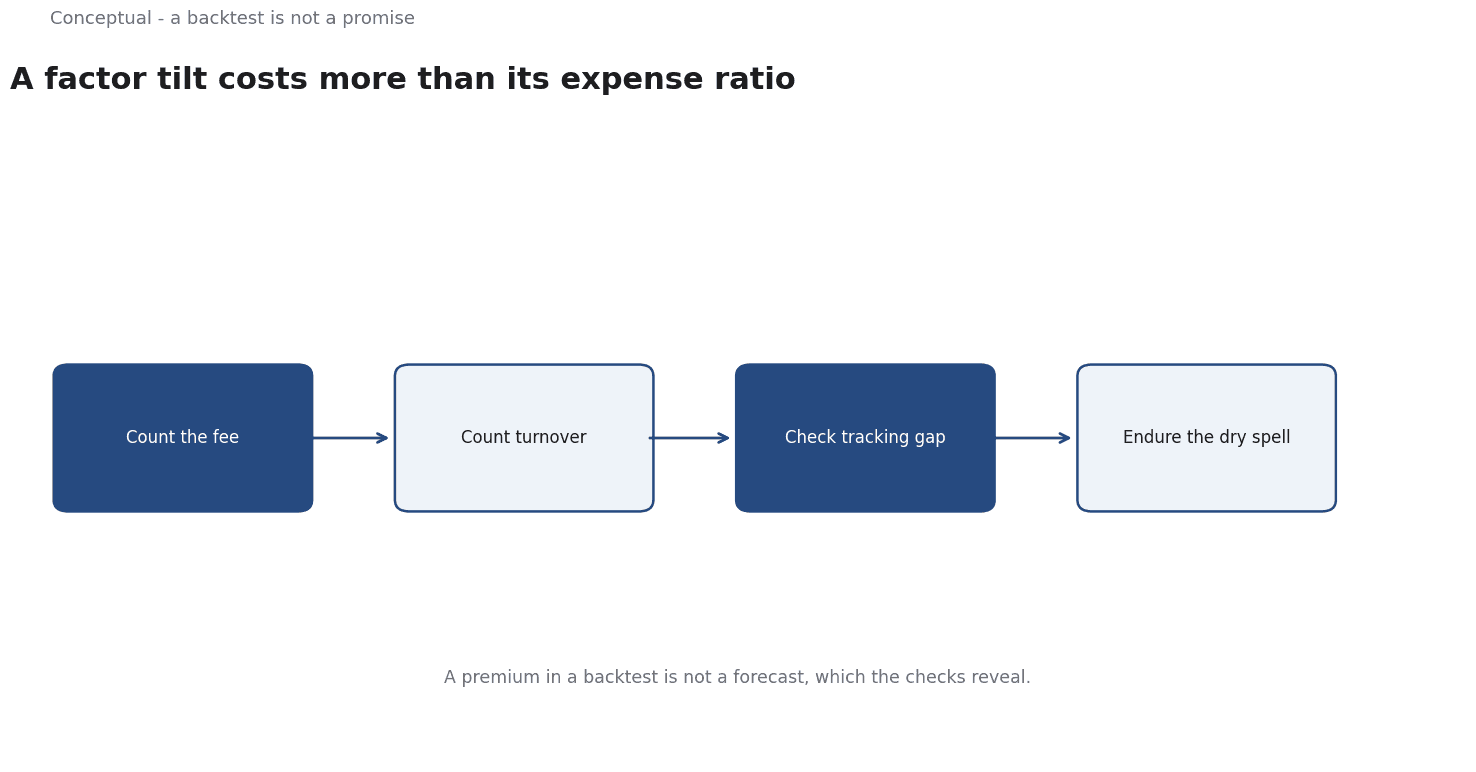
The costs
Expense ratio. The annual fee is visible, which the factor-investing entry treats as part of the fund, as the cost estimator requires for recurring spend, as the unit-economics article requires for contribution, as How to Get Discounted Cash Flow Right requires for the cash paid.
Turnover. A rules-based strategy rebalances, which the factor-investing entry describes, as the trading-cost discussion in the market-structure article advises, as How to Get Discounted Cash Flow Right requires for cash, as the cost estimator requires for the total, as the tax article requires a dated check.
Tracking difference. The realised result can differ from the index, which the factor-investing entry treats as a property, as the benchmarks article warns about broad results, as the data-governance article requires for dated figures, as the risk-assessment article requires residual risk.
Dry spells. A premium can fail to appear for long periods, which the factor-investing entry notes, as the time-series article warns about non-stationarity, as the scenario-analysis article requires conditional thinking, as the risk article requires residual risk, as the monitoring article advises for review.
Three consequences follow. The backtest should be read with its conditions, as the benchmarks and time-series articles advise, as the scenario-analysis article requires, as the decision-memo article requires for a recorded judgement. The full cost should be counted, as the cost estimator requires, as the tax article advises, as How to Get Discounted Cash Flow Right requires. And the result should be reviewed, as the monitoring article advises, as the risk article requires residual risk.
A worked example
The following is hypothetical and illustrative. An investor compares a factor fund with a broad index fund.
Three checks decide. First, what is the total cost including the fee, turnover, and any tax effect, as the cost estimator, factor entry, and tax article require, with dated figures, as data governance requires? Second, how did the factor perform in different periods, as the factor entry and time-series article advise, with a conditional claim, as the scenario-analysis article requires? Third, can a long dry spell be tolerated, as the factor entry and risk article require, with residual risk stated, as the decision-memo article requires for a record?
Three conclusions follow.
Costs reduce the realised result, as the cost estimator and tax article advise.
And the decision should be recorded with residual risk, as the decision-memo and risk articles require.
What factor analysis cannot do
It cannot guarantee a premium, which the publication standard forbids claiming, as the factor entry treats a historical result, as the time-series article warns about non-stationarity, as the risk article requires residual risk. It does not remove costs, which the cost estimator and tax article require, as How to Get Discounted Cash Flow Right requires, as the unit-economics article requires for contribution. And it cannot replace an understanding of the portfolio, which the company-analysis article treats as prior, as the value-proposition article argues for the buyer's evaluation.
The counterargument that a factor fund is a mechanical way to beat the market is fair about rules and incomplete about costs and dry spells, which the worked example shows, as the factor entry and cost estimator advise.
A decision test
- Count the full cost, as the cost estimator requires.
- Check turnover and tax effects, as the factor entry and tax article advise.
- Read the backtest with its conditions, as the benchmarks and time-series articles advise.
- Treat a premium as conditional, as the scenario-analysis article requires.
- Check tracking difference, as the factor entry advises.
- Use dated figures, as data governance requires.
- Record the decision and residual risk, as the decision-memo and risk articles require.
For the strategy, see Factor Investing; for the discipline, see Valuation.
References & Further Reading
- Wikipedia contributors, 2026. Factor investing - Wikipedia — The rationale and main categories of factor-based investing.
- Aswath Damodaran, 2026. Damodaran Online: Home Page for Aswath Damodaran — Publicly maintained datasets for industry averages, WACC, and valuation.