Featured Snippets Mistakes to Avoid
A bounded audit of the errors that block snippet extraction, with a worked example and explicit claim status.
Featured snippets look like a formatting trick, which leads teams to chase markup without fixing the underlying answer. A snippet is an extracted answer displayed prominently in search results, and a page has to contain a clear, usable answer before formatting matters. The Wikipedia entry on featured snippets and the Google SEO Starter Guide describe the surface and the prerequisites, but neither lists the mistakes teams actually make.
Direct answer: Avoid the errors that block extraction: hiding the answer behind long preambles, using vague headings, restricting crawler access, and offering thin or duplicated content. The sources describe what snippets are and what good content looks like; the mistake list is a synthesis of those descriptions.
Delta: This article adds a claim-status table and a worked audit, mapping snippet mechanics to specific corrections while keeping documented facts separate from inferred practice.
The mechanism
The Wikipedia entry describes a featured snippet as a search result that extracts and displays an answer from a page, often with a link to the source. That description carries a practical consequence: the source page must contain a self-contained answer that can be lifted out of context. A passage that only makes sense after three paragraphs of setup is a poor candidate, regardless of how accurate the full article is.
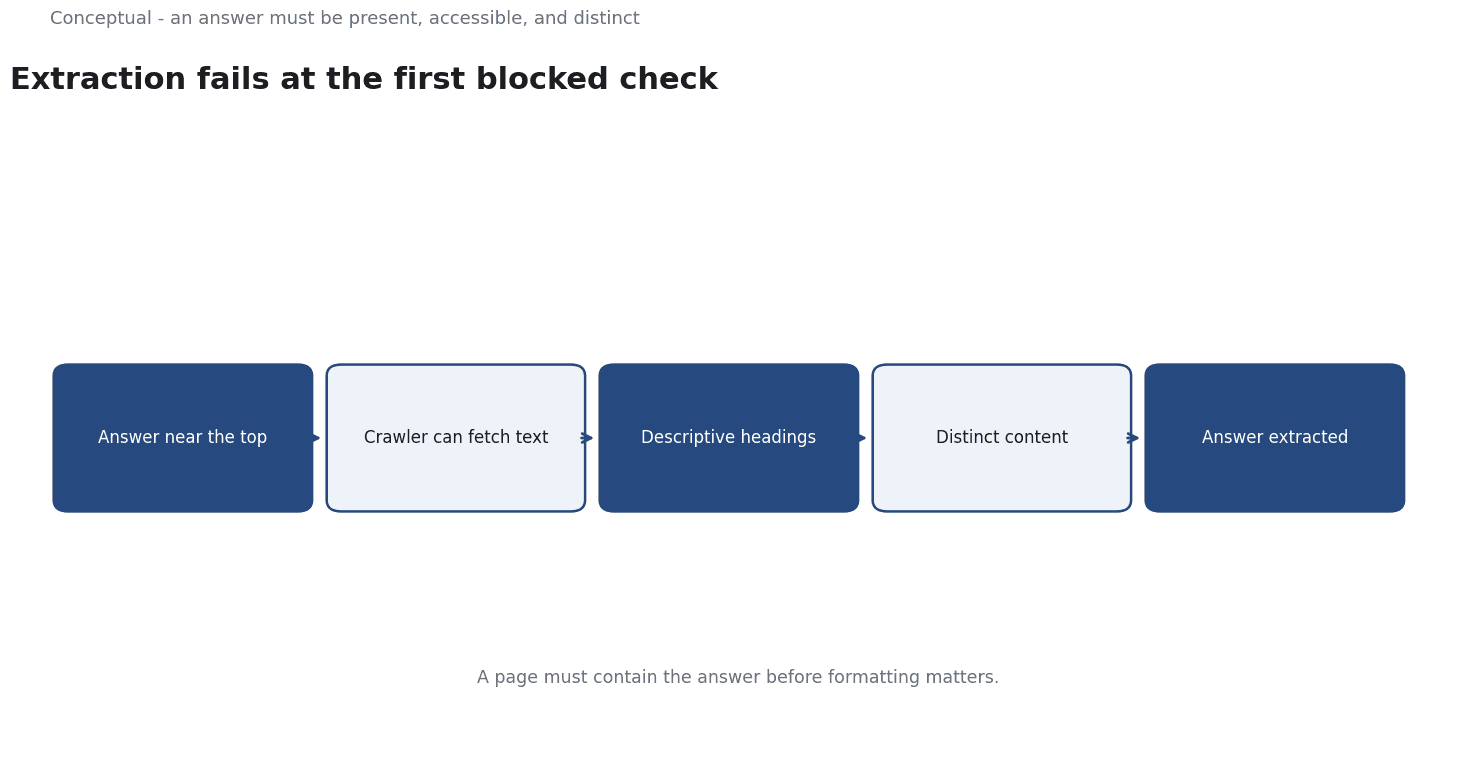
Extraction also depends on access. If a crawler cannot fetch the page, or if a directive or script hides the relevant text, there is nothing to extract. The practical consequence is that technical access precedes formatting work.
The Google SEO Starter Guide emphasizes clear structure, useful original content, and headings that describe what follows. The practical consequence for snippets is that a direct question-and-answer shape, supported by detail beneath it, serves both readers and extraction. A page that opens with a concise answer and then expands gives a search engine a clean unit to display and gives a reader a reason to stay.
The existence and form of snippets are reported by the Wikipedia entry; the link to answer-first structure and the ordering of checks are inferred from the two sources.
A worked example
The following is hypothetical and illustrative. A team publishes a guide it expects to appear as a snippet, but no snippet appears after several weeks.
Three checks decide. First, answer presence: does the page state a concise answer near the top, or only inside a late paragraph? Second, access: can a crawler fetch the text that contains the answer, or is it rendered only after a script runs? Third, distinctness: does the page repeat wording already published elsewhere, offering no single clear passage to lift?
The outcome is that the answer exists but sits in a script-rendered panel, so the fix is to place a plain-text summary in the server-rendered page rather than to add new markup. The scenario is hypothetical; the contribution is the ordered check, not the invented guide.
Evidence status
| Claim | Status | Source | Verified | Recheck when |
|---|---|---|---|---|
| Featured snippets extract and display answers from pages | source-reported | Wikipedia, Featured snippet | 2026-11-18 | Entry definition changes |
| Clear structure and useful content support search visibility | source-reported | Google, SEO Starter Guide | 2026-11-18 | Starter Guide guidance changes |
| Answer-first structure reduces common snippet failures | inferred | Derived from the sources | 2026-11-18 | Snippet formats or site rendering change |
The first two rows restate documented facts. The third row is a local synthesis: it follows from how extraction works but is not presented as a rule by either source. Recheck it when snippet display formats change or when the site's rendering approach changes.
What it cannot do
An audit cannot make a search engine show a snippet. The sources describe what snippets are and what content quality involves; they do not provide a threshold that guarantees display. A page can contain a clean answer, be fully accessible, and be highly original, yet no snippet appears because display is decided elsewhere. Promising a snippet as the outcome of formatting is therefore unsupported by the material cited here.
It cannot rescue weak content. Formatting an answer block does not make the underlying claim accurate or the page worth citing. A concise but misleading summary is worse than none, because it presents a wrong answer in the most prominent position on the page. The hidden cost of snippet chasing is that teams optimize the visible unit while leaving the substance untested, and the summary becomes the thing they defend rather than the thing they verify.
There is a real traffic trade-off. A displayed answer can satisfy a query on the results page, which may reduce clicks even when the page is cited. That outcome is not a failure of content quality, but it conflicts with the click goals that often motivate snippet work in the first place. A team should decide whether visibility or clicks is the objective before investing, because the same successful extraction can serve one and undercut the other.
A failure mode is over-formatting for a single display type. Filling a page with rigid question-and-answer blocks to court one snippet shape can make the reading experience worse for people who want depth. When the display format changes, the page is left with a structure that serves a stale target. Readability is the durable asset; a particular snippet shape is a moving one.
The boundary is between eligibility and control. A good structure makes a page a plausible source for extraction; it does not hand a team control over whether, when, or how an answer is shown. Review the audit when snippet formats, rendering methods, or the site's content model change, since each reshapes what "answer-first" means in practice.
Counterargument: the claim that snippet optimization is mostly formatting is fair when the answer is already strong and visible, and incomplete when the answer is buried, script-rendered, or duplicated.
A decision test
- Define whether the goal is visibility or clicks.
- Locate a concise, self-contained answer near the top of the page.
- Confirm a crawler can fetch the text that contains it.
- Check the answer is distinct from other published pages.
- Verify headings describe the sections that follow them.
- Make the smallest change that fixes the failing check.
- Recheck after publication and record the condition for review.
The test converts a vague expectation into verifiable conditions.
It does not promise a snippet; it removes the errors that make extraction unlikely.
For further reading, see AI search measurement.
References & Further Reading
- Wikipedia contributors, 2026. Knowledge Graph (Google) - Wikipedia — Direct answers shown in search results.
- Google, 2026. SEO Starter Guide: The Basics — The search engine's own description of what it needs from a site.