Featured Snippets without the Hype
Featured snippets reward concise answers, not tricks. Read what they are, how the basics support them, a worked example, and explicit claim status.
Featured snippets are often sold as a shortcut to traffic, which encourages tactics the underlying system does not reward. The reference sources describe what a snippet is and what basic search optimization involves. The practical question is which parts of that guidance actually apply to earning one.
Direct answer: A featured snippet is an answer box that a search engine extracts from a page, and the basics of discoverability apply before snippet eligibility is even relevant. The sources describe the feature and the fundamentals; the ordering of those steps is a synthesis.
Delta: This article adds a claim-status table and a worked example beyond the sources: it maps page structure to an extraction outcome, with claim status explicit.
The mechanism
A featured snippet is a summarized answer shown prominently in search results, drawn from content on a page. Common forms include a short paragraph, a list, or a table. The practical consequence is that the text an engine can extract must already exist on the page in a clear, self-contained form; it is not generated from nothing.
The basics of search optimization concern whether a page can be found and understood. Making content discoverable, using descriptive titles and headings, and keeping the page relevant to the query are the foundations. Snippet display sits on top of these basics. A page that is hard to crawl or poorly matched to the query is unlikely to be a source, regardless of formatting tricks applied later.
Structure is the bridge between the two ideas. An answer placed near the top of a page, under a heading that mirrors the question, gives an extraction system a clean candidate. The supporting detail then sits below, which serves the reader while keeping the answer easy to locate. That arrangement is a consequence of how extraction works, not a guarantee of display.
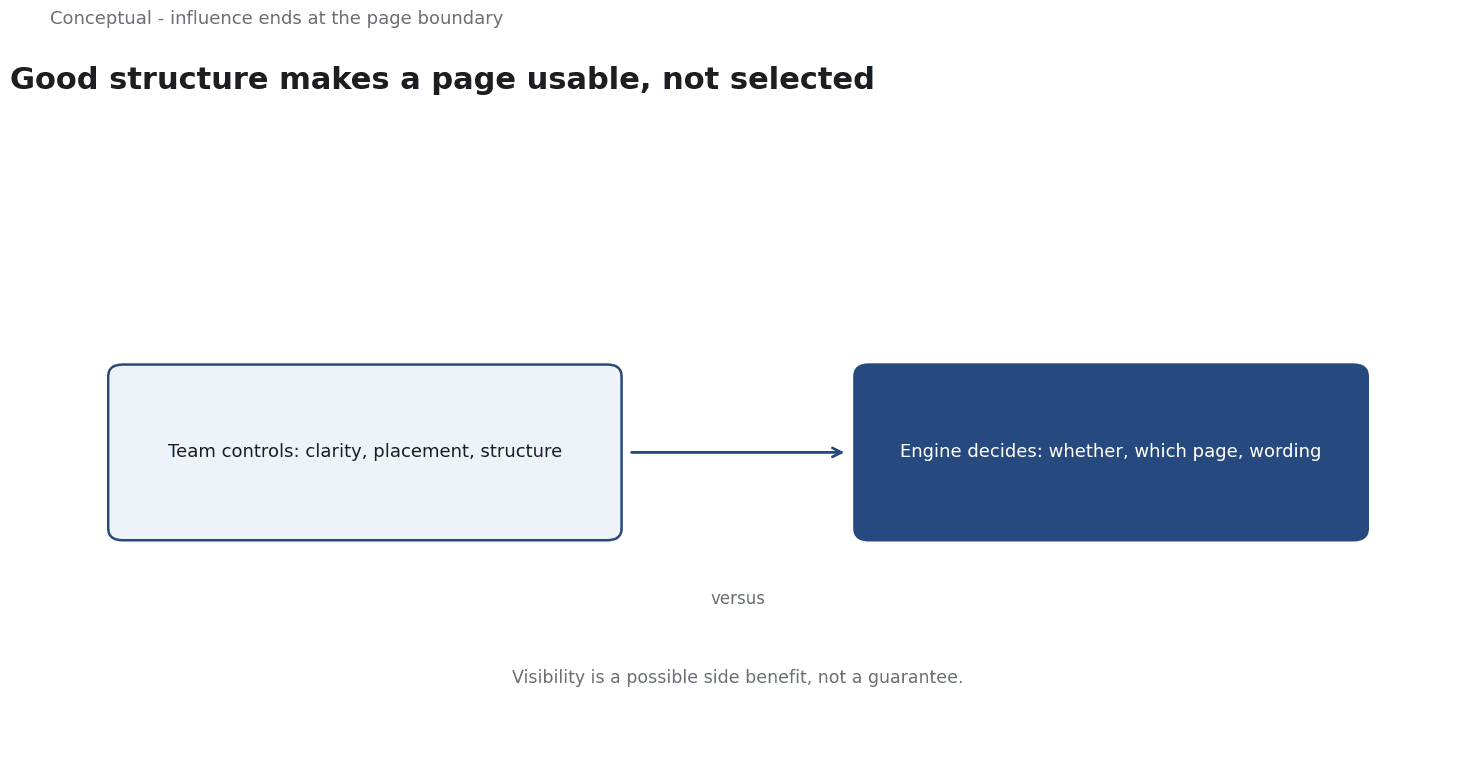
The key distinction is between what can be influenced and what cannot. A team controls the clarity, placement, and structure of its own content. It does not control whether a snippet appears, which page is chosen, or how the answer is worded after extraction.
Good practice raises the chance of being a usable source; it does not purchase the feature.
A worked example
The following is hypothetical and illustrative. A page addresses a common how-to question but buries the answer in a long introduction, and the team wants to be considered for a snippet.
Three checks decide the change. First, does a direct answer appear near the top of the page under a matching heading? Second, is the page crawlable and indexed, since an invisible page cannot be extracted? Third, does the answer format match the query, with a numbered list for a procedural question or a short paragraph for a definitional one? The outcome is a restructured page with the answer first and detail below. The scenario is hypothetical; the method is the contribution.
Evidence status
| Claim | Status | Source | Verified | Recheck when |
|---|---|---|---|---|
| Featured snippets extract an answer from page content | source-reported | Wikipedia, Featured snippet | 2026-11-18 | Feature definition changes |
| Basic SEO covers crawlability and relevant content | source-reported | Google SEO Starter Guide | 2026-11-18 | Guidance updates |
| Answer-first structure can support extraction | inferred | Derived from the sources | 2026-11-18 | Display behavior changes |
The two source-reported rows describe the feature and the guidance; the inferred row is the local application. One source defines what a snippet is, and the other defines what makes a page findable. Recheck conditions follow changes to the feature or the guidance, rather than any fixed interval.
What it cannot do
A featured snippet cannot be guaranteed. The sources describe the feature and the basics, but they do not describe an opt-in or a switch a site owner can flip. A page can follow every reasonable practice and still never be selected, which means the work should be justified by readability and findability rather than by the promise of a snippet.
It does not necessarily increase clicks. Because the answer is displayed in the results, a user may read it without visiting the page. The benefit is visibility and authority, not guaranteed traffic, and a team that measures only clicks may conclude the effort failed when it achieved something different. The metric should match the goal before the work begins.
There is a hidden cost in over-optimizing for extraction. A page rewritten as a string of terse answers can become worse for the reader, and a format chosen for a snippet may strip the context that makes the answer trustworthy. Hidden costs also appear in maintenance, since a structure tuned to a query can grow stale as the query or the answer changes.
Adding headings and lists to a page with weak or irrelevant content does not fix the underlying mismatch. The extraction system still needs a correct, self-contained answer to display; without one, structure is decoration. Teams that treat the feature as a formatting contest tend to optimize the wrong thing and ignore whether the answer is accurate.
The boundary is that these sources describe a feature and a set of fundamentals, not a tactic with a success rate. They do not quantify how layout affects selection, and no reliable threshold can be derived from them. Any layout decision is therefore a local hypothesis to be tested against the team's own pages and queries. It should be revisited when the underlying content, the query set, or the documented guidance changes.
Counterargument: "The counterargument that snippet formatting is worth the effort is fair for clarifying an existing, accurate answer and incomplete when it is treated as a substitute for relevant content."
A decision test
- Confirm the page is crawlable and indexed.
- Identify the single question the page answers.
- Place a direct, self-contained answer near the top.
- Match the answer format to the query type.
- Put supporting detail below the answer for readers.
- Check that the answer is accurate on its own.
- Review the result against page goals, not clicks alone.
Snippet work is best treated as a readability improvement with a possible side benefit. A page that answers its question clearly serves the reader whether or not an extractor uses it, which is why the change is defensible on its own terms. Teams that frame it that way avoid the disappointment of a tactic that never guaranteed an outcome.
For further reading, see What AI Search Actually Measures.
References & Further Reading
- Wikipedia contributors, 2026. Knowledge Graph (Google) - Wikipedia — Direct answers shown in search results.
- Google, 2026. SEO Starter Guide: The Basics — The search engine's own description of what it needs from a site.