FinOps for Beginners
FinOps is a practice, not a product. Understand how cloud cost visibility maps to decisions, where the framework stops, and what a beginner should verify first.
Cloud spending is variable, shared, and incurred by people who rarely see the bill at the moment they create it. That gap produces a familiar failure: engineering teams make technical choices without cost feedback, finance sees a number without context, and nobody owns the result. "Cost optimization" then gets treated as a one-time cleanup rather than a continuing practice, which is why a beginner needs the concept before the tooling.
Direct answer: FinOps, or cloud financial management, is a practice that brings financial accountability to variable spend by connecting engineering, finance, and business decisions. It is a framework of phases and principles, not a product you install. Its value comes from turning visibility into ownership and then into choices about what the spend buys.
Delta: This article adds a beginner's decision map beyond the two sources: it connects each framework phase to a specific action a small team can take, with claim status made explicit rather than implied.
The mechanism
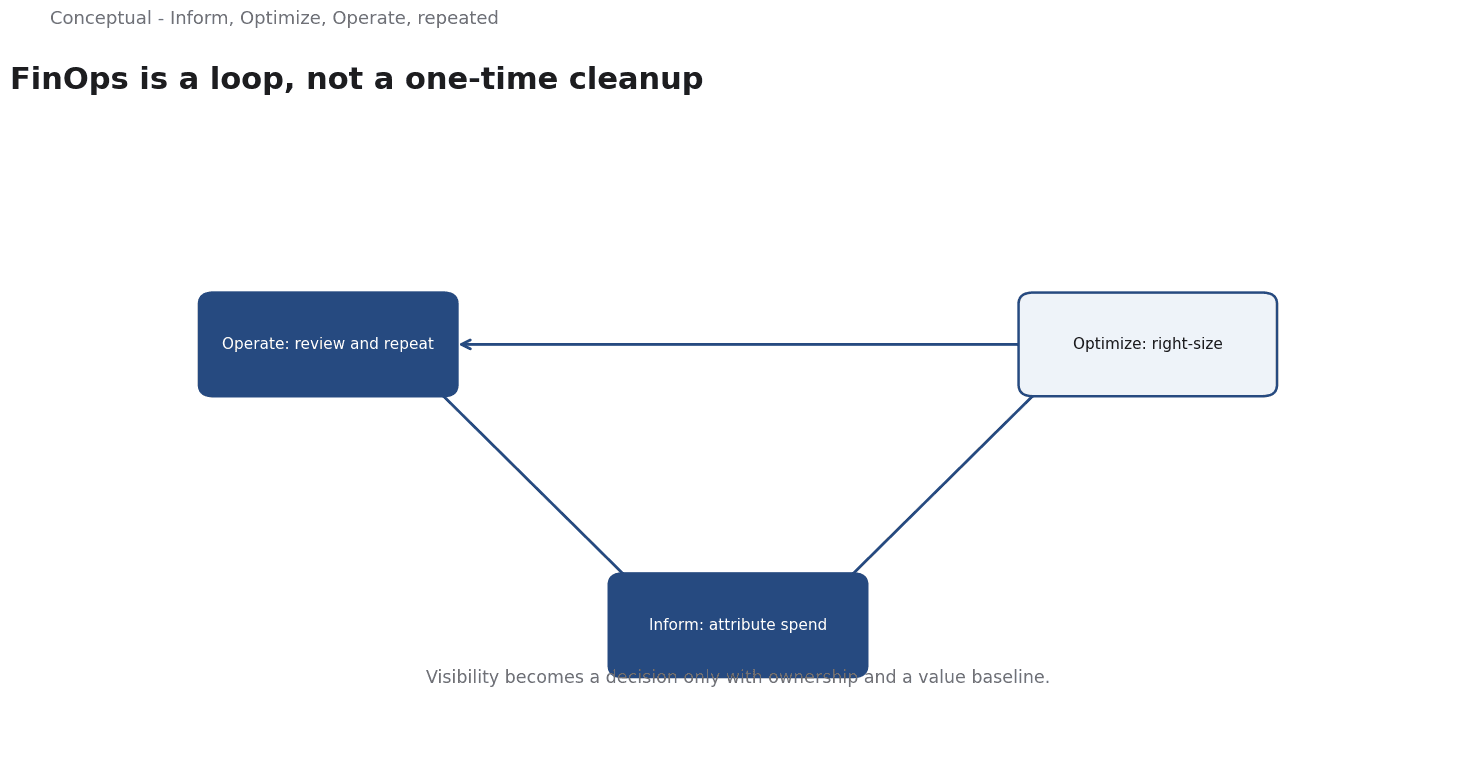
The FinOps Foundation describes FinOps as a practice for managing the variable nature of cloud cost, organized around an iterative set of phases often summarized as Inform, Optimize, and Operate. The framework's emphasis is cultural: it asks that the people who create cost understand it and that decisions be driven by business value rather than by a central finance function acting alone. The practical consequence for a beginner is that the starting point is not a discount or a dashboard but an agreement about who owns which costs and what those costs are for.
The Amazon Web Services Well-Architected Cost Optimization pillar makes a complementary case. It treats cost as a design concern that must be balanced against performance, reliability, and security, and it stresses understanding usage, establishing visibility, and improving continuously rather than once. In this view, the cheapest design is not automatically the best one; the goal is to meet the business need at an acceptable cost. The practical consequence is that cost is a property of architecture and behaviour, not an accounting afterthought.
Read together, the two sources describe a loop: make spend visible, understand what drives it, act on that understanding, and repeat. Visibility without ownership produces reports nobody uses. Ownership without a value baseline produces indiscriminate cutting. Action without review produces savings that decay as the workload changes. A beginner should therefore build the loop in that order, starting with attribution so that every unit of spend has an owner and a purpose.
That ordering has a direct consequence for what counts as progress.
The first useful outcome of FinOps is usually not a lower bill but a clearer answer to what the bill is buying.
Once spend is attributed to services, teams, and products, it becomes possible to express cost in units that matter, such as cost per customer or per transaction. Decisions about right-sizing, commitments, or architecture then rest on those units instead of on the raw total, which is the difference between managing cost and merely reacting to it.
A worked example
The following is hypothetical and illustrative. A small product team sees its monthly cloud bill rising and discusses adopting a FinOps practice before the next planning cycle. The question is whether the rise represents waste or the cost of growth.
Three checks shape the answer. First, can the spend be attributed to specific services and owners, or does it sit in one undifferentiated account? Without attribution, no one can act on it. Second, is there a value baseline, such as cost per active customer, that shows whether the rise is proportional to usage? An absolute increase means little on its own. Third, is optimization framed as an ongoing practice with trade-offs, or as a one-time cut? A cut that reduces headroom or redundancy can cost more in reliability than it saves.
The outcome is a bounded decision. The team adopts attribution and a unit-cost baseline first, then schedules a regular review to look for right-sizing and commitment opportunities. It does not claim the framework itself lowered the bill; it claims only that the framework made the next cost decision traceable.
Evidence status
| Claim | Status | Source | Verified | Recheck when |
|---|---|---|---|---|
| The FinOps framework organizes cloud financial management around phases such as Inform, Optimize, and Operate. | source-reported | FinOps Foundation, FinOps framework | 2026-11-18 | The published framework or its phase names change. |
| The AWS Cost Optimization pillar treats cost as a design concern balanced against other requirements and improved continuously. | source-reported | Amazon Web Services, Cost Optimization pillar | 2026-11-18 | The Well-Architected guidance is revised. |
| Cost visibility becomes a decision input only when ownership and a value baseline are present. | inferred | Derived from the sources | 2026-11-18 | A method is found that produces decisions without those prerequisites. |
The reported rows reflect how each source frames the discipline; the inferred row is a synthesis, not a quotation from either. Marking the distinction prevents a practical conclusion from being mistaken for an official requirement. The recheck conditions matter because both frameworks are living documents, and a beginner's guidance should track the current version rather than a remembered one.
What it cannot do
FinOps does not lower a bill by itself. The framework describes a practice and a set of phases; the savings come from the decisions people make using it. A team can adopt the vocabulary, hold the meetings, and publish the dashboards while changing nothing about how it builds or buys. Expecting the framework to produce savings without decisions is like expecting a budget template to manage money. The practice creates the conditions for better choices, but the choices remain the work.
It also carries a hidden cost. Attribution requires tagging discipline, governance rules, and ongoing cleanup, all of which consume time that a small team may not have. The reporting layer can create false precision, where a number looks authoritative simply because it appears in a dashboard. And the cultural shift asks engineers to think about cost alongside correctness and speed, which adds a dimension to decisions that were already complex. If the overhead of maintaining the practice exceeds the value of the decisions it changes, the program has failed even if the dashboard is elegant.
A common failure mode is cutting cost without a value frame. When the only target is a lower total, teams remove capacity, reduce redundancy, or delay upgrades in ways that raise risk and slow delivery. The FinOps framing and the AWS pillar both resist this by treating cost as a trade-off, but in practice the trade-off is easy to forget under pressure.
Without a repeating review, the loop is broken.
The boundary is that this material addresses variable, usage-driven cloud spend. It is less directly useful for fixed licenses, long-term contracts, or costs that do not respond to engineering choices. It does not replace architectural judgment, security review, or product strategy, and it does not tell a team which features to build. A beginner who expects the framework to answer those questions will be disappointed; it is a lens on cost, not a general management system.
Finally, the guidance needs review. Cloud prices change, services change, and workloads change, so a right-sizing decision or commitment made this quarter may be wrong next quarter. A responsible practice records the assumptions behind each decision, states which claims are reported and which are inferred, and sets a date to revisit them. That review habit is what keeps the loop from decaying into a ritual.
The counterargument that FinOps is just cost cutting is fair for short-term savings and incomplete for the accountability and value framing that make those savings durable.
A decision test
- Name the specific decision the cost information is meant to support.
- Confirm that spend can be attributed to an owner and a purpose before acting on it.
- Establish a value baseline, such as cost per unit of output, rather than watching the raw total.
- Treat cost as a trade-off and state what reliability, performance, or speed might be given up.
- Choose one concrete action, such as right-sizing or a commitment, that follows from the baseline.
- Record the decision, its assumptions, and the reported versus inferred claims behind it.
- Set a review date, because prices and workloads will change the answer.
The sequence is deliberately modest. A beginner who completes these steps has not mastered cloud economics, but has built a loop that can be improved. The measure of success is not a single dramatic saving; it is that the next cost decision is better informed than the last one, and that its reasoning can be reconstructed later.
For further reading, see Cash Flow Forecasting: A 13-Week Operating Model.
References & Further Reading
- FinOps Foundation, 2026. The FinOps Foundation — The cross-industry framework for managing cloud cost as an engineering discipline.
- Amazon Web Services, 2026. Cost Optimization (AWS Well-Architected Framework) — Vendor primary documentation on right-sizing and commitment models.