Financial Modeling Mistakes to Avoid
A model is an argument in arithmetic form. Read the mistakes, a worked review, and why a precise spreadsheet can hide a fragile assumption.
A financial model looks authoritative because it produces precise numbers, which is why its assumptions often go unexamined. The work is an argument expressed in arithmetic, which Damodaran's framework treats as requiring explicit inputs, as the DCF entry describes the structure, as the earnings-quality article warns about clean figures, as the scenario-analysis article requires conditional thinking.
Direct answer: Avoid model mistakes by separating inputs from calculations, stating assumptions, testing outcomes under alternatives, and reconciling to cash. Damodaran's work provides the valuation framework, and the DCF entry covers the structure. The boundary: this is educational orientation, not personalised advice — tax and accounting rules are jurisdiction-specific, as the tax article requires a dated check, as the publication standard forbids guaranteed outcomes.
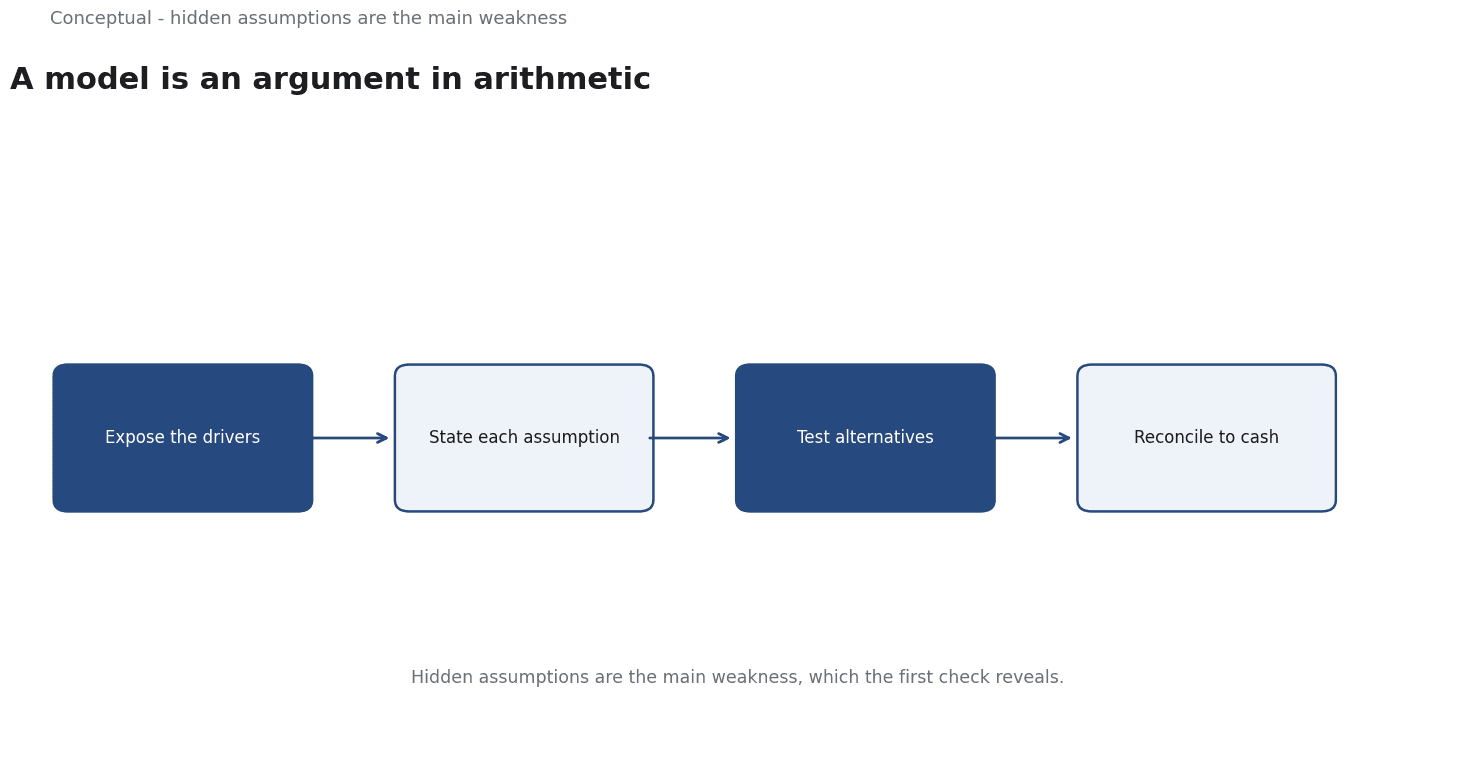
The mistakes
Burying assumptions.
Confusing precision with accuracy. A model can compute to many decimal places from weak inputs, which the data-quality article warns about, as the earnings-quality article warns about clean figures, as the risk-assessment article requires residual risk, as the scenario-analysis article requires conditional thinking.
Skipping the cash check. A profitable projection that never converts to cash is a story, which the free-cash-flow article explains, as the cash-flow model requires a dated plan, as the earnings-quality article warns about accruals, as the comparables article requires consistent definitions.
Using one scenario. A single case hides the range, which the scenario-analysis article requires conditional thinking, as the Monte-Carlo article treats distributions, as the risk article requires residual risk, as the monitoring article advises for review.
Three consequences follow. Inputs should be separated and sourced, as data governance requires, as the valuation framework advises. The cash check should be explicit, as Free Cash Flow Explained With an Example requires, as the cash-flow model advises. And the result should be tested across scenarios, as the scenario-analysis article requires, as the decision-memo article requires for a record.
A worked review
The following is hypothetical and illustrative. A model projects revenue growth and a stable margin for five years.
Three checks decide the review. First, are the growth and margin assumptions visible and sourced, as the valuation framework and data-governance article require, with a dated figure? Second, does the projected profit convert to cash, as the free-cash-flow and earnings-quality articles require, with a working-capital assumption, as the cash-flow model advises? Third, what happens under lower growth, as the scenario-analysis article requires, with residual risk, as the risk article requires, as the decision-memo article requires for a record?
Three conclusions follow.
Hidden assumptions are the main weakness, which the first check reveals.
Profit does not guarantee cash, as the free-cash-flow and earnings-quality articles advise. And the result should be recorded with the scenarios, as the decision-memo article requires.
Why the structure is part of the argument
A model that mixes assumptions into formulas cannot be challenged, which the financial-modeling best-practices article treats as a structural error, as the valuation framework advises on explicit inputs, as the data-governance article requires for provenance, as the decision-memo article requires for a recorded judgement, as the comparables article requires consistent definitions, as the earnings-quality article warns about clean figures, as the cash-flow model requires a dated plan, as the scenario-analysis article requires conditional thinking, as the risk article requires residual risk, as the monitoring article advises for review after change.
What a model cannot do
It cannot establish truth, which the valuation framework treats as an argument, as the publication standard forbids guaranteed outcomes, as the risk article requires residual risk. It does not replace an understanding of the business, which the company-analysis article treats as prior, as the value-proposition article argues for the buyer's evaluation. And it cannot remove uncertainty, which the scenario-analysis article requires conditional thinking, as the Monte-Carlo article treats distributions.
The counterargument that a detailed model is more reliable is fair for arithmetic and wrong about inputs, which the worked review shows, as the data-quality and earnings-quality articles advise.
A decision test
- Separate inputs from calculations, as Financial Modeling Best Practices and Common Errors advises.
- Source and date each assumption, as data governance requires.
- Reconcile profit to cash, as Free Cash Flow Explained With an Example requires.
- Test alternative scenarios, as the scenario-analysis article requires.
- Check definitions across comparables, as the comparables article requires.
- State residual risk, as the risk article requires.
- Record the decision, as the decision-memo article requires.
For the method, see Financial Modeling Best Practices; for the cash check, see Free Cash Flow.
References & Further Reading
- Aswath Damodaran, 2026. Damodaran Online: Home Page for Aswath Damodaran — Publicly maintained datasets for industry averages, WACC, and valuation.
- Wikipedia contributors, 2026. Discounted cash flow - Wikipedia — The structure and use of discounted cash flow analysis.