First-party Data Trade-Offs
First-party data is an advantage with a cost: collection, consent, and accuracy. Read what it buys, a worked example, and where it disappoints.
First-party data has become the answer to a lot of marketing problems — cookie loss, attribution gaps, personalisation. The phrase describes data a company collects directly from its own audience, which is useful precisely because the relationship is direct. It is also a responsibility: the data must have a lawful basis, be accurate, and be worth the cost of collecting.
Direct answer: First-party data buys direct measurement and relevance when it is collected with a clear purpose and used within the consent given. GDPR Article 6 sets out lawful bases for processing, and the GDPR overview covers the wider obligations. The boundary: first-party data is not automatically accurate or complete, and it does not grant permission to do anything, which the data-ethics article argues for limits on use, as Data Privacy: GDPR, CCPA, Data Governance, and Privacy by Design requires provenance.
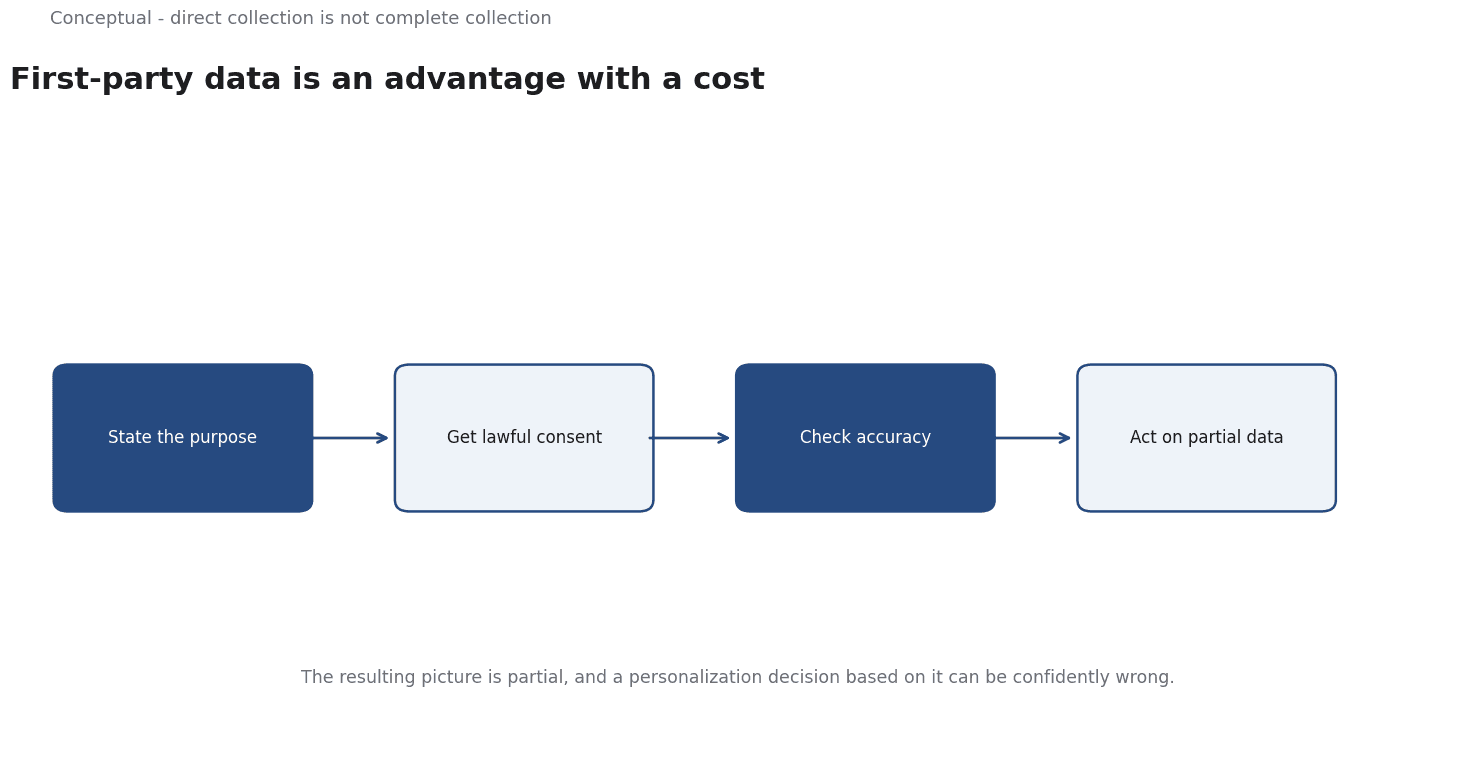
Where first-party data disappoints
A retailer sees purchases in its own channels and nothing about the conversation that led to them, which the dark-social article explains for sharing that loses its tags.
The resulting picture is partial, and a personalization decision based on it can be confidently wrong, as the data-quality article warns about the cost of bad inputs.
A second disappointment is treating consent as a one-time event. A purpose that was acceptable when the data was collected may not cover a new use, which Article 6 requires you to check, as Data Privacy: GDPR, CCPA, Data Governance, and Privacy by Design treats scope as an obligation. Teams that expand use without revisiting the basis create a compliance gap, which the risk-assessment article argues for catching before an incident.
Finally, first-party data can be expensive to maintain. Records go stale, identities merge incorrectly, and systems drift apart, as Data Privacy: GDPR, CCPA, Data Governance, and Privacy by Design describes for any relied-upon asset. The strategic question is whether the data changes a decision enough to justify that work, which the data-strategy article frames as the test of a data asset.
What it buys
Direct measurement. Behaviour observed on your own properties can be tied to a defined event, which the event-measurement guidance covers for how events are defined. This is more controllable than third-party signals, which the attribution article treats as credit rules from other systems.
Relevance. Knowing a customer's past purchases or stated preferences can make a message more useful, as the personalization article argues for personalizing the dimension that changes a decision. Data without a decision to change is a cost, as Data Strategy: How Organizations Use Data to Compete warns about assets nobody uses.
Resilience. A direct relationship does not depend on a third-party identifier, which the retail-media article discusses for why first-party data grew in importance. It is not immune to privacy choices, which the data-privacy article makes jurisdiction-specific.
Three consequences follow. Collection should have a stated purpose, as Article 6 requires for lawful processing. The data needs a quality bar, which the data-quality article argues for before any analysis. And the consent and retention rules must be honoured, which the privacy article treats as an obligation, not a feature.
A worked example
The following is hypothetical and illustrative. A retailer wants to use purchase history to personalise email.
Three checks decide whether the data is worth using. First, lawful basis and consent: does the customer's consent cover this use, as Article 6 requires, and is the purpose stated, as Data Privacy: GDPR, CCPA, Data Governance, and Privacy by Design advises? Second, quality: is the purchase history accurate and current, which the data-governance article requires for relied-upon records? Third, lift: does using the history improve qualified conversion against a non-personalised baseline, as the geo-experiment guidance recommends for a comparison?
Three conclusions follow. The data is an asset only if all three checks pass, as Data Strategy: How Organizations Use Data to Compete argues for value tied to a decision. An outdated purchase record can make a message irrelevant, which the data-quality article treats as a correctness problem. And the consent boundary applies even when the data is yours, as the data-ethics article warns about scope creep in use.
What first-party data cannot do
It cannot see behaviour outside your properties, which the dark-social article explains for sharing that loses tags. It cannot substitute for a good offer, which the value-proposition article treats as the buyer's real evaluation. And it does not remove obligations — a first-party relationship still has legal limits, as the GDPR overview specifies.
The counterargument that first-party data is free because you already own the platform misses collection and governance costs, which the cost article treats as real expenses on any workload.
A decision test
- State the purpose for each data field, as GDPR Article 6 requires.
- Check consent against the intended use, as Data Privacy: GDPR, CCPA, Data Governance, and Privacy by Design advises.
- Set a quality bar, as the data-quality article requires.
- Measure lift against a baseline, as the geo-experiment guidance recommends.
- Respect retention limits, as the GDPR overview specifies.
- Assign an owner for the data, as the governance checklist requires.
- Review on a change in purpose or rules, as the monitoring article advises.
For the obligations, see Data Privacy; for the strategic view, see Data Strategy.
References & Further Reading
- GDPR Info, 2016. Art. 6 GDPR – Lawfulness of processing - General Data Protection Regulation (GDPR) — The lawful bases for processing personal data under GDPR.
- European Union (GDPR text via gdpr-info.eu), 2016. Art. 33 GDPR – Notification of a personal data breach to the supervisory authority — Article 33: notification of a personal-data breach to the supervisory authority within 72 hours where feasible, and the risk-based exception. Stable HTML rendering of the EU regulation text.