First Principles for Beginners
First-principles reasoning builds up from what is known. Read how to start, a worked example, and why it is not the same as being contrarian.
First-principles reasoning is often described as questioning everything, which misses that it requires a foundation. The first-principle entry describes reasoning from basic truths, and the decision-making entry covers structure and evidence. The practice starts with identifying what is actually known.
Direct answer: Break a problem into claims you can defend, rebuild from those, and check where the result disagrees with convention. The sources describe reasoning; the method is a synthesis.
Delta: This article adds a claim-status table and a worked example, separating documented reasoning from local judgements about what counts as a basic truth.
The mechanism
The first step is separating facts from assumptions. The first-principle entry describes reasoning from propositions that cannot be deduced further, which in practice means claims you can defend with evidence. A belief inherited from an industry convention is not automatically a fact, and a fact does not become a convention by being ignored.
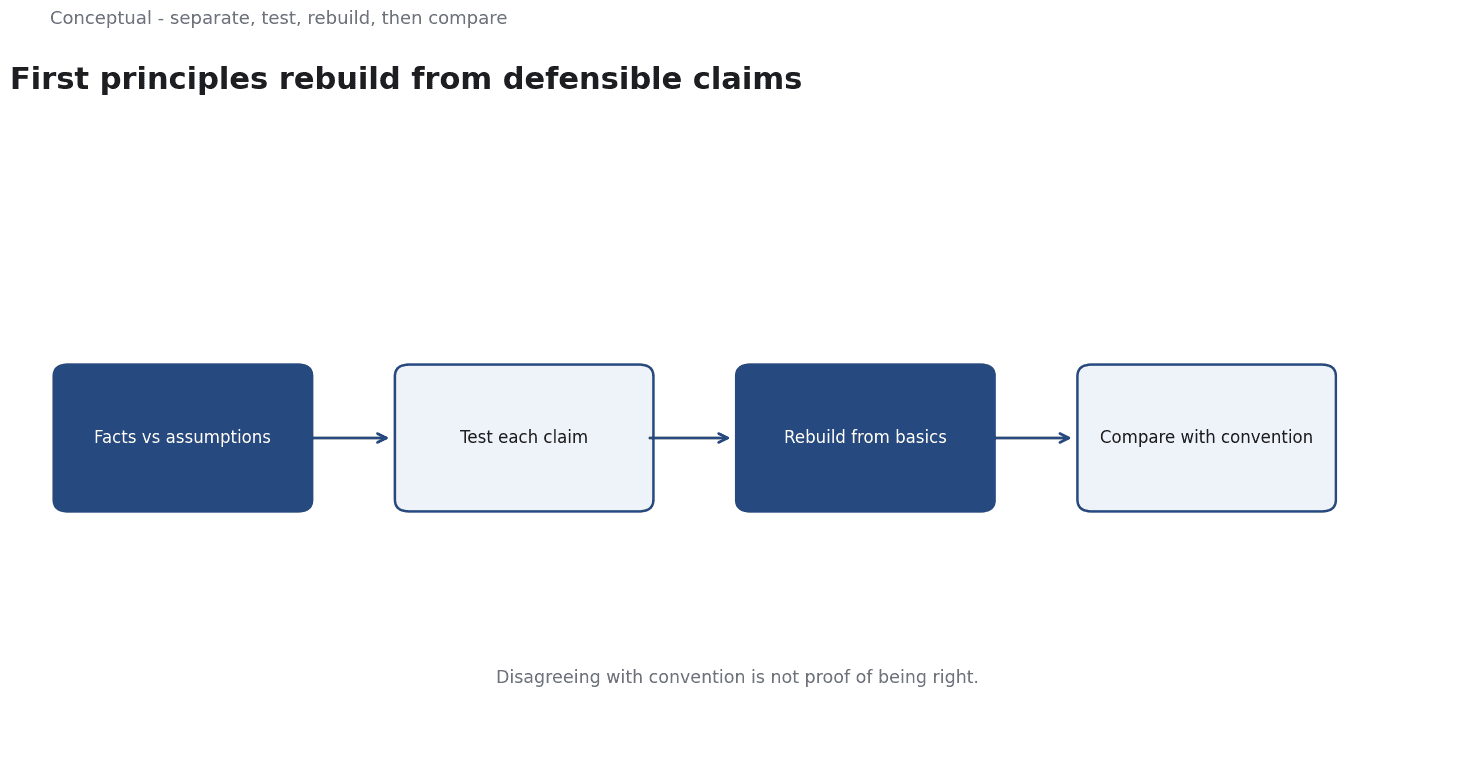
The second step is rebuilding. The decision-making entry describes evidence and ownership, which applies to the chain of reasoning from basics to conclusion. A chain with a weak link is not strengthened by skipping the link, and writing the steps makes the weak point visible.
The third step is comparison. A result that disagrees with convention is interesting and not automatically right, while agreement with convention is not proof of correctness. The value is in knowing why the result differs, which is a different question from whether it does.
The sequence is: list the claims, test each, rebuild, then compare.
The testing is local work, so the conclusions are inferred; the concept is source-reported.
A worked example
Illustrative. A team assumes that a feature must be built in-house because competitors do.
Three checks decide. First, what claim makes in-house necessary, and is it supported by evidence? Second, what would follow from the basic facts — the team's capability, the timeline, and the cost — if the convention were removed? Third, does the rebuilt conclusion differ, and why?
The outcome is a decision with an explicit chain rather than an inherited one. The scenario is hypothetical; the method is the contribution.
Evidence status
| Claim | Status | Source | Verified | Recheck when |
|---|---|---|---|---|
| First principles are basic propositions | source-reported | Wikipedia, First principle | 2026-11-18 | Definition changes |
| Decisions use evidence and owners | source-reported | Wikipedia, Decision making | 2026-11-18 | Source revised |
| Test each claim before rebuilding | inferred | Derived from both | 2026-11-18 | Problem changes |
Why it is not contrarianism
Questioning an assumption is useful only when the replacement is better supported.
A further point is that not every decision deserves this treatment. A routine choice with a known answer does not benefit from rebuilding from basics, and the effort is better spent where the stakes are high and the convention may be wrong. Choosing where to apply the method is part of using it well.
The chain also has to be written down. A reasoning sequence held in memory tends to lose its weak links, which makes the conclusion feel better supported than it is. A short record of each claim and its evidence is the practical artefact.
The third limitation is that a basic claim can be wrong. Calling something fundamental does not make it true, and a chain built on an error produces a confident wrong conclusion. Marking which claims have been tested versus assumed is the control.
A routine decision does not repay the effort of rebuilding from basics, which is a reason to choose where to apply the method.
A reasoning chain held in memory loses its weak links, so a short written record is the practical artefact.
Calling a claim fundamental does not make it true, and the tested ones should be marked as such.
Disagreeing with convention is not the method unless the replacement is better supported.
The value lies in knowing why a conclusion differs from convention, not that it does.
A chain built on an untested basic claim is confident for the wrong reason.
The method is not for routine choices, which is a matter of where to spend the effort.
A decision test
- State the claim being examined.
- Separate facts from conventions.
- Test the foundational claims.
- Rebuild the conclusion.
- Compare with convention and explain the difference.
- Record the chain and recheck date.
For the written form, see Decision Memos.
A counterargument
A reasonable critic could object that the article treats "test each claim before rebuilding" as a clean, neutral step when it is the part least supported by the cited sources.
Both the first-principle and decision-making entries are described as source-reported, but the key prescription - test the foundational claims, then rebuild - is marked inferred in the article's own table. The method assumes those foundational claims can in fact be tested with the available evidence, an assumption the sources do not establish and that the article concedes can fail when a "basic" claim is wrong. The article is candid about these limits, but it still presents the sequence as more robust than its own evidence status suggests.
References & Further Reading
- Wikipedia contributors, 2026. First principle - Wikipedia — Reasoning from basic truths rather than analogy.
- Wikipedia contributors, 2026. Decision-making - Wikipedia — Overview of decision processes, trade-offs and the distinction between the decision and its outcome; secondary reference.