GDPR Compliance without the Hype
GDPR compliance is a processing decision, not a cookie banner. Read how lawful basis and data subject rights map to obligations, with claim status explicit.
GDPR is often reduced to a cookie banner and a consent checkbox, which makes compliance look like a one-time design task. The regulation defines obligations for processing personal data, and the California Privacy Protection Agency publishes regulations implementing state privacy law. The real problem is that most exposure comes from ordinary processing decisions, such as why data is collected and how long it is kept, long before any banner is shown.
Direct answer: GDPR sets principles and rights that apply to processing personal data of people in the EU, with extraterritorial reach for some controllers. The California Privacy Protection Agency issues regulations under state law, including rules on risk assessments and automated decision-making.
Delta: This article adds a processing-to-obligation mapping beyond the sources: it maps each processing decision to a compliance obligation, with claim status explicit.
The mechanism
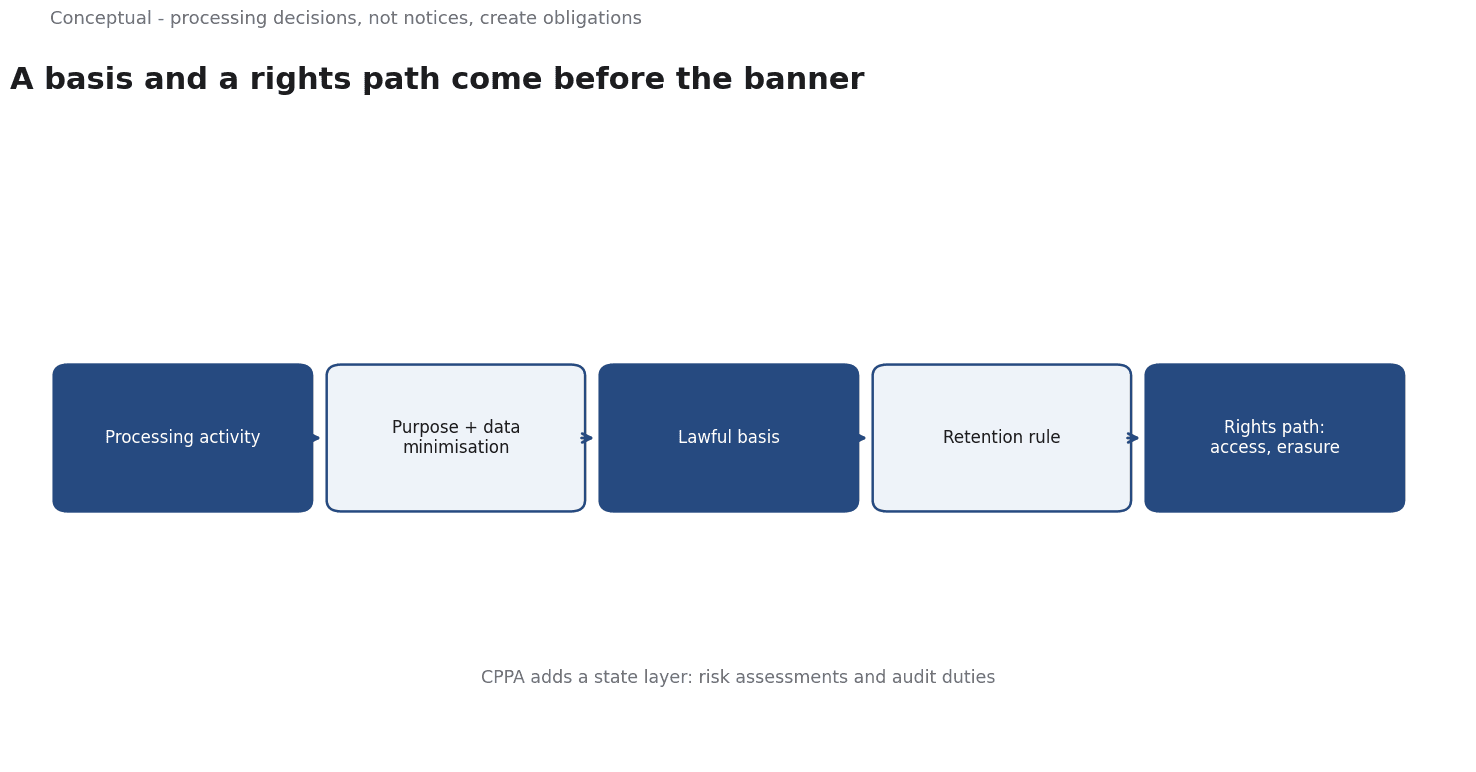
The bounded claim: a processing activity needs a lawful basis and a rights path before it needs a notice.
The GDPR entry describes a regulation built on principles: lawfulness, fairness, and transparency; purpose limitation; data minimisation; accuracy; storage limitation; integrity and confidentiality; and accountability. These are not slogans but constraints on a processing activity. The practical consequence is that a team must state why it collects each field and limit collection to that purpose. Accountability means the reasoning must be recorded, so a decision that cannot be explained is already a gap.
The regulation also grants data subject rights, including access, rectification, erasure, portability, and objection, and it requires controllers to report certain personal data breaches to a supervisory authority within a set window. Consent is one lawful basis among several, not a universal requirement. The practical consequence is that rights handling is an operational capability, not a legal sentence in a policy. A controller must be able to find a person's records and act on a request within the required time.
The California Privacy Protection Agency regulations add a state-layer example. The agency adopts regulations under California privacy law, including requirements around risk assessments, cybersecurity audits, and automated decision-making technology. The practical consequence is that compliance is not a single jurisdiction's checklist. A product serving both regions must satisfy overlapping but non-identical obligations, and the same processing activity can trigger duties under each regime.
The two sources connect at the processing decision. GDPR supplies principles and rights; the CPPA regulations show a parallel state framework with its own procedures. A lawful basis under one does not satisfy the other automatically. The mapping from an activity to an obligation is therefore local and must be marked as inferred, because neither source assigns a specific obligation to a specific product. The useful output is a register that ties each processing activity to its purpose, basis, retention rule, and rights path.
A worked example
The following is hypothetical and illustrative. A team plans to collect email addresses to send product updates. Three checks decide the compliance work. First, what is the specific purpose, and is the collection limited to what that purpose needs? Second, which lawful basis applies, and is consent the right one or merely the easiest? Third, can the team locate and delete a person's record when an erasure request arrives, and how long is the address retained? The review finds a broad purpose and no deletion path. The team narrows the purpose, records the basis, and implements a deletion route. The outcome is a defensible activity. The details are hypothetical; the method is the contribution.
Evidence status
| Claim | Status | Source | Verified | Recheck when |
|---|---|---|---|---|
| GDPR sets processing principles and data subject rights | source-reported | Wikipedia, GDPR | 2026-11-18 | Regulation amended |
| CPPA issues regulations under California privacy law | source-reported | CPPA, Regulations | 2026-11-18 | Regulations updated |
| Each processing activity needs a local basis and rights path | inferred | Derived from the sources | 2026-11-18 | Product scope changes |
The first two rows report what the sources state. The third is an inference about applying broad rules to a specific activity, because neither source assigns a basis to a particular product. Recheck the GDPR row when the regulation is amended, the CPPA row when regulations change, and the inferred row when product scope changes.
What it cannot do
Compliance work does not make processing harmless. It establishes a lawful basis, a retention rule, and a rights path, but the underlying activity can still be intrusive or disproportionate. A documented basis answers whether a rule was followed, not whether the collection was justified in practice. Treating a completed register as a safety certificate is a category error. A team that needs a judgement about fairness must look to the purpose and the people affected, not to the form.
The hidden cost is that compliance is organisational and slow. Defining purposes, recording bases, building deletion paths, and updating a register require cooperation across product, legal, and engineering teams that do not share a backlog. The notice and banner are cheap by comparison. That asymmetry is why teams over-invest in visible notices and under-invest in the operational work. The cost is paid in decisions about collection that someone must be willing to make and record.
Consent is often selected by default because it is familiar, but a basis chosen for convenience can be invalid for the actual purpose, and consent can be withdrawn. When the basis is wrong, every downstream right and notice is built on a weak foundation. The relevant question is which basis genuinely fits the purpose and whether the team can evidence it. A defensible record states the basis alongside the reason for choosing it.
There is a boundary around this method. It covers principles, rights, and a state regulatory layer, not legal advice for a specific controller or a guarantee against enforcement. It does not resolve conflicting obligations between jurisdictions, determine whether a particular transfer mechanism is valid, or replace counsel. It cannot tell a team what lawful basis applies to its product; it only shows whether the chosen basis and rights path are consistent with the stated purpose. That is a narrower contribution than a compliance label suggests.
Because regulations and product scope evolve, the register needs a refresh. Each activity should carry its basis, retention rule, and recheck condition, and the choice of basis should be treated as a local decision rather than a value the sources supply. Without that record, a future reviewer cannot tell which decisions were deliberate and which were copied from a template. The processing will continue; the rationale for its legality is what makes the review possible.
The counterargument that a cookie banner is fair for surface transparency is incomplete when the processing behind it has no recorded lawful basis.
A decision test
- Name the processing activity and its specific purpose.
- Check that collection is limited to that purpose.
- Identify the lawful basis and record why it fits.
- State the retention rule and the event that ends retention.
- Confirm a path exists for access, erasure, and other rights.
- Check overlapping obligations for each region served.
- Record the basis and its recheck condition.
A compliance practice is useful only when basis and rights path are both recorded. The test turns a vague obligation into a sequence of decisions with a visible rationale, so a reviewer can see why an activity is permitted and when it must be revisited. For further reading, see Responsible AI: Ethics, Fairness, and Regulatory Compliance.
References & Further Reading
- Wikipedia contributors, 2026. General Data Protection Regulation - Wikipedia — Overview of the EU data protection regulation.
- California Privacy Protection Agency, 2026. California Privacy Protection Agency — Regulations — The California privacy rules and the implementing regulations.