GDPR Compliance Trade-Offs
Choosing a GDPR lawful basis is a trade-off, not a form. Read the Article 6 options, a hypothetical processing decision, and what the regulation cannot settle.
GDPR compliance is often presented as a checklist of documents and notices. The real problem is that each processing purpose forces a choice of lawful basis, and that choice changes which obligations and data subject rights follow. A team that picks a basis for convenience inherits consequences it has not examined.
Direct answer: The GDPR sets principles, rights, and controller obligations for processing personal data, and Article 6 lists the lawful bases on which processing may rest. The sources state the regulation and the article; the trade-off map is a synthesis.
Delta: This article adds a basis-to-obligation map beyond the sources: it maps each Article 6 choice to the duties and rights it triggers, with claim status explicit.
The mechanism
The practical trade-off is that consent, contract, legal obligation, vital interests, public task, and legitimate interests carry different duties and different rights for the individual.
The GDPR legal text rests on principles such as lawfulness, fairness, transparency, purpose limitation, data minimisation, accuracy, storage limitation, integrity and confidentiality, and accountability. It also sets out data subject rights and the duties of controllers and processors. The consequence is that compliance is not a single switch. A choice about one purpose interacts with purpose limitation and storage limits, and accountability requires evidence rather than intention.
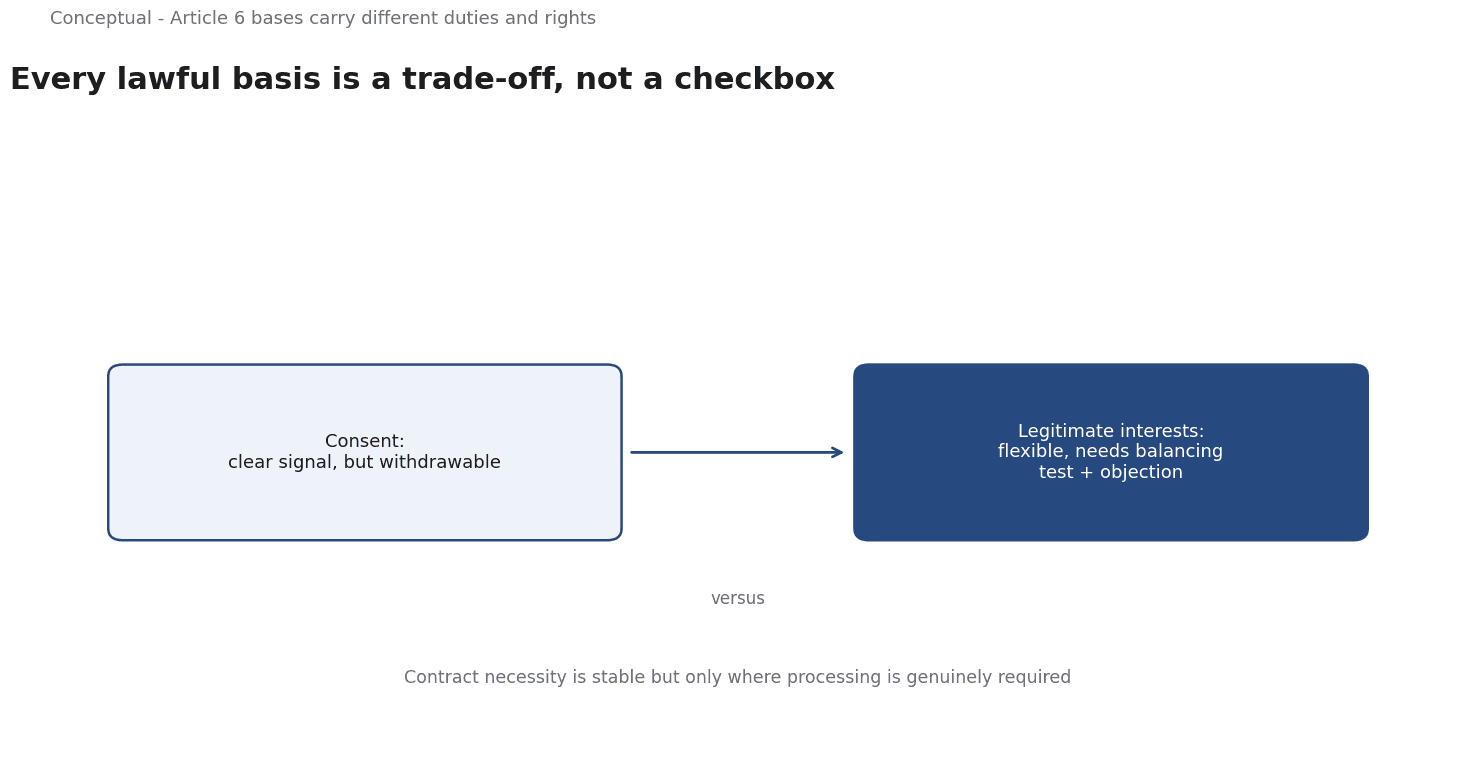
Article 6 lists the lawful bases: consent, necessity for a contract, compliance with a legal obligation, protection of vital interests, performance of a public task, and legitimate interests. Consent must be freely given, specific, informed, and unambiguous, and the article treats withdrawal as something that must be possible. Legitimate interests requires a balance against the rights of the individual and carries a right to object. Contract necessity is narrower than often assumed: it covers what is needed to perform a contract or take pre-contractual steps.
That difference is the trade-off. Consent gives a clear signal but is fragile because it can be withdrawn. Legitimate interests is more flexible but demands a documented balancing test and an objection path. Contract necessity is stable but applies only where processing is genuinely required. The basis belongs to a specific purpose and should be identified before processing begins. It also has to match the purpose as it is described to the person, not as it is labelled internally. Where one activity serves several purposes, each needs its own analysis. Neither source chooses a basis for a given product; that judgment stays local.
A worked example
The following is hypothetical and illustrative. An online retailer wants to use past purchase history to personalise product suggestions and to send marketing email. Three checks decide the compliance path. First, necessity: is the suggestion feature required to perform the purchase contract, or is it an optional extra? Second, balancing: if the retailer relies on legitimate interests for suggestions, has it recorded the balancing test and provided a way to object? Third, consent: for marketing email, is consent specific, separate from the terms of sale, and as easy to withdraw as to give? The review finds that suggestions are optional but low-risk, so the retailer records a legitimate-interests assessment with an opt-out, and uses separate consent for email. It also records which team owns each basis and sets a recheck for when the suggestion feature changes. The outcome is two documented bases, not one blanket notice.
Evidence status
| Claim | Status | Source | Verified | Recheck when |
|---|---|---|---|---|
| The GDPR sets principles, data subject rights and controller obligations | source-reported | GDPR Info, Legal Text | 2026-11-18 | The regulation or official guidance is amended |
| Article 6 lists six lawful bases including consent, contract and legitimate interests | source-reported | GDPR Info, Art. 6 | 2026-11-18 | The article text is amended |
| The chosen basis changes the rights and duties that follow for a purpose | inferred | Derived from the sources | 2026-11-18 | Supervisory guidance or case law changes |
The first two rows restate the regulation and Article 6 as reproduced by the source site, and they change only if those texts change. The third row is an inference about downstream consequences, not a sentence from the regulation. Because this source site reproduces legal text rather than issuing it, the first two rows should be rechecked against the official text when a decision carries real legal risk.
What it cannot do
Neither source decides which basis applies to a particular processing activity. That is a contextual legal judgment about purpose, necessity, and the rights of the people affected. A map can list the options and their consequences, but it cannot substitute for a decision made on the facts. A basis that looks defensible in the abstract can fail when the actual purpose is written down plainly. Teams should resist the temptation to treat the list as a menu from which any item can be chosen.
The hidden cost is documentation and ongoing handling. A legitimate-interests basis needs a recorded balancing test; a consent basis needs a way to capture, evidence, and withdraw consent; and data subject rights need workflows that can actually be fulfilled. Records of processing, impact assessments for higher-risk work, and request handling all take time. These costs are easy to omit from a launch plan because they do not appear in a product specification.
Consent applied to every purpose makes processing brittle, because withdrawal can stop it and because generic consent may not be specific. Legitimate interests applied to everything invites objections and weak balancing records. Contract necessity stretched beyond what a contract requires will not survive scrutiny. Mixed purposes usually need separate bases, and a single privacy notice cannot blur that distinction.
The boundary is in the authority of the sources. The site reproduces the regulation and provides article-by-article explanation, but it is not the issuing authority, and national implementing rules sit alongside the text. A team operating in more than one jurisdiction has to check local requirements that neither page settles. The trade-off map is also silent on security measures, breach handling, and transfers, which belong to other parts of the regulation.
Finally, the analysis needs review. Supervisory guidance and case law refine how the bases are read, and a new purpose can invalidate an earlier choice. Each basis should be recorded with its purpose, its balancing note where relevant, an owner, and a recheck condition. Without that record a future reviewer cannot tell why a basis was chosen or whether it still fits. Review is not optional even when the product is unchanged, because guidance evolves and a purpose can drift without anyone formally reclassifying it.
Counterargument: the claim that a narrow consent-first policy is fair for low-risk marketing is incomplete when processing is necessary to deliver a contracted service, where the contract basis fits better.
A decision test
- State the specific processing purpose.
- Test whether the processing is necessary to perform a contract.
- Consider each remaining Article 6 basis in turn.
- If relying on legitimate interests, record the balancing test.
- If relying on consent, make it specific and easy to withdraw.
- Map the data subject rights that follow from the chosen basis.
- Record the basis, its owner, and the condition that reopens the decision.
A lawful basis earns its place only when it is tied to a purpose and can be explained to a reviewer. The test turns a legal list into a sequence of decisions with evidence attached, so the reason for a choice survives staff changes. For further reading, see Responsible AI: Ethics, Fairness, and Regulatory Compliance.
References & Further Reading
- European Union, 2016. General Data Protection Regulation (GDPR) - Legal Text — Full text of the EU data protection regulation.
- GDPR Info, 2016. Art. 6 GDPR – Lawfulness of processing - General Data Protection Regulation (GDPR) — The lawful bases for processing personal data under GDPR.