Getting Started with Activation Emails
Activation emails turn a signup into a first action. Read the sequence behind them, a worked example, and why open rates cannot prove a message worked.
Activation emails are the messages a product sends to move a new user toward a first meaningful action. Email marketing is the broader practice of sending commercial messages to a list; A/B testing is the method for comparing two variants. The real problem is that onboarding sequences are often built from what is easy to send, so a new user receives a stream of messages that never connects to a specific first action.
Direct answer: Choose the first action, then build the shortest sequence that can produce it. The sources define email marketing and controlled comparison; mapping each message to an activation step is a synthesis. Start small, test one change at a time, and judge the sequence by the action it produces rather than by delivery statistics alone.
Delta: This article adds a claim-status table and a message-to-action decision test beyond the sources: it maps each email to a first-action decision, with claim status explicit.
The mechanism
Email marketing, as the source describes it, involves sending messages to a group of recipients, usually with a commercial or relationship purpose. A/B testing compares two versions of a variable to see which performs better under controlled conditions. The practical consequence is that a sequence can be designed as a series of tests rather than a fixed broadcast: each message is an attempt to move a user one step, and each variant tests one hypothesis about that step.
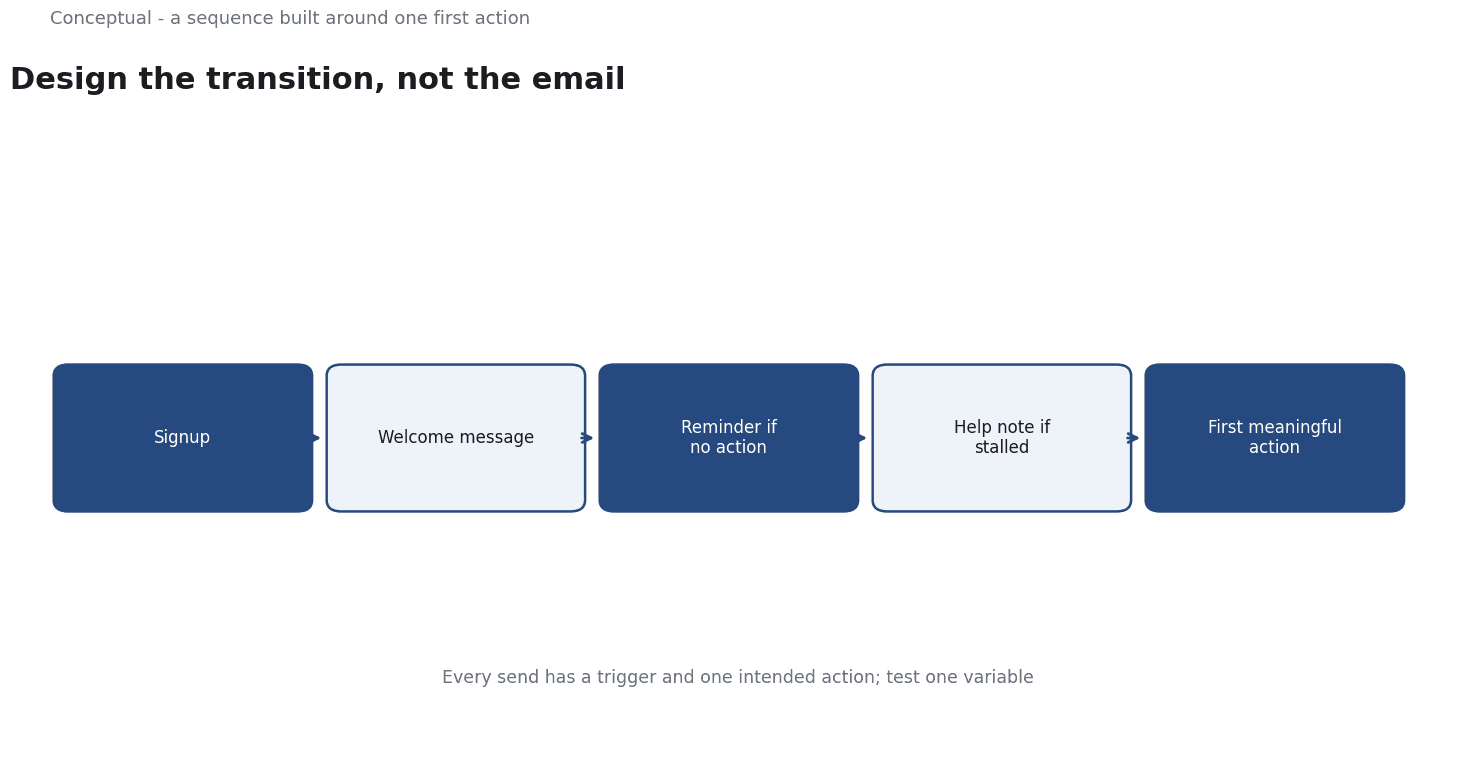
The sequence works by timing and relevance. A message sent immediately after signup can prompt the first action, while a later message can address a user who stalled. The consequence is that every send should have a trigger and an intended next step. Without a trigger, messages arrive regardless of context; without a next step, a message cannot be judged.
The unit of design is therefore not the email but the transition it is meant to cause.
The sources define email marketing and A/B testing; they do not prescribe an onboarding sequence or require that each message map to an action. That mapping is a synthesis and is marked inferred. The marker matters because it is a local design choice: another team might sequence messages differently. The claim here is that the mapping makes the sequence reviewable, not that the sources demand it.
The output of a careful design pass is a list of messages, each with a trigger, a single intended action, and a measure of whether that action occurred. That list is the decision instrument. Without it, review collapses into comparing open rates across unrelated emails, where context and timing differ too much for the numbers to mean much.
A worked example
The following is hypothetical and illustrative. A small product team builds an activation sequence for new signups. Three checks decide the review. First, does each message have a trigger tied to a user state, such as signup or a stalled first action? Second, does each message ask for one clear action rather than several? Third, when two variants are compared, is only one element changed so the result can be interpreted? The sequence shows a welcome message, a reminder for users who have not acted, and a help note for those who stall. A test changes only the subject line of the reminder. The outcome is a sequence whose messages can be judged against first-action rates. The users and rates are hypothetical; the verification method is the contribution.
Evidence status
| Claim | Status | Source | Verified | Recheck when |
|---|---|---|---|---|
| Email marketing sends messages to a group of recipients | source-reported | Wikipedia, Email marketing | 2026-11-18 | Definition revised |
| A/B testing compares two variants under controlled conditions | source-reported | Wikipedia, A/B testing | 2026-11-18 | Definition revised |
| Mapping each message to a first action makes a sequence reviewable | inferred | Derived from the sources | 2026-11-18 | Product onboarding changes |
The first two rows are factual claims drawn from the sources and should be rechecked when those entries change. The third is an inference about sequence design, because neither source describes onboarding practice. Recheck it when the product's first action or signup flow changes.
What it cannot do
Activation emails cannot rescue a product whose first action is unclear. If a new user does not understand what the product is for, more messages will not create that understanding. The sources describe email marketing and testing, not product clarity, so treating a sequence as a substitute for a coherent first-run experience is a category error. The email can invite an action; it cannot make the action meaningful once the user arrives.
The hidden cost is list hygiene and timing. Messages sent to unengaged recipients can train filters to deprioritize future mail, and a poorly timed reminder can arrive after the user has already acted or given up. The consequence is that a sequence needs maintenance: triggers must be checked, lists cleaned, and timing revised as behavior changes. The cost is paid in attention, not in the writing of a few messages.
A comparison that changes subject line, body, and timing together cannot tell which change produced the result. A/B testing, as the source describes it, depends on changing one variable, and a sequence that violates this produces numbers that cannot guide a decision. The format encourages the mistake because it is tempting to "improve" everything in a single send. Reviewers should insist on a single variable per test.
There is a boundary around what open and click rates can prove. An open can be triggered by automated systems, and a click does not guarantee that a user reached the intended action. These metrics are delivery signals, not proof of activation. The sources do not claim otherwise. Where the question is whether a user completed the first action, the product event is the more honest measure, and a reviewer should not accept an open rate as a stand-in.
Because products and behavior change, the mapping needs periodic review. Each message should carry a recheck condition tied to the action it serves, and a test should be rerun when the variable or the audience changes. Without that record, a future reviewer cannot tell which message was a deliberate step and which was inherited from an earlier sequence.
The counterargument that short onboarding sequences are fair for prompting a first action is incomplete when the product's first action is itself unclear.
A decision test
- Define the first meaningful action for a new user.
- Identify the user state that should trigger each message.
- Write one message per state, each asking for a single action.
- Choose one variable to test and hold the rest fixed.
- Measure the intended action, not just opens or clicks.
- Remove messages that do not map to an action or state.
- Record triggers, results, and a recheck date for each message.
A sequence is useful only when every message can be traced to a user state and an action. The test turns a broadcast habit into a set of decisions a reviewer can follow, so a weak message can be identified and changed without disturbing the rest. For further reading, see Voice of Customer: Turning Feedback into Decisions.
References & Further Reading
- Wikipedia contributors, 2026. Email marketing - Wikipedia — The mechanisms and measurement of email campaigns.
- Wikipedia contributors, 2026. A/B testing - Wikipedia — Controlled comparison of two variants.