Getting Started with AI Approval Gates
An approval gate should stop a real risk, not slow everything. Read where to place one, a worked example, and why a gate needs an owner.
An approval gate is a pause where a person must confirm an action before the system continues. Teams add gates to feel safe, which produces rubber stamps and delays when gates sit on low-risk steps, as the Anthropic agent guidance treats checkpoints as part of a design, as the NIST AI RMF frames trustworthiness as a property across the lifecycle, as Human in the Loop by Design: Overrides, Escalation, and Failure States argues for meaningful review.
Direct answer:
Place a gate where the action is high-impact, hard to reverse, or uncertain, and give the reviewer authority and information to decide.
Anthropic's agent guidance covers checkpoints, and the NIST AI RMF provides the governance frame. The boundary: a gate is a control, not a guarantee, which the publication standard forbids claiming, as the risk-assessment article requires residual risk, as the red-teaming article explains why untested failures remain.
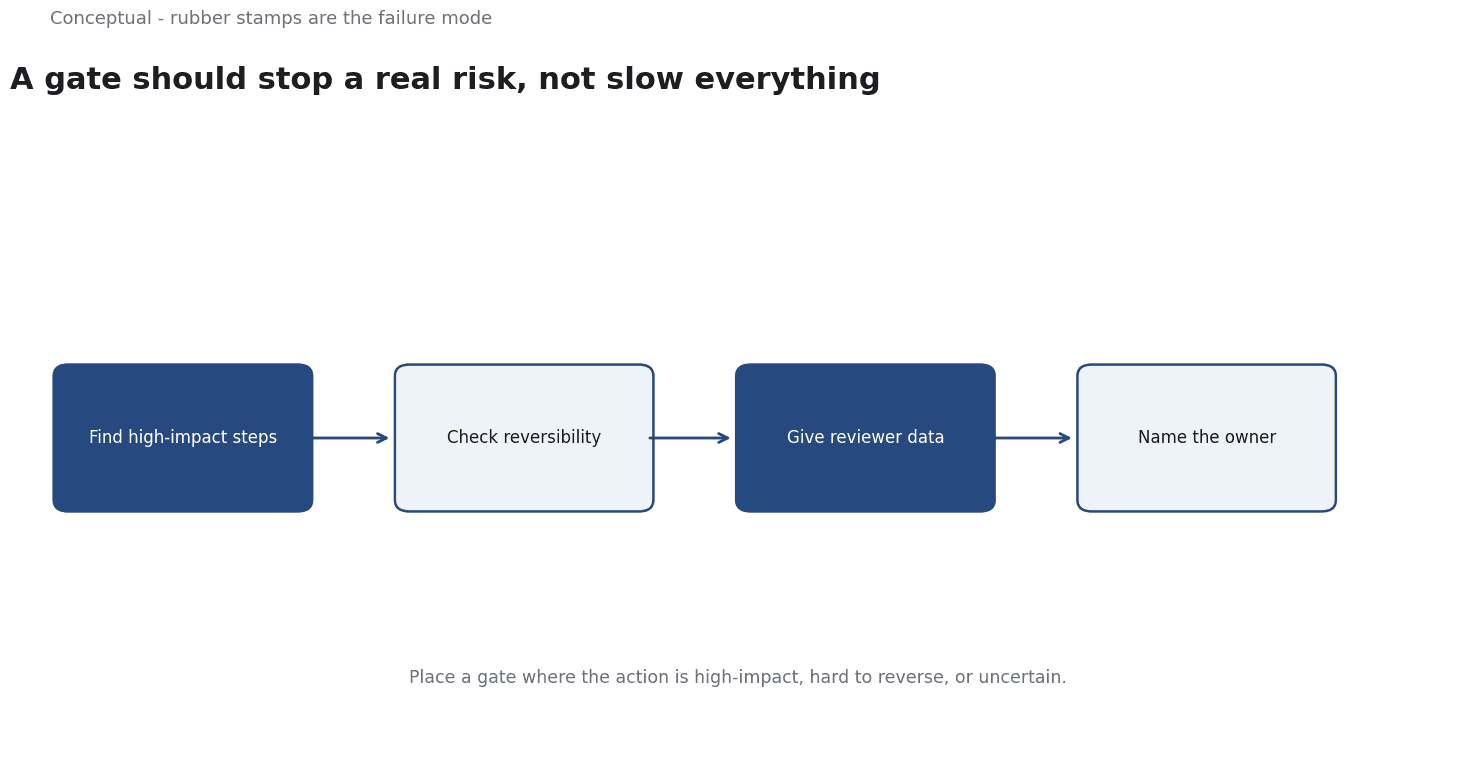
Where to place a gate
High-impact actions. Sending money, changing a record, or publishing externally, which the tool-calling article treats as an authorisation boundary, as the AI HR screening article treats hiring as a high-impact decision, as the legal article treats formal duties, as the risk-assessment article requires likelihood and impact.
Hard-to-reverse actions. A step whose effects cannot be undone, which the rollback article treats as a structural limit, as the decision-memo article requires a reversal condition, as the risk article requires residual risk to be stated.
Uncertain output. A low-confidence result that a model should not act on alone, which the hallucination article treats as a control problem, as the reduce-hallucinations article advises checks, as the agent guidance treats escalation as a tool.
A gate needs an owner. Someone accountable for the decision, which the governance checklist requires, as the decision-memo article requires for a recorded judgement, as the monitoring article treats as a review trigger.
Three consequences follow. Low-risk steps should not be gated, which the agent guidance advises for efficiency, as the small-team decision article argues for proportionality. The reviewer needs information, not just a button, as the explainability article argues for traces, as the decision-memo article requires for evidence. And the gate should be reviewed, as the monitoring article treats as a trigger, as the risk article requires residual risk.
A worked example
The following is hypothetical and illustrative. A support agent can draft a reply, read the knowledge base, and issue a refund.
Three checks decide where gates go. First, which actions are high-impact or hard to reverse, as the tool-calling and rollback articles ask, with the refund as the candidate, as the risk-assessment article requires for impact? Second, does the reviewer see the evidence — the policy citation and the refund details, as the legal-research and explainability articles advise, with a record, as the decision-memo article requires? Third, can low-risk steps run without a gate, as the agent guidance advises, with escalation for uncertainty, as Human in the Loop by Design: Overrides, Escalation, and Failure States recommends?
Three conclusions follow. The refund deserves a gate; the draft and search do not, which the impact check reveals. Review needs evidence, as the explainability and decision-memo articles advise. And the gate should be recorded with an owner, as the governance checklist requires.
What approval gates cannot do
They cannot guarantee a correct decision, which the publication standard forbids claiming, as the risk-assessment article requires residual risk, as the red-teaming article treats testing as partial. They do not remove the need for monitoring, which the observability article treats as evidence from a system, as the monitoring article advises. And they cannot fix a process with no accountable owner, which the governance checklist treats as a gap, as the small-team decision article advises.
The counterargument that every action should be gated is fair for safety and wrong about rates and attention, which the agent guidance advises, as Human in the Loop by Design: Overrides, Escalation, and Failure States argues for meaningful review, as the worked example shows.
A decision test
- Identify high-impact and hard-to-reverse actions, as the risk-assessment and rollback articles require.
- Gate those, not low-risk steps, as the agent guidance advises.
- Give the reviewer evidence and authority, as the explainability article advises.
- Assign an accountable owner, as the governance checklist requires.
- Record the decision, as the decision-memo article requires.
- Review after a tool or policy change, as the monitoring article advises.
- State residual risk, as the risk-assessment article requires.
For the design, see Human-in-the-Loop by Design; for the boundary, see Tool Calling Reliability.
References & Further Reading
- Anthropic, 2026. Building effective AI agents — Guidance on agent design including checkpoints and human oversight.
- NIST, 2023. AI Risk Management Framework | NIST — The governance framework referenced in AI risk and compliance work.