Getting Started with AI Document Extraction
Document extraction is a data-quality problem before it is an AI problem. Read the starting steps, a worked example, and why a confident wrong field is costly.
AI document extraction looks like a clean win: feed in invoices or forms, get structured fields out. The difficulty is that a plausible wrong field is worse than an obvious miss, because downstream systems act on it, which the structured-output article treats as a reliability problem, as the data-quality article warns about bad inputs, as How to Reduce Hallucinations in LLM Applications warns about confident invented detail.
Direct answer:
Start with a narrow document type, a defined schema, a measured baseline, and a human check on low-confidence fields.
Anthropic's use-case guides cover extraction patterns, and OpenAI's structured-output guide covers schema-enforced results. The boundary: this is educational orientation, not a guarantee — extraction accuracy depends on document quality and definition, which the data-governance article requires you to source and date, as the publication standard forbids guaranteed outcomes.
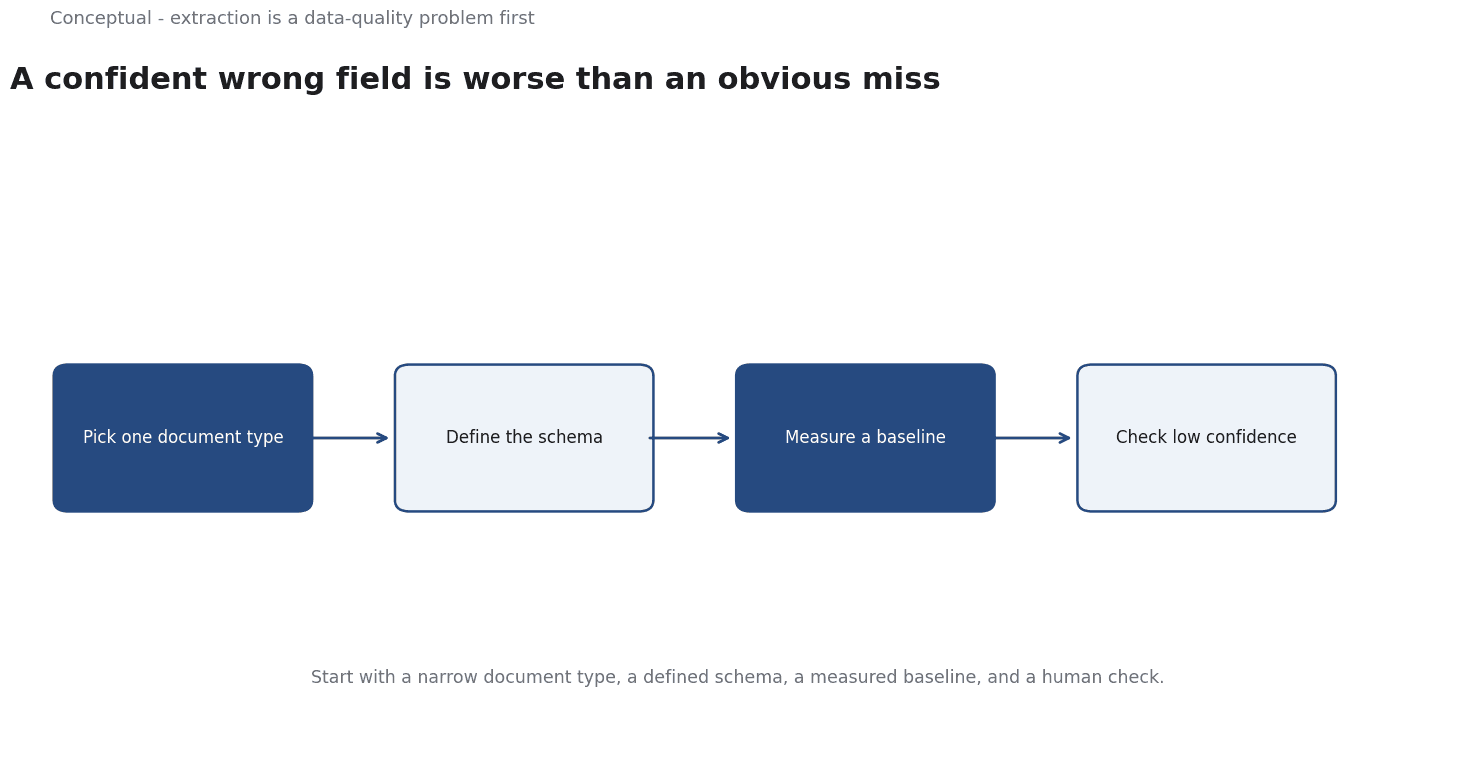
The starting steps
Define the fields. What exactly must be extracted, with what type and what rule, which the structured-output article requires for a schema, as the evaluation-rubric article demands for concrete criteria? A vague "extract the total" invites inconsistent results, as the data-governance article requires for a defined record.
Start with one document type. A narrow set makes errors visible, as the integration blueprint recommends for bounded experiments, as the evaluation article advises for a fixed test set.
Measure against a baseline. Have a labelled sample and score field-level accuracy, which the evaluation-rubric article requires, as the data-quality article advises for a quality bar, as the dashboard article argues for metrics tied to a decision.
Keep a human check. Route low-confidence or high-cost fields to a person, which the human-in-the-loop article treats as meaningful review, as How to Reduce Hallucinations in LLM Applications warns about confident wrong output, as the decision-memo article requires for a recorded judgement.
Three consequences follow. The schema is the contract, which the structured-output article advises, as the data-governance article requires for provenance. The field-level score matters more than a document-level average, as the evaluation-rubric article requires, as the risk article requires residual risk to be stated. And the process should be reviewed when document types change, as the monitoring article treats as a trigger.
A worked example
The following is hypothetical and illustrative. A team extracts totals and dates from a single invoice format.
Three checks decide the start. First, is each field defined with a type and a rule, as Structured Outputs: Common Questions requires, with a schema the system must follow, as the OpenAI guide describes? Second, is there a labelled sample and a field-level score, as the rubric article requires, as the data-quality article advises? Third, are low-confidence fields routed to a person, as the oversight article advises, with a record of the decision, as the decision-memo article requires?
Three conclusions follow. A schema makes the output testable, which the structured-output article argues. Field-level accuracy reveals which fields need a human, as the evaluation-rubric article advises. And the design should be reviewed after a format change, as the monitoring article recommends.
What document extraction cannot do
It cannot create information missing from the document, which the data-quality article treats as an upstream problem, as How to Reduce Hallucinations in LLM Applications warns about invented detail. It does not remove the need for a human check on high-cost fields, which the oversight article treats as meaningful review, as the decision-memo article requires. And it cannot guarantee accuracy across new formats, which the benchmarks article warns about, as the publication standard forbids guaranteed outcomes.
The counterargument that extraction is fully solved by a model is fair on clean, defined formats and incomplete where documents vary or fields are ambiguous, which the worked example shows, as the data-quality and hallucination articles advise.
A decision test
- Define each field with a type and rule, as Structured Outputs: Common Questions requires.
- Start with one document type, as the integration blueprint recommends.
- Build a labelled sample, as the evaluation-rubric article requires.
- Score field-level accuracy, as the rubric article requires.
- Route low-confidence fields to a person, as the oversight article advises.
- Source and date any relied-upon records, as the data-governance article requires.
- Record the decision and review on format change, as the decision-memo article requires.
For the output contract, see Structured Outputs; for the failure mode, see Reducing Hallucinations.
References & Further Reading
- Anthropic, 2026. Guides to common use cases - Claude Platform Docs — Production use-case guides for ticket routing, customer support agents, content moderation, legal summarization and commerce agents.
- OpenAI, 2026. Structured model outputs | OpenAI API — The official guide to constrained decoding and schema-enforced model outputs.