Getting Started with AI for Energy
AI is used across energy systems, from forecasting to grid operations. Read where it fits, a worked example, and the physical limits.
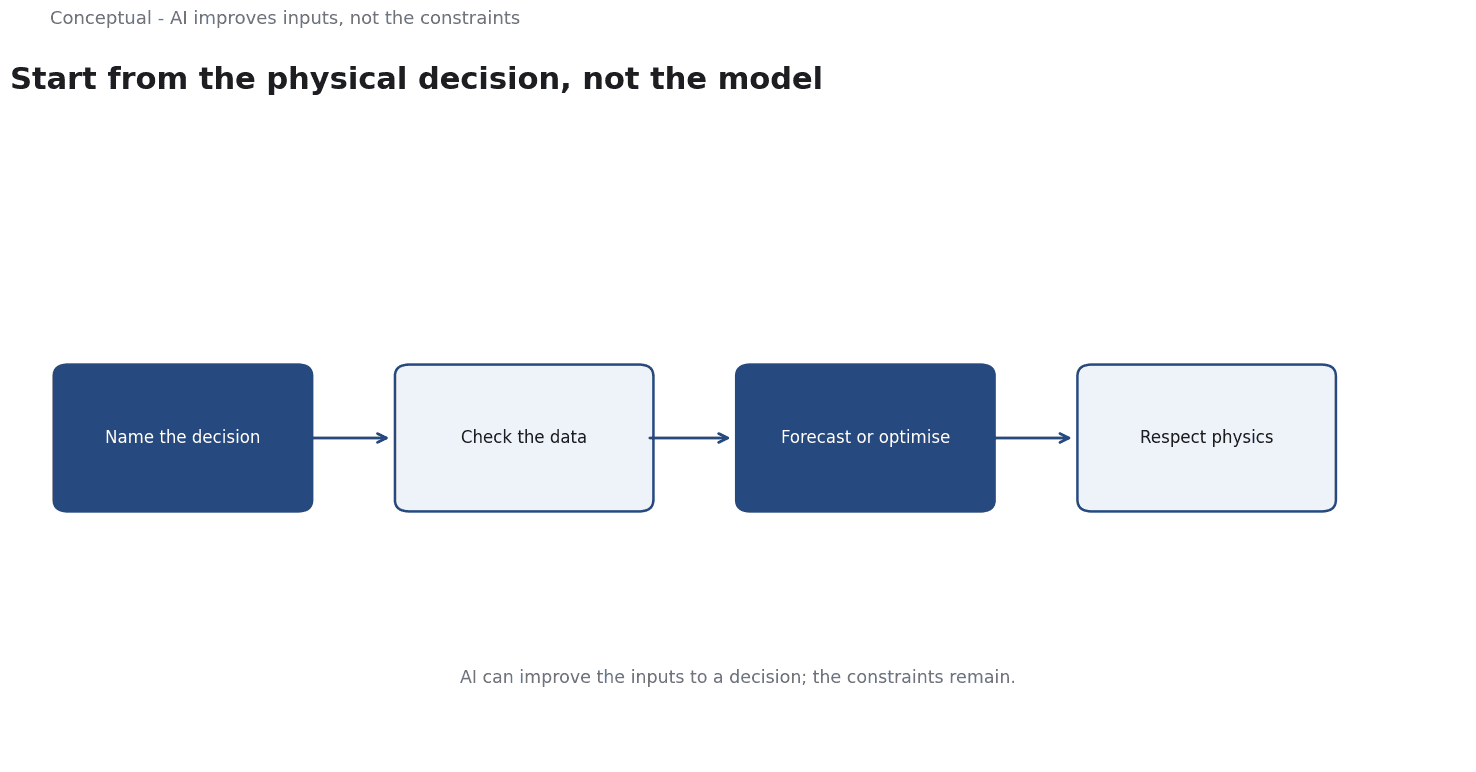
AI in energy is often discussed as a single thing, which hides the range of tasks: forecasting demand, predicting equipment failure, optimising a grid, or estimating the electricity use of data centres. The useful starting point is the physical system and the decision that needs improving, not the model.
Direct answer: Apply AI where a decision has a measurable physical consequence and the data exists to support it — forecasting, maintenance, or operations. The IEA's energy reports provide primary context on demand and data-centre use, and the time-series article covers forecasting methods. The boundary: a model cannot change physics or supply constraints, which the energy-markets article explains for price and inventory, and a forecast is conditional, as the valuation literature treats any projection.
Where it fits
Forecasting. Demand, renewable output, and equipment loads are time-series problems, which the time-series article covers for method and validation. A forecast should be scored against a naive baseline, as the forecasting article recommends, because a complex model that loses to persistence is not useful.
Maintenance. Predicting failure in turbines, transformers, or pumps is anomaly detection with a physical consequence, which the anomaly-detection article describes for estimator families. The metric is avoided downtime, not model accuracy, as the evaluation-rubric article argues for outcome measures.
Operations. Grid balancing and dispatch are optimisation problems under physical constraints, which the energy-markets article explains for supply and demand.
AI can improve the inputs to a decision; the constraints remain, as the causal-inference article treats model output as different from a physical guarantee.
Data-centre demand. The IEA reports on electricity use for AI infrastructure, which the data-centre electricity article covers for how to read such forecasts honestly. This is a demand-side consequence of AI rather than an application of it, and the distinction matters.
A worked example
The following is hypothetical and illustrative. A utility wants to forecast next-day demand for a region to improve scheduling.
Three checks decide whether a model helps. First, baseline: does the model beat a seasonal-naive forecast on a time-ordered holdout, as the time-series article requires? Second, consequence: does a better forecast reduce reserve capacity or fuel cost, which the energy-markets article treats as the physical and economic outcome? Third, failure mode: what happens on an extreme weather day when the training data has few examples, which the anomaly-detection article treats as tail risk?
Three conclusions follow. The model is judged by a physical outcome, as How Energy Markets Actually Work advises. A holdout that respects chronology is required, which the cross-validation guidance in the time-series article specifies. And the forecast should be labelled conditional, as the valuation article recommends for any projection with assumptions.
Reading the IEA material honestly
The International Energy Agency publishes scenarios, not forecasts in the ordinary sense, and the difference matters when an energy decision depends on them. A scenario states a set of assumptions about policy, technology, and demand, then shows what follows if those assumptions hold, which the forecasting article treats as a conditional claim.
The data-centre electricity article explains this discipline in detail: check the base year, the scenario, and the geography, then ask whether the number describes current use or a projected path. It also distinguishes the electricity consumed by AI infrastructure from the electricity AI might help save elsewhere, which are different questions that are often combined in a single headline. A clear article on AI for energy should keep them separate, as the causal-inference article warns about treating association as effect.
For a practitioner, the useful output of the IEA material is a boundary on the physical system, not a market forecast. It tells you what constraints are likely to matter, as How Energy Markets Actually Work advises for reading supply and demand, and which assumptions to test in your own model, as the scenario-analysis article recommends for consequential decisions.
What AI for energy cannot do
It cannot create generation capacity or change the fuel mix, which the energy-markets article treats as physical constraints. It cannot eliminate uncertainty in weather or demand, which the forecasting article frames as conditional. And it does not make a forecast into a decision — grid operations have rules and human oversight, which the human-in-the-loop article argues for high-impact systems.
The counterargument that optimisation will solve the energy transition is too strong.
It can improve the use of existing assets, which the IEA context supports, but the physical build remains a separate question, as the data-centre electricity article warns about reading forecasts honestly.
A decision test
- Identify the physical decision and its outcome, as How Energy Markets Actually Work advises.
- Check that the data exists and is dated, as the data-governance article requires.
- Compare with a naive baseline on a time-ordered holdout, as the time-series article requires.
- Measure the physical consequence, not model accuracy, as the evaluation-rubric article advises.
- Test tail conditions such as extreme weather, as the anomaly-detection article recommends.
- Keep human oversight for high-impact operations, as the oversight article requires.
- Read IEA forecasts with dates and assumptions, as the data-centre electricity article advises.
For the physical context, see How Energy Markets Actually Work; for the forecast caveat, see Data Centre Electricity.
References & Further Reading
- International Energy Agency, 2025. Energy and AI: Data Centres and Electricity Demand — Primary data on how data-centre electricity demand is growing and what that implies for energy markets.
- International Energy Agency, 2026. Electricity — Global electricity demand and capacity outlook.