Getting Started with Compound Interest
Compound interest is usually quoted nominally, which hides inflation. Read the nominal-to-real map, a worked example, and where compounding misleads.
Compound interest is often described as a powerful force, but the headline number is almost always nominal. A rate that looks generous can lose much of its meaning once the prices of everyday goods rise. The sources define compounding and inflation separately and never place them side by side. The real problem is judging what compounding actually does to purchasing power.
Direct answer: Compound interest is interest earned on both the principal and the interest already accumulated, so a balance grows on a growing base. Wikipedia defines that mechanism, and Wikipedia's inflation entry defines the rise in prices and fall in purchasing power that erodes it. The practical step is to compare the compounding rate with inflation so the decision rests on real rather than nominal growth.
Delta: This article adds a nominal-to-real decision map beyond the sources: it maps a compounding rate to a real return and a decision, with claim status explicit.
The mechanism
Wikipedia describes compound interest as interest calculated on the initial principal and also on the interest accumulated from previous periods, sometimes summarized as interest on interest. The standard expression relates the final amount to the principal, the rate, the number of compounding periods, and the time held. The practical consequence is that growth accelerates, because each period's interest is computed on an increasingly larger base. Rate and time therefore dominate the outcome, and a small difference in either can widen considerably over a long horizon.
Wikipedia describes inflation as a general increase in prices and a corresponding fall in the purchasing power of money, typically measured through a price index. The consequence for a saver or borrower is easy to state and easy to ignore: a balance can grow in nominal terms while the goods it can buy shrink. The number in the account is not the number that matters for decisions. What matters is the change in real terms, after the general rise in prices is taken into account.
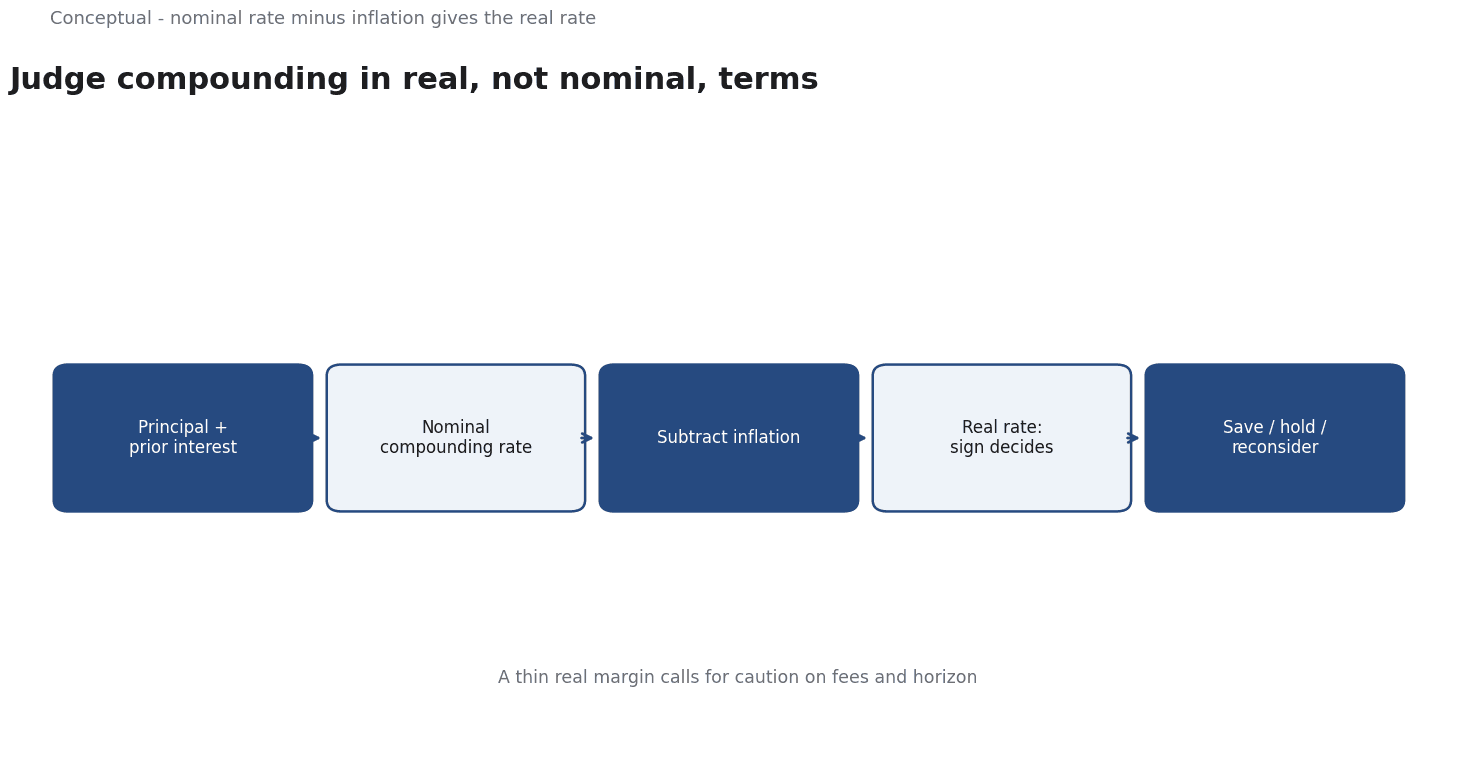
The nominal-to-real map is built by placing the two definitions together.
A reasonable first-order estimate of the real rate is the nominal compounding rate minus the inflation rate, with the sign of the result indicating whether purchasing power grows or shrinks.
That step is a synthesis drawn from the two sources rather than a figure either one supplies, so it is marked inferred. The sign then points to a decision: a positive real rate supports saving or holding the position, a negative one argues for reconsidering, and a thin margin calls for caution about fees and time horizon.
The map also keeps the role of time and compounding frequency visible. The sources give the mechanism but no target rate, no investment product, and no horizon to use. Those are local choices, and the map works by making them explicit rather than by answering them. A reader can record the nominal rate, the inflation assumption, and the horizon, then revisit each when conditions change. The discipline is to treat the estimate as revisable input to a decision, not as a forecast that settles the matter.
A worked example
The following is hypothetical and illustrative. A saver compares an account whose interest compounds at a stated nominal rate against a period of observed inflation, with no actual figures supplied. Three checks frame the comparison. First, mechanism: is interest earned on prior interest so that the balance grows on a growing base? Second, real comparison: does the nominal rate exceed inflation, leaving positive real growth after the general rise in prices? Third, horizon: is the money left in place long enough for compounding to matter rather than being withdrawn early? The comparison shows a modest positive real margin and a horizon long enough for growth to accumulate. The outcome is a decision to keep the position and revisit it if inflation rises toward the rate. The scenario illustrates the method, not an investment recommendation.
Evidence status
| Claim | Status | Source | Verified | Recheck when |
|---|---|---|---|---|
| Compound interest is interest on principal plus accumulated interest | source-reported | Wikipedia, Compound interest | 2026-11-18 | The entry is revised |
| Inflation is a rise in prices and a fall in purchasing power | source-reported | Wikipedia, Inflation | 2026-11-18 | The entry is revised |
| A nominal compounding rate should be judged against inflation to see real growth | inferred | Derived from the sources | 2026-11-18 | Inflation or rates change materially |
The first two rows are definition-level claims taken directly from the sources and remain stable until those entries change. The third is an inference about how to use the two definitions together; neither source endorses a particular decision rule. It is the row to revisit when inflation or rates move materially, because the sign of the real rate can flip. Readers should treat the table as a snapshot tied to the verification date.
What it cannot do
The sources define mechanisms, not advice. Neither the compounding entry nor the inflation entry recommends a rate, a product, or a course of action for any individual. A reader who expects a verdict on whether to save or borrow will not find one there. The nominal-to-real map is a way of organizing the two definitions for a decision, but the decision still depends on circumstances the sources do not describe, such as goals, access to money, and tolerance for loss.
There is a hidden cost that compounding encourages people to overlook. Growth on a growing base rewards time and consistency, which means early withdrawals, fees, and gaps in contribution interrupt the process in ways a headline rate hides. Inflation and taxes reduce the real return further, and a nominal figure that ignores them overstates what a saver will actually be able to buy. The cost is not a flaw in the arithmetic but a gap between the arithmetic and the lived outcome, and it is paid quietly over a long horizon.
A larger number feels better and is easier to compare across products, so it draws attention away from inflation, fees, and compounding frequency. The same bias works in reverse for borrowing, where a low advertised rate can conceal a high real cost or a short term. The map counters this by forcing the inflation assumption into the open, but only if the reader actually records it rather than leaving it implicit.
There is a clear boundary around the method. The compounding expression assumes reinvestment and a rate that can be treated as stable over the period considered, while real rates vary and price indices are estimates of a broad basket rather than of any one person's spending. Compounding has little effect over very short horizons, so the mechanism matters most for long-term positions. For borrowing, the same arithmetic works against the borrower, and a positive real rate for a saver is a cost for a debtor. The map does not resolve these cases on its own.
Because the inputs move, the comparison needs periodic review. An inflation assumption that was reasonable at one point can drift, and a rate that was competitive can fall behind. Each input should carry a recheck condition, and the real-rate estimate should be recalculated when inflation or rates change materially. Without that habit, a reader keeps acting on a margin that no longer exists, which is the precise error the nominal-to-real map was built to prevent.
Counterargument: the claim that subtracting inflation clarifies compounding is fair for a long-horizon saver and incomplete for short horizons or tactical decisions, where the nominal amount available on a specific date may matter more than the real trend.
A decision test
- State the nominal rate and the compounding frequency of the balance in question.
- State the inflation assumption and the source or basis it rests on.
- Estimate the real rate by comparing the nominal rate with inflation.
- Check the sign to see whether purchasing power grows or shrinks.
- Check the horizon to confirm compounding has time to matter.
- Account for frictions such as fees, taxes, or early access that reduce the real result.
- Set a recheck condition to revisit the estimate when inflation or rates change.
A compounding calculation is useful only when its inputs are owned and revisited. The test turns a headline rate into a real-rate decision with a visible sign, a horizon, and a review point, so a reader can see what the estimate rests on. That is the difference between reacting to a nominal number and understanding what it buys.
For further reading, see Cash Flow Forecasting.
References & Further Reading
- Wikipedia contributors, 2026. Compound interest - Wikipedia — Interest calculated on principal plus prior interest.
- Wikipedia contributors, 2026. Inflation - Wikipedia — The definition of inflation, its measurement and its effect on nominal versus real quantities; secondary reference.