Getting Started with Creative Testing
A creative test compares messages, not just formats. Read where to start, a worked example, and why more variants can mean less learning.
Creative testing is often treated as producing many variants, which can dilute the learning. The A/B-testing entry describes controlled comparison, and the marketing-communications entry covers how messages are received. The starting point is the claim being tested.
Direct answer:
Test one claim at a time against a defined outcome, with enough sample to distinguish a real effect.
The sources describe the method and reception; the rule is a synthesis.
Delta: This article adds a claim-status table and a worked example, separating documented comparison method from local choices about what to test.
The mechanism
The first point is the hypothesis. The A/B-testing entry describes comparing variants under controlled conditions, which requires knowing what differs between them. A test with five changes at once cannot say which one worked, and the result cannot guide the next version.
The second point is the outcome. The marketing-communications entry treats a message as something received, which means the measure should reflect understanding or action, not only a click. A claim that increases clicks while reducing trust is a loss, and a single metric will not show it.
The third point is sample. A test with too few observations will produce a winner by chance, which is a limit of comparison rather than a property of the creative. Estimating the required sample before launching is the control.
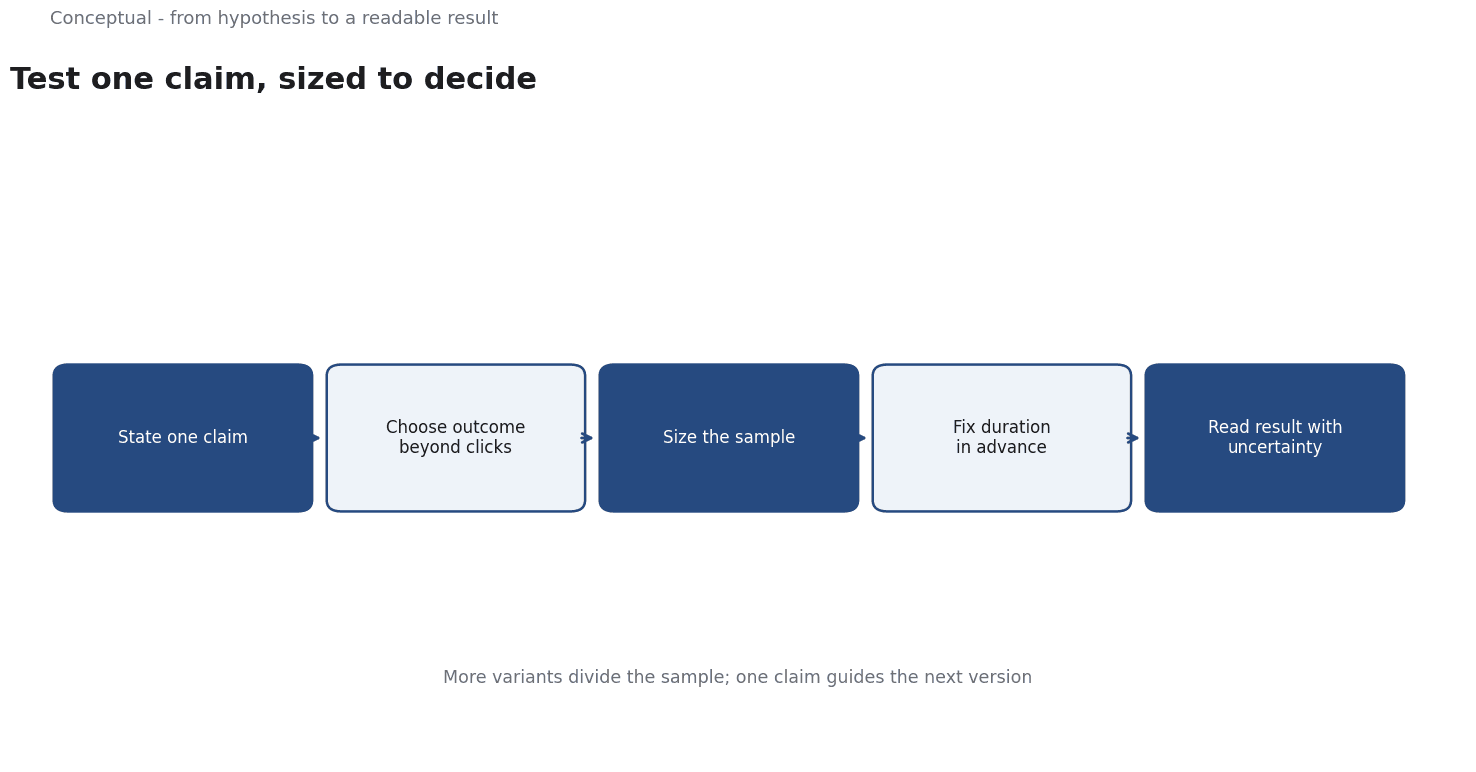
The sequence is: state the claim, choose the outcome, size the test, then read the result with its uncertainty. The choices are local, so the conclusions are inferred; the method is source-reported.
A worked example
Illustrative. A team tests a new headline and a new image at the same time.
Three checks decide. First, can the result be attributed to one change, or were two introduced together? Second, does the outcome measure what the campaign exists for, rather than an intermediate signal? Third, is the sample large enough that a small difference is meaningful?
The outcome is a narrower test with a readable result. The scenario is hypothetical; the method is the contribution.
Evidence status
| Claim | Status | Source | Verified | Recheck when |
|---|---|---|---|---|
| A/B testing is a controlled comparison | source-reported | Wikipedia, A/B testing | 2026-11-18 | Method changes |
| Messages are received by an audience | source-reported | Wikipedia, Marketing communications | 2026-11-18 | Practice changes |
| Test one claim with a sized sample | inferred | Derived from both | 2026-11-18 | Goals change |
Why more variants can help less
Each additional variant divides the available sample, which makes it harder to detect a real difference. A small number of focused tests produces clearer learning than a large test that finishes with noise, which is the reason to start narrow.
A further consideration is where the test runs. A creative that works in one placement may not work in another, because the audience and the frame differ. Testing in the conditions of intended use is part of the design, not a detail to address after launch.
The test also needs a stopping rule. Checking the result repeatedly and stopping when it looks favourable produces a false positive, which is a known property of repeated looks. Setting the duration in advance is the control, and it belongs in the record.
The third limitation is that a winning creative can decay. A message that stands out at first becomes familiar, and the effect falls over time. Reviewing the winner after a period is the way to notice, rather than assuming the first result is permanent.
Checking a result repeatedly and stopping when it looks favourable produces a false positive.
A winning creative can decay as it becomes familiar, which is why the first result is not permanent.
The duration should be fixed before launch, since an early stop favours a false positive.
A test in one placement may not transfer to another, which is why the conditions of use belong in the design.
One claim at a time is the only way a result can guide the next version.
The outcome should reflect the decision the campaign exists to change.
A small focus produces clearer learning than a large comparison with no power.
A decision test
- State the claim being tested.
- Choose an outcome measure.
- Change one thing at a time.
- Size the sample.
- Set the duration in advance.
- Record the result and recheck condition.
For the comparison method, see Subject Line Testing.
A counterargument
A reasonable critic could object that the article's "one claim at a time" rule is stricter than the sources it cites support.
The A/B-testing entry describes controlled comparison of two variants, and the marketing-communications entry treats messages as coordinated across channels - yet neither establishes that isolating a single claim is the only way to learn, and the article marks that prescription inferred in its own table. A critic could add that audiences receive messages in combination, so a finding about one isolated headline may not describe how the creative performs in the coordinated campaign the second source describes. The method produces cleaner attribution; calling it the only defensible approach - when placement dependence and winner decay are acknowledged limitations - overstates what controlled comparison alone can deliver.
References & Further Reading
- Wikipedia contributors, 2026. A/B testing - Wikipedia — Controlled comparison of two variants.
- Wikipedia contributors, 2026. Marketing communications - Wikipedia — The coordination of messages across channels and the distinction between consistent and identical communication.