Getting Started with Engineering Management
Engineering management is a set of decisions, not a title. Read the responsibility map, a worked example, and where the role can quietly fail.
A new engineering manager is often promoted for technical skill and then handed a role nobody has defined. The sources describe the field and the occupation, but neither tells a first-time manager which decisions are now theirs. The real problem is turning a broad job description into a set of decisions with clear owners and a repeatable cadence.
Direct answer: Engineering management is the application of management principles to engineering work, and in practice it shows up as decisions about planning, coordination, and direction. Wikipedia frames the field as a blend of engineering and management, while O*NET describes the tasks, skills, and work activities attached to management occupations. Reading the role as a decision set, rather than as a title, is what makes it actionable.
Delta: This article adds a responsibility-to-decision map beyond the sources: it maps each management duty to a decision the manager owns, with claim status explicit.
The mechanism
Wikipedia describes engineering management as a discipline that applies management principles to engineering activities. The field sits between technical work and organizational direction, covering the planning, coordination, and direction of engineering projects and of the people who carry them out.
The practical consequence is that the manager's output is not a thing they build but the quality of the decisions they make about work and people.
A first-time manager who expects the role to be a more senior version of engineering will misread what is actually being asked of them.
O*NET approaches the topic from the occupation side. It catalogs tasks, skills, work activities, and technology skills for management roles, offering a structured vocabulary of what people in those jobs do. That vocabulary is useful precisely because it is generic: it names responsibilities without prescribing any local process. The consequence is that a manager can use it to inventory duties, but must translate each duty into a concrete decision before it becomes useful. A list of tasks is not the same thing as a role.
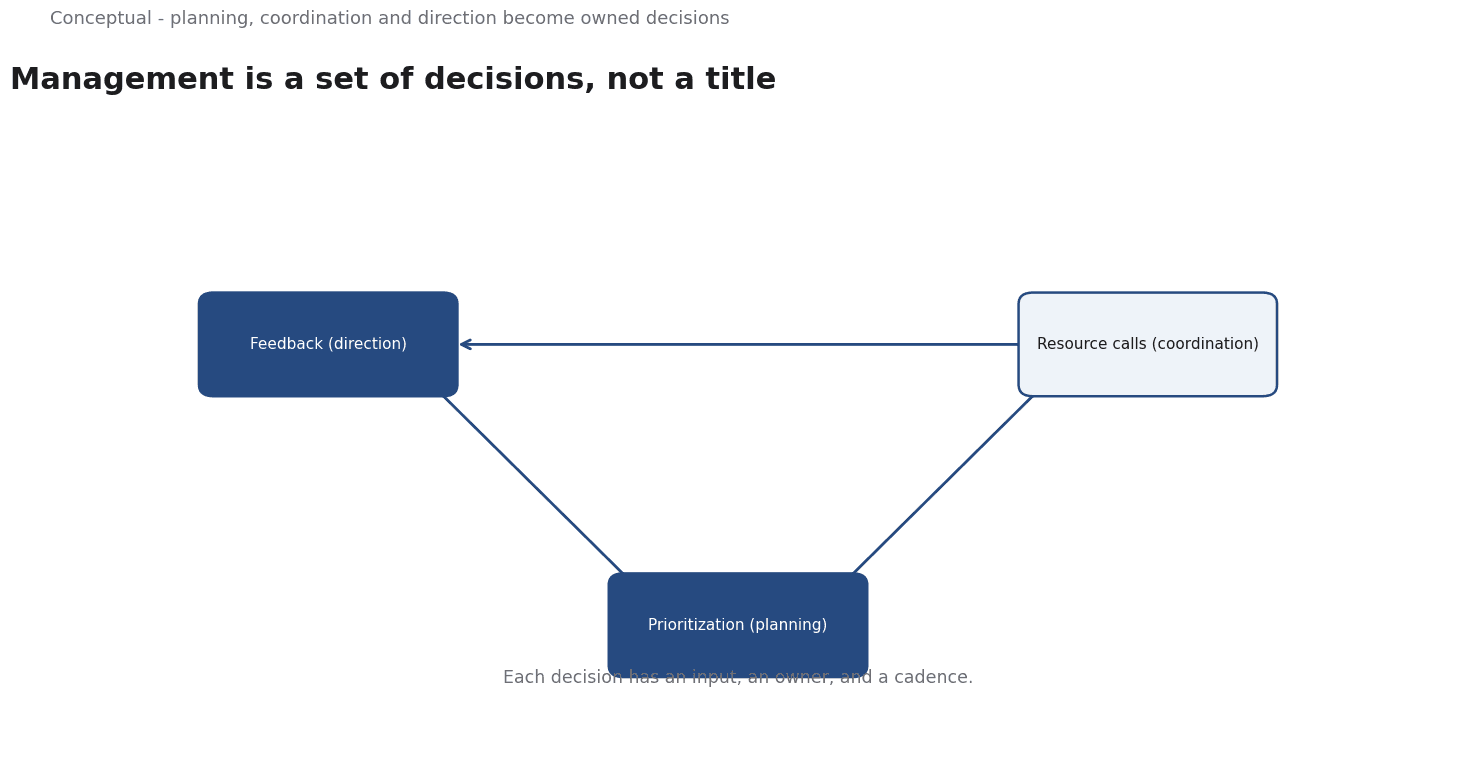
The translation step is where a working map gets built. Planning becomes a prioritization decision: what the team works on next and in what order. Coordination becomes a resource decision: who owns which piece and what they need to finish it. Direction becomes a performance and feedback decision: what good looks like and how it gets reinforced. Each decision has an input, an owner, and a cadence. This map is a synthesis drawn from the two sources, not a claim either one makes, and it should be treated as inferred rather than reported.
Once the decisions are named, the role becomes a recurring cycle rather than a fixed job description. Weekly prioritization, periodic one-to-one feedback, and event-driven resource decisions each have a place. The value is that every decision can be reviewed: a manager can ask which input was used, who owned the call, and whether the cadence still fits the work. Time shifts from doing technical tasks to making the conditions for good technical work, and that shift is the real substance of getting started in the role.
A worked example
The following is hypothetical and illustrative. An engineer is promoted to manage a small platform team and inherits a vague remit to lead the group. Three checks structure the first month. First, responsibility inventory: the manager lists the duties the sources describe, planning, coordination, and direction, and writes one line on what each means locally. Second, decision mapping: for each duty, the manager names a decision, an input, and a cadence, discovering that prioritization currently happens ad hoc with no clear owner. Third, delegation boundary: the manager marks which technical choices stay with engineers and which rise to the manager. The outcome is a rewrite of the remit into a weekly prioritization decision with a named owner, a monthly feedback cycle, and an explicit escalation line. The map is a diagnostic, not a verdict on the manager's ability.
Evidence status
| Claim | Status | Source | Verified | Recheck when |
|---|---|---|---|---|
| Engineering management applies management principles to engineering work | source-reported | Wikipedia, Engineering management | 2026-11-18 | The entry is revised |
| O*NET catalogs tasks, skills and work activities for management occupations | source-reported | O*NET OnLine | 2026-11-18 | Occupation data is updated |
| Mapping each duty to a named decision clarifies a new manager's role | inferred | Derived from the sources | 2026-11-18 | Role outcomes do not improve |
The first two rows are drawn directly from the sources and stay stable until those entries change. The third is an inference about practice, not a statement either source makes. It is the row to revisit first, because it depends on local behavior rather than on a fixed definition. Readers should treat the table as a snapshot tied to the verification date, not as a permanent conclusion.
What it cannot do
The sources describe a field and an occupation in general terms; they do not prescribe how a manager should behave in a particular team. What counts as good planning in one organization may be wrong in another. A responsibility-to-decision map is a translation aid, and a translation can be wrong. The manager still has to supply the context the sources leave out, including the team's norms, the product's constraints, and the organization's politics. Treating a generic duty list as a complete job description is possibly the first mistake a new manager can make.
There is a real hidden cost in the role itself. Management trades the direct satisfaction of building things for work that is mediated through other people. A significant share of the time goes to coordination, feedback, and unblocking, and that time produces no artifact the manager can point to. Hands-on technical skill also decays when it is not practiced. This cost is not a flaw to be eliminated but a trade to be acknowledged, and a manager who refuses to pay it will keep reaching for technical tasks that no longer belong to them.
When a project slips, the manager steps in and does the technical work personally, which feels productive and quietly starves the team of ownership. This is worse than a slow project, because it teaches the team that decisions will be taken back and that waiting is safer than acting. The map only helps if the manager holds the line on delegation when it is uncomfortable to do so.
There is also a boundary around what the sources cover. Neither a general description nor an occupation database prescribes a leadership style, a span of control, or an organizational structure. Those are local design choices, and no source can make them for a manager. The entries are also snapshots as of the verification date; occupations and management practice evolve, and a duty list that is accurate today may be incomplete later. A manager should expect to revise the map rather than inherit it finished.
Finally, the map needs periodic review because the work changes. A decision that belonged to the manager last quarter may be ready to delegate, and a new project may introduce a decision nobody has assigned. Without a scheduled revisit, the map hardens into the same vague remit it was meant to replace. A named owner, a recheck condition, and a date keep the role alive as a working instrument rather than a one-time exercise that gets filed away.
Counterargument: the claim that a decision map adds clarity is fair for a new manager facing a vague remit and incomplete for a mature team, where tacit norms already carry much of the role without any written map.
A decision test
- Inventory the duties using the field description and the occupation tasks.
- Name one decision for each duty, such as prioritization or feedback.
- Assign an input to every decision so the basis for the call is visible.
- Set a cadence, separating weekly, monthly, and event-driven decisions.
- Draw a delegation line marking which technical choices stay with engineers.
- Name an owner for each decision, including the ones the manager keeps.
- Schedule a review with a recheck condition for when the map should change.
A map earns its place only if it changes at least one decision. If writing it down never shifts who prioritizes or who owns a call, the exercise is paperwork. The test above is designed to keep each row answerable, so a manager can point to the input, the owner, and the cadence behind a decision. That is the difference between a role that is understood and one that is merely titled.
For further reading, see Decision Memos.
References & Further Reading
- Wikipedia contributors, 2026. Engineering management - Wikipedia — Management of engineering teams and projects.
- U.S. Department of Labor, 2026. O*NET OnLine — The standard occupational taxonomy used to compare roles across industries.