Getting Started with Estate Planning
Estate planning is a set of documents and decisions about incapacity and transfer. Read the essentials, a worked example, and the legal limits.
Estate planning is usually framed as something wealthy people do with a lawyer. The essentials — who makes decisions if you cannot, and who receives what if you die — apply to almost everyone, and doing nothing is itself a decision under the law. The first step is to name the decisions rather than buy a product.
Direct answer:
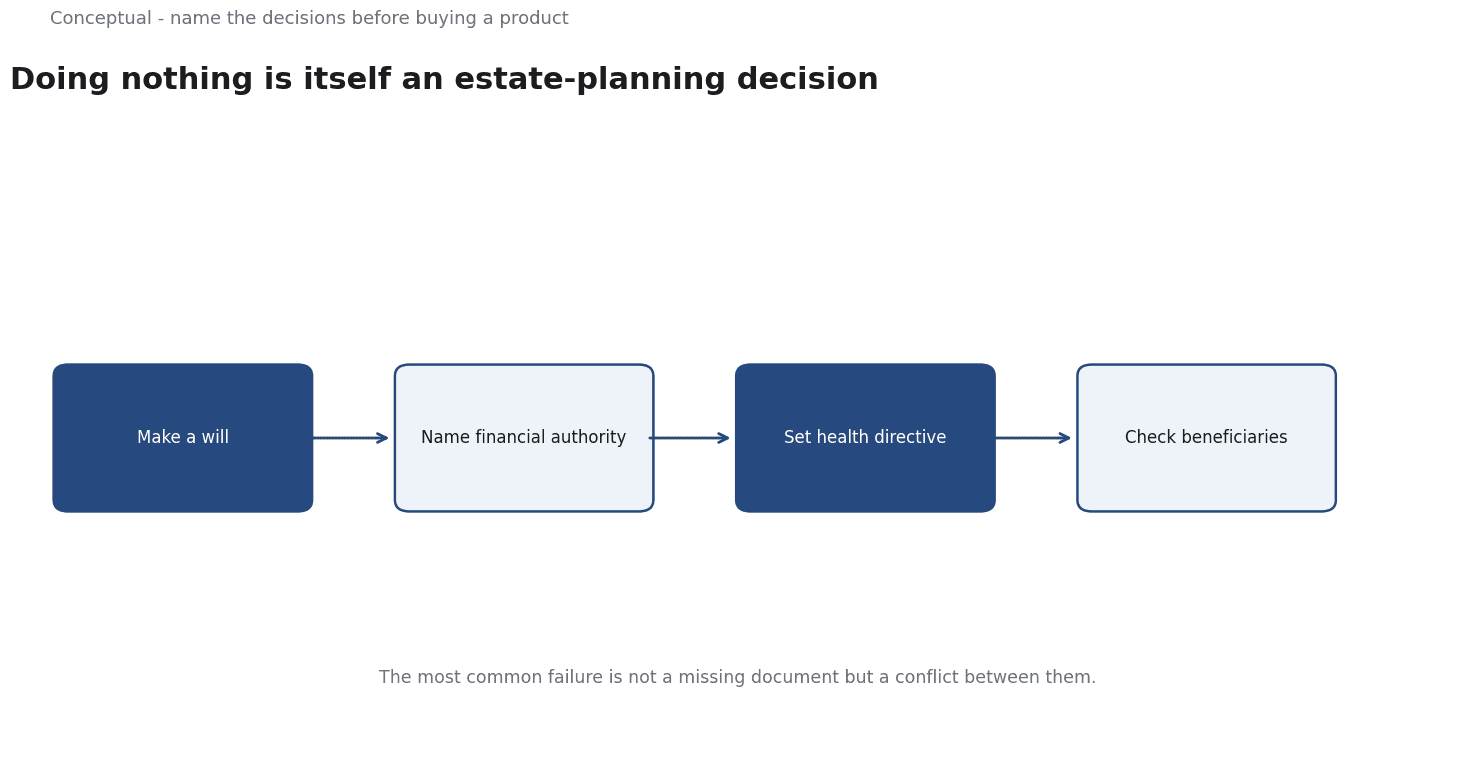
Start with a will, a power of attorney for finances, a health-care directive, and a review of beneficiary designations, then consider trusts if the situation warrants them.
The estate-planning overview provides the context, and investor education frames these as part of a household's financial arrangements. The boundary: this is educational orientation, not legal advice — documents must meet local formal requirements, and qualified counsel should review them, as the copyright article treats date-sensitive law generally.
The essentials
A will states who receives your assets and who manages the process. Without one, the law's default distribution applies, which may not match your wishes, as the estate-planning overview explains for intestacy.
A power of attorney names someone to handle financial matters if you cannot. Without one, family members may need a court process to act, which is slow and public in many jurisdictions.
A health-care directive names someone to make medical decisions and states your preferences, which the estate-planning overview treats as part of planning for incapacity.
Beneficiary designations on pensions, insurance, and accounts often pass outside the will, which the retirement-planning article treats as a separate mechanism. An outdated designation can override the will, as the estate-planning overview warns about conflicting documents.
Three consequences follow. The documents should agree with each other, which the data-governance article argues for any set of relied-upon records. They should be reviewed after a major life change, as the monitoring article treats as a review trigger. And they should be stored where the people involved can find them, which the documentation article recommends for any record that must be usable under pressure.
A worked example
The following is hypothetical and illustrative. A person with a modest estate, a spouse, and two children wants a basic plan.
Three steps follow. First, make a list of assets and who is named as beneficiary on each, as the data-governance article requires for a complete inventory. Second, execute a will, a financial power of attorney, and a health directive, as the essentials above describe, with qualified review of the local formalities. Third, tell the named people where the documents are and what they are expected to do, which the internal-communications article argues for making decisions legible.
Three checks decide whether the plan works. Do the beneficiaries match the will, as the estate-planning overview requires? Can the named person act without a court process if incapacity occurs, which the power-of-attorney step addresses? Has anything changed — a birth, a move, a new account — that requires a review, as the monitoring article advises?
Why documents must agree
A will that names one beneficiary and an account that names another produces a dispute, because the designated account passes outside the will, as the estate-planning overview explains for non-probate transfers. A plan is therefore a system of records that should be reviewed together, which the data-governance article argues for any set of relied-upon documents.
The same logic applies to the people named. A person who is named to act but does not know until a crisis may be unable or unwilling to serve, which the communication article treats as a failure to make a decision legible. Telling the named people what is expected, and where the documents are, is part of completing the plan, not a courtesy. The worked example above includes that step for this reason.
Finally, the plan should be revisited after a major change, as the monitoring article advises for any maintained record. A new account, a move to a different jurisdiction, a birth, or a death changes what the right documents are, as the estate-planning overview implies for a plan tied to circumstances. The discipline is to set a review trigger, which the risk-assessment article recommends for known change events.
What estate planning cannot do
It cannot avoid all tax, which depends on jurisdiction and value, as the local law must settle. It cannot replace a conversation with the people involved, which the family context makes consequential, as the communication article argues for decisions others can act on. And it is not permanent: a document that fit one stage of life may not fit the next, which the monitoring article treats as a change trigger.
The counterargument that a will is enough misses the incapacity documents, which the estate-planning overview treats as a distinct part of the plan, as the worked example shows.
A decision test
- List assets and existing beneficiary designations, as the data-governance article requires.
- Decide who acts if you cannot, as the power-of-attorney step addresses.
- Execute the local documents with qualified review.
- Check that will and beneficiaries agree, as the estate-planning overview warns.
- Tell the named people where the documents are, as the communication article advises.
- Store records where they can be found, as the documentation article recommends.
- Review after a major life change, as the monitoring article advises.
For the household frame, see Personal Finance for Professionals; for the account mechanism, see Tax-Efficient Investing.
References & Further Reading
- Wikipedia contributors, 2026. Estate planning - Wikipedia — An overview of arranging the transfer of assets at death or incapacity.
- U.S. Securities and Exchange Commission (Investor.gov), 2026. Introduction to Investing — Primary regulator guidance on market mechanics and investor protection.