Getting Started with Food and Beverage
A food and beverage venture sits at specific stages of the chain. Read the sourcing-to-decision map, a hypothetical launch, and where the framing breaks.
The food industry is often described as one sector, but a new venture enters at only one or two stages of a long chain. The real problem is treating food and beverage like a generic consumer goods category when the binding constraints are physical, time-bound, and shaped by who owns each handoff. A team that never decides where it adds value inherits obligations from stages it did not mean to own.
Direct answer: The food industry covers the production, processing, distribution, and retail of food products, while supply chain management plans and controls the flow of goods from raw materials to the consumer. Getting started means choosing a position in that chain and then mapping sourcing, preservation, and distribution decisions onto it. The two sources define the industry and the chain; the position map is a synthesis rather than a stated rule.
Delta: This article adds a position-to-constraint map beyond the sources: it maps each stage a venture occupies to the decision that stage forces, with claim status explicit.
The mechanism
The Wikipedia entry on the food industry describes a system spanning agriculture, processing, manufacturing, distribution, retail, and the services that connect them. Food and beverage is therefore not one activity but a set of stages, and a new venture normally occupies only part of it. A drink brand might buy finished product from a co-packer and focus on distribution, while a produce business might process and pack its own output. The stage chosen determines which constraints bind: a processor inherits yield and preservation decisions, and a brand inherits channel and demand decisions.
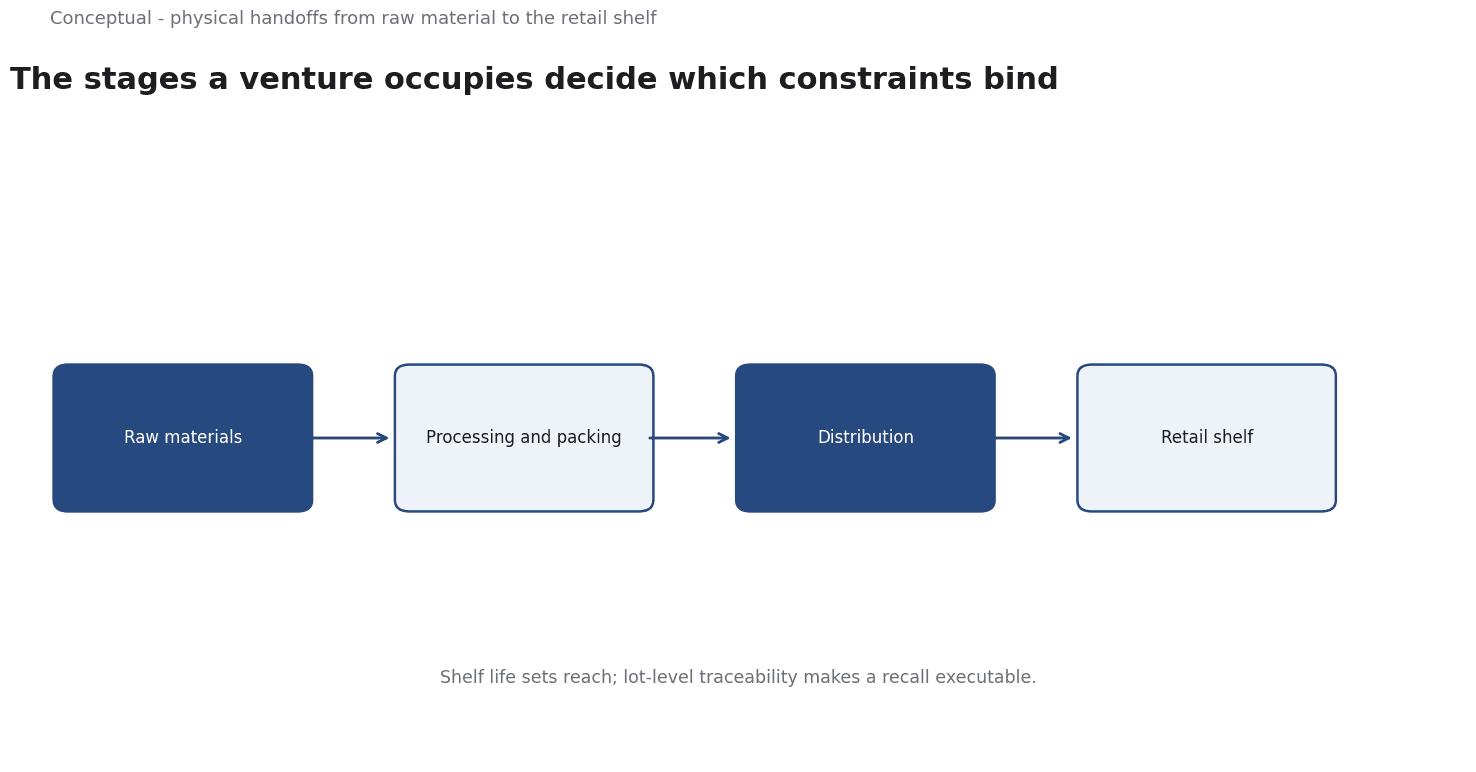
Supply chain management is described as the design, planning, execution, control, and monitoring of activities that move goods from raw material to end consumer, coordinating suppliers, manufacturers, distributors, and retailers, with information and financial flows alongside physical goods. For a new venture the chain is a network of handoffs rather than a single pipeline. Each handoff is where cost, time, and accountability accumulate, and where a failure first becomes visible to the customer. Reading the sources together turns a broad industry label into boundaries the venture must choose.
Two ideas link the descriptions. Preservation and shelf life determine how long a product can remain in the chain and which channels are reachable. Traceability, the ability to follow a product through production, processing, and distribution, makes a quality claim or a recall executable. Neither source prescribes a business model; both describe structure. The decision map must therefore be built by the venture: name the stages occupied, then attach the constraint each stage imposes. That converts a general description into a short list of decisions a reviewer can audit.
A worked example
The following is hypothetical and illustrative. A small beverage brand plans to sell a shelf-stable drink through regional retailers. Three checks structure the launch. First, position: does the brand process its own ingredients or buy finished product from a co-packer, and which stages does that choice remove from its control? Second, reach: can shelf life cover the time from packing to the retail shelf across the intended territory? Third, traceability: can an ingredient lot be followed through the co-packer's records to a finished case? The review finds that self-processing adds yield risk without adding customer value, so the brand chooses a co-packer, limits the first launch to one region, and requires lot-level records from the supplier. The team also sets a recheck point for the shelf-life assumption before a second region is added. The outcome is a stage choice and a distribution boundary, not a new product.
Evidence status
| Claim | Status | Source | Verified | Recheck when |
|---|---|---|---|---|
| The food industry spans production, processing, distribution and retail | source-reported | Wikipedia, Food industry | 2026-11-18 | The entry is revised |
| Supply chain management plans and controls flows from raw material to consumer | source-reported | Wikipedia, Supply chain management | 2026-11-18 | The definition is revised |
| The stage a venture occupies determines which constraints bind | inferred | Derived from the sources | 2026-11-18 | The business model or channel changes |
The first two rows restate descriptions found in the source entries and change only when those entries are revised. The third row is an inference about how structure becomes a decision, so it depends on the venture's own model rather than on the sources. Recheck it whenever the venture changes stage, channel, or supplier arrangement.
What it cannot do
The two sources describe structure, not strategy. Nothing in them identifies which product to make, which customer to serve, or what price to charge. A reader expecting a recipe for success will find categories and relationships instead. The map built here only organizes decisions, and its value depends on the accuracy of the venture's own assumptions about the stages it occupies. It is a way to ask sharper questions, not an answer key.
The hidden cost sits in the stages a venture does not initially count. Cold storage, waste from short shelf life, packaging compliance, and working capital tied up in inventory all consume resources before the first sale. These costs are easier to see in a stage map than in a generic startup budget because they attach to specific handoffs. Ignoring them makes a launch plan look cheaper than it is, and the gap usually appears only after the first production run.
In practice it has returns, recalls, seasonality, and parallel channels that feed back into earlier stages.
A brand shipping to retailers also handles returns and complaints, which flow back to the co-packer and the ingredient supplier. A one-way picture leaves no place for these reverse flows, so a recall becomes a scramble rather than a traced step. That is when missing records become expensive.
The boundary lies in what the sources actually cover. They do not provide labeling law, food safety systems, or local regulatory requirements, and they do not set quality standards for a particular product category. Those belong to jurisdiction-specific rules and buyer requirements that sit outside a general industry description. A venture must add them explicitly rather than assume the chain description already includes them. Skipping that step is a common way to discover a compliance gap late.
The map also needs periodic review. Supplier reliability, shelf-life data, and channel terms all change, and each change can move the binding constraint to a different stage. What looked like a distribution decision can become a processing decision after a supplier switch. Each assumption should carry a named owner and a recheck condition, so a later reader can tell which choices were deliberate and which were inherited by default.
The counterargument that a stage map is fair for organizing a launch is incomplete when the binding constraint is demand, because no amount of supply-chain clarity creates customers for a product nobody wants.
A decision test
- Name the stages of the chain the venture actually occupies.
- Identify the handoffs where cost or accountability can accumulate.
- Check whether shelf life covers the time to the intended channel.
- Confirm that lot-level traceability is available for each source.
- Attach one decision to each occupied stage.
- Price the hidden costs attached to those handoffs.
- Record the stage map with an owner and a recheck condition.
A stage map earns its place only if it changes a launch decision.
The test converts a broad industry description into a short list of owned choices with visible costs, so a reviewer can see why a stage was taken on or avoided. For further reading, see Data Governance: Managing Data as an Asset.
References & Further Reading
- Wikipedia contributors, 2026. Food industry - Wikipedia — The structure of food and beverage production and distribution.
- Wikipedia contributors, 2026. Supply chain management - Wikipedia — Management of the flow of goods and services.