Getting Started with Featured Snippets
Featured snippets reward clear answers, not clever wording. Learn what the snippet formats measure, how to structure a page for them, and the limits of chasing position zero.
Featured snippets are often treated as a trick for capturing attention without a click. The Featured snippet entry describes an answer box that appears above the organic results, and Google's SEO Starter Guide emphasizes helping search engines understand and crawl a page. The real problem is that a snippet is a format the search engine chooses, not a ranking a site can claim by writing in a particular style.
Direct answer: A featured snippet is an extracted answer displayed at the top of a results page. The sources describe the snippet formats and general SEO basics but do not promise that any formatting guarantees inclusion. The practical aim is to make a page easy to crawl and to contain a clear, self-contained answer.
Delta: This article adds a claim-status table and an answer-fit test beyond the sources: it maps each snippet format to the on-page decision it supports, with claim status explicit.
The mechanism
The Featured snippet source describes an answer extracted from a web page and displayed in search results, often above the traditional listings. Common formats include paragraphs, lists, and tables. The practical consequence is that the snippet is selected from content that already exists on the page, so the source text must be present and clearly structured. A page that buries the answer in prose or requires the reader to combine several sections gives an extractor little to work with.
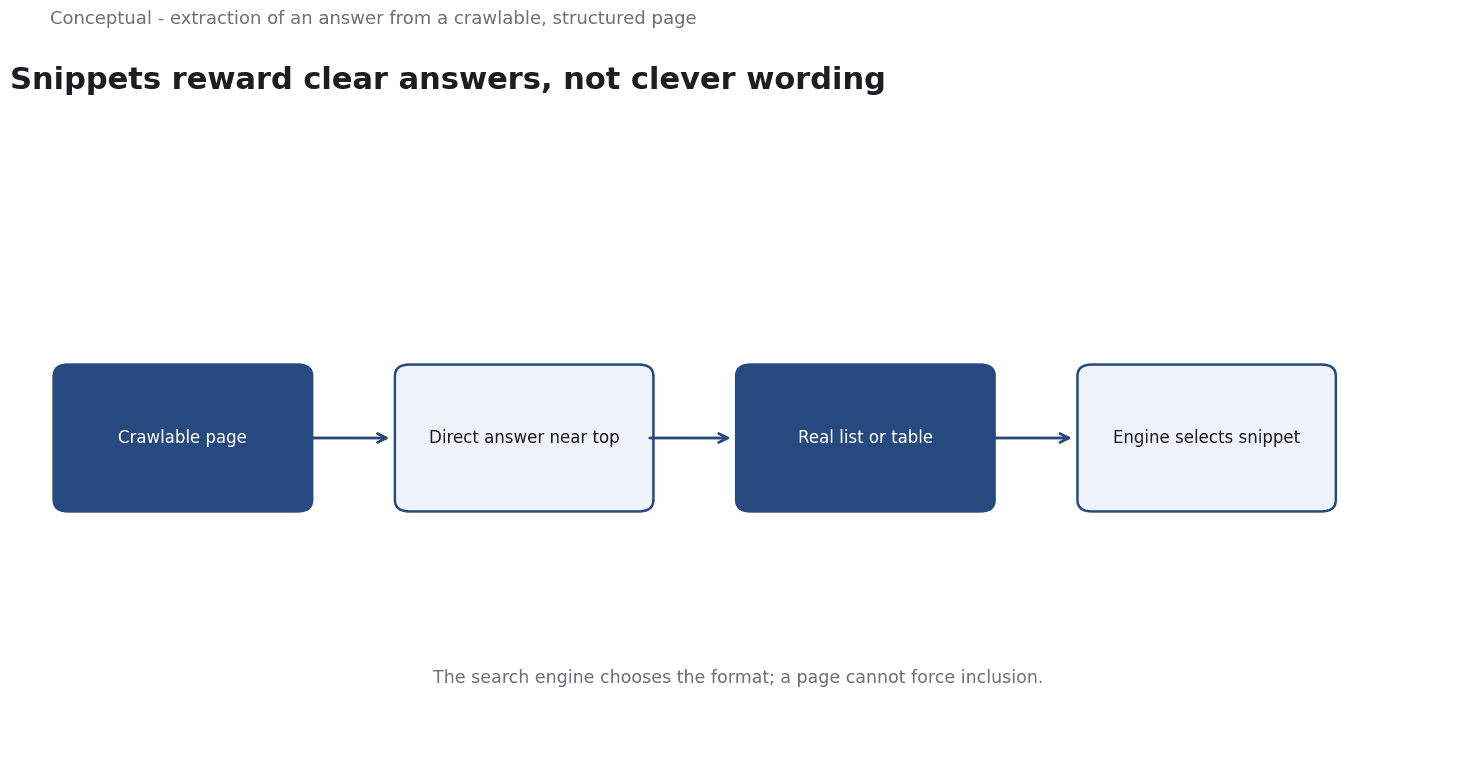
Google's SEO Starter Guide focuses on fundamentals: making content crawlable, using descriptive titles, and helping search engines understand a page. The practical consequence is that snippet eligibility starts with the same basics as any search visibility. If a page cannot be crawled or its structure is ambiguous, there is nothing reliable to extract. The guide does not present snippets as a separate track with secret rules; they sit on top of sound technical and content practices.
Neither source guarantees inclusion or specifies a format that wins. That choice is inferred, not source-reported. A useful discipline is to write a direct answer to a specific question near the top of the page, then support it with detail below. Lists and tables should be genuine lists and tables, not styling applied to prose. Starting from the question a searcher asks keeps the page aligned with what an extractor can reuse.
The consequence for practice is to treat snippet optimization as a clarity exercise rather than a formatting hack. Each important page should answer one question plainly, with supporting context that stands on its own. Each answer should have a defined owner and a recheck date so wording stays current. A page that is hard to parse or vague at the top is unlikely to be extracted, regardless of how it is styled.
A worked example
The following is hypothetical and illustrative. A content editor wants a how-to page to appear as a snippet for a common question and asks whether rewriting the introduction will help. Three checks decide the review. First, does the page contain a single, self-contained answer to the question near the top, or is the answer spread across several sections? Second, is the content genuinely crawlable, with clear headings and no rendering barriers? Third, does the format match the question, such as a real list for a step-by-step query? The review finds that the answer is buried and that the page relies on client-rendered text. The editor rewrites the opening as a direct answer and verifies the rendered page. The figures are hypothetical; the verification method is the contribution.
Evidence status
| Claim | Status | Source | Verified | Recheck when |
|---|---|---|---|---|
| A featured snippet is an answer box shown above organic results | source-reported | Wikipedia, Featured snippet | 2026-11-18 | SERP layout changes |
| SEO basics emphasize crawlability and clear page structure | source-reported | Google SEO Starter Guide | 2026-11-18 | Guidelines revised |
| A clear on-page answer improves snippet fit but does not guarantee inclusion | inferred | Derived from the sources | 2026-11-18 | Snippet behavior changes |
The first two rows restate what the sources describe. The third row is a synthesis, since neither source promises inclusion from a particular format. Recheck when the search-result layout or the starter guide changes, or when the page's rendering or question target shifts.
What it cannot do
A featured snippet cannot be claimed or guaranteed. The Featured snippet source describes a format chosen from page content, not a badge a site earns by following a checklist. Google's starter guide offers general SEO advice, not a rule that a given structure forces an extraction. A team can do everything the sources suggest and still see no snippet, because the search engine decides what to display for each query.
The hidden cost is in the opportunity cost of rewriting. Structuring every page around a single question can flatten content that genuinely needs nuance, and a short answer at the top may reduce the incentive for a reader to explore the rest. The sources do not discuss this trade-off, so it is an inference from the gap between snippet fit and reader value. Content optimized only for extraction can serve a search query well while serving the reader poorly.
Applying list markup to prose, stuffing a page with question headings, or repeating the same answer in several places can make a page look engineered.
The starter guide favors clarity and crawlability, not manipulation. A page built around a format rather than an honest answer can lose trust with readers and may still fail to be selected.
There is a boundary around what these sources cover. They describe what a featured snippet is and the basics of SEO, not the full range of snippet types, the selection algorithm, or how snippets vary by device and locale. They also do not address how answer engines and generative results change the value of a snippet. A plan that ignores these factors is a partial view, and the sources do not claim otherwise.
Because result layouts and page content change, snippet targets need periodic review. The direct answer, the crawl status, and the format match should be rechecked, with definitions and recheck dates recorded alongside the target. Without that record, a page that once earned a snippet can drift and lose it without anyone noticing. A reviewer should be able to see what question the page targets and when the answer was last verified.
The counterargument that structuring a clear answer is fair for readers is incomplete when the rewrite exists only to chase a snippet rather than to inform.
A decision test
- Name the question the page is meant to answer.
- Check that the page is crawlable and renders its text.
- Confirm a single, self-contained answer appears near the top.
- Match the format to the question, using real lists or tables where appropriate.
- Review the supporting detail for accuracy and independence.
- Decide whether to rewrite, restructure, or leave the page as is.
- Record the target question, owner, and recheck date.
A featured snippet is an outcome a search engine may grant, not a format a site can force.
The test ties the page to a real question and makes crawlability, answer placement, and format visible, so a reviewer can see when a rewrite helps readers rather than just chasing a snippet. For further reading, see What AI Search Actually Measures.
References & Further Reading
- Wikipedia contributors, 2026. Knowledge Graph (Google) - Wikipedia — Direct answers shown in search results.
- Google, 2026. SEO Starter Guide: The Basics — The search engine's own description of what it needs from a site.