Getting Started with Green Bonds
Green bonds fund environmental projects, but what the label measures depends on how proceeds, reporting, and additionality are defined and verified.
A green bond is presented as a straightforward way to fund environmental projects, but the label covers a range of practices with different levels of rigor. For someone deciding whether the instrument does what it claims, the key question is what the label actually measures. The relevant sources distinguish the bond structure from the broader market for carbon emission trading, and that distinction matters for any evaluation.
Direct answer:
A green bond measures a financing commitment whose proceeds are earmarked for environmental projects, not the environmental outcome itself.
Its credibility depends on how proceeds are tracked, reported, and verified, and on what counts as eligible. The bounded answer is that the label signals intent and process, with impact requiring separate evidence.
Delta: This article adds a decision map beyond the sources: it maps green-bond claims to investor decisions, with claim status explicit.
The mechanism
The reference entry on green bonds describes the instrument by its use of proceeds: the capital raised is earmarked for projects with environmental benefits. The mechanism is a set of process commitments rather than a single guaranteed outcome, typically covering how projects are selected, how proceeds are managed, and how results are reported. That framing matters because it tells you what the bond directly measures. It measures that money was directed to a defined category, not that the category produced a specific ton of avoided emissions.
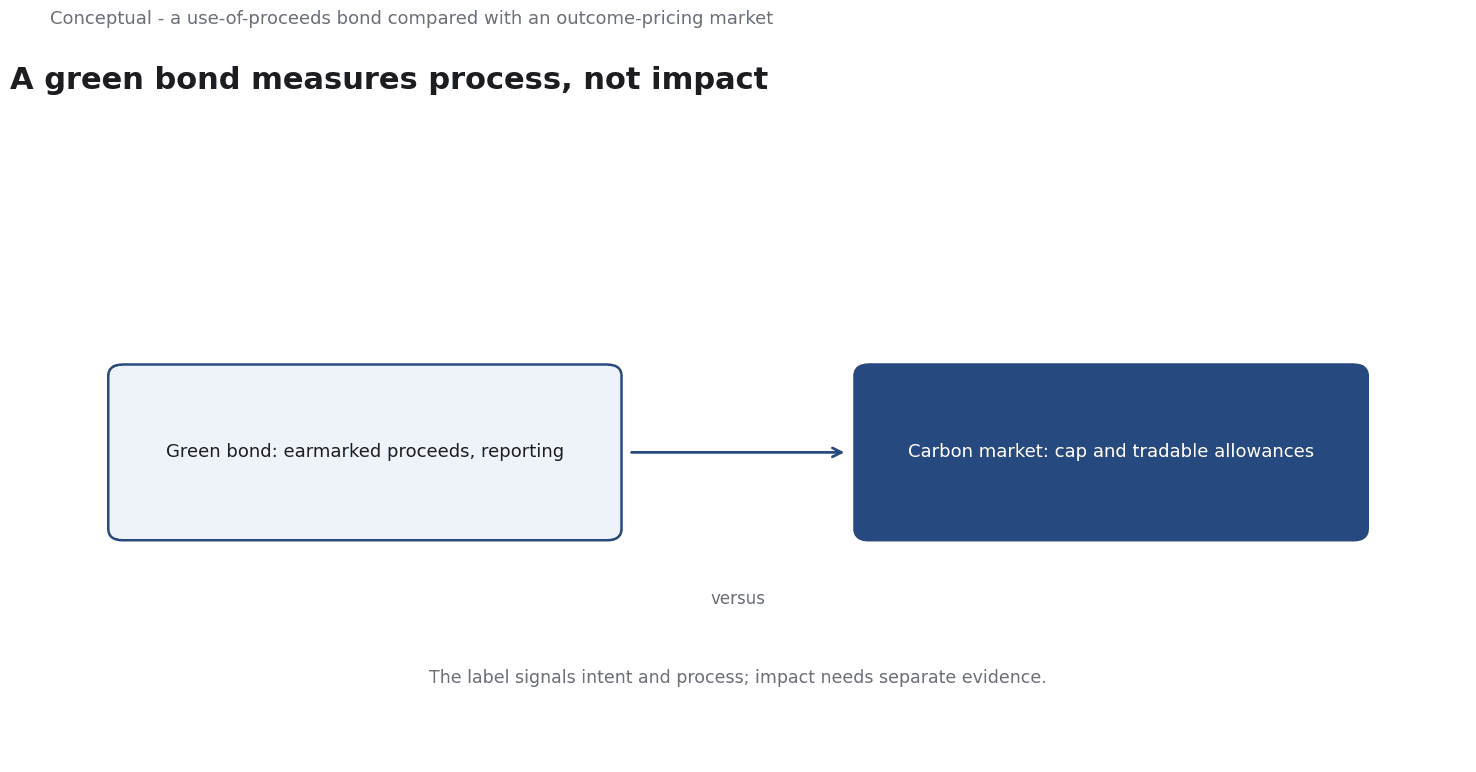
The second source, on carbon emission trading, describes a different but related market mechanism. There, a cap on emissions is combined with tradable allowances, so a price is attached to the right to emit. The two mechanisms are often discussed together because both put a financial value on environmental performance, but they operate at different levels. A green bond finances an activity; a carbon market prices an emission outcome. Confusing the two leads to assuming that a bond carries the measurement rigor of a carbon price, which it does not.
The practical consequence is that getting started with green bonds requires separating three questions that are easy to merge. First, is the use of proceeds defined clearly enough to know what is eligible? Second, is the management of proceeds traceable so that the money can be followed? Third, is reporting frequent and specific enough that claimed benefits can be checked? A bond that scores well on the first question but poorly on the third has a real label with weak evidence behind it.
Seen as a decision tool, the green-bond label is a signal about process, and the carbon-market comparison shows what a stronger outcome-based signal looks like. The decision is not whether the label is good or bad in the abstract but whether a particular bond's commitments are specific and its reporting verifiable. When those conditions hold, the label narrows uncertainty; when they do not, it mostly restates intent.
A worked example
The following is hypothetical and illustrative. A hypothetical investor compares two green bonds that both claim to finance renewable energy. Three checks decide the comparison. First, the investor reads the use-of-proceeds definition to see whether it includes only new renewable generation or also refinancing of existing assets, which changes what the label implies. Second, the investor checks whether proceeds are tracked in a separate account or pooled with general funding, which determines traceability. Third, the investor looks for periodic reporting that states the amount allocated and the projects funded, which determines whether the claim can be verified. In this scenario one bond defines eligibility narrowly, tracks proceeds separately, and reports annually, while the other is vague on two checks. The outcome is that the label alone did not differentiate them; the process details did.
Evidence status
| Claim | Status | Source | Verified | Recheck when |
|---|---|---|---|---|
| Green bonds earmark proceeds for projects with environmental benefits | source-reported | Green bond overview | 2026-11-18 | If bond standards change |
| Carbon emission trading uses tradable allowances under a cap | source-reported | Carbon market overview | 2026-11-18 | If market designs change |
| The bond label signals process while carbon pricing signals an outcome | inferred | Derived from the sources | 2026-11-18 | If reporting rules change |
The first two claims are reported by the reference entries and can be rechecked on those pages. The third is an inference from placing the two mechanisms side by side, so it should be revisited when reporting rules or market designs change. Separating reported claims from inference keeps the investor guidance clear about what is established and what is reasoned comparison.
What it cannot do
A green bond cannot by itself prove an environmental result. It proves that a financing structure was put in place and that certain commitments were made. Whether the funded projects deliver the claimed benefits depends on execution, on the baseline used to define a benefit, and on factors outside the bond's control.
There is a hidden cost in the verification work that the label does not advertise. Meaningful assessment requires reading frameworks, allocation reports, and impact reports, and comparing them across issuers with different definitions. That work is ongoing because reporting practices evolve and a bond that was well documented at issuance may report less later. Getting started therefore means budgeting for analysis capacity, not just for capital allocation.
A common failure mode is ambiguity about what counts as eligible. When definitions are broad, a bond can include projects with weak environmental margins while still carrying the green label. Another failure mode is the absence of a credible baseline, which makes an impact claim hard to interpret. A project can be reported as avoiding emissions relative to a generous baseline, and the number will look impressive without measuring a difficult counterfactual.
The evidence also has a boundary. The sources describe what green bonds and carbon markets are; they do not rank particular bonds or certify any issuer. Any judgment about a specific bond's quality is an inference that must be checked against that bond's own documents. This article provides the questions to ask, not the answers, and it cannot substitute for reading the actual framework and reports.
For that reason, a green-bond assessment needs review at each reporting cycle. Allocation changes as projects are completed or replaced, definitions can be revised, and external standards can be updated. A recurring check should ask whether the use of proceeds still matches the original eligibility rules, whether reporting remains timely and specific, and whether impact figures rest on a stated and defensible baseline.
Counterargument: "The counterargument that green bonds still help by directing capital to environmental uses is fair for mobilizing funding and incomplete for establishing impact: a financing signal is not the same as a measured outcome."
A decision test
- Read the use-of-proceeds definition and decide whether its eligibility rules match your own criteria.
- Check how proceeds are managed, including whether they are tracked separately from general funding.
- Look for periodic allocation reporting that states amounts and named projects.
- Examine impact reporting for a stated baseline and a clear method behind each figure.
- Compare the bond's process commitments against an outcome-based benchmark such as carbon pricing.
- Identify which claims are issuer statements and which are independently verified.
- Schedule a review at each reporting cycle to catch changes in allocation and definitions.
Used together, these steps turn a broad label into a set of checkable claims. The goal is not to declare a bond good or bad in general but to decide whether its specific commitments support the decision at hand. An investor who can answer each step is evaluating evidence; one who cannot is relying on a label alone.
For further reading, see Cash Flow Forecasting: A 13-Week Operating Model.
References & Further Reading
- Wikipedia contributors, 2026. Green bond - Wikipedia — Bond whose proceeds are earmarked for environmental projects.
- Wikipedia contributors, 2026. Carbon emission trading - Wikipedia — Markets for trading emission allowances.