Getting Started with Loan Covenants
Covenants are contract conditions separate from repayment. Read the mechanism, a worked monitoring example, and a claim-status table.
A borrower signs a loan agreement and focuses on the interest rate and the repayment schedule, then discovers that the same document contains conditions that can change what the lender is allowed to do when circumstances shift. The debt covenant entry describes these as conditions written into a credit agreement, while the SBA funding-programs page describes how guaranteed loans such as 7(a), 504, and microloans are accessed. The real problem is that a borrower can meet every scheduled payment and still breach a covenant, which is a different kind of failure.
Direct answer:
Loan covenants are contractual conditions that require a borrower to meet certain obligations or refrain from certain actions, and breaching one can give the lender rights even when payments are current.
The debt covenant entry supplies the definition; the SBA page describes the lending environment where such conditions appear. The boundary: this is educational orientation, not advice on any specific agreement, because the exact consequences depend on the contract text.
Delta: This article adds a claim-status table beyond the sources: it maps covenant types to a monitoring decision, with claim status explicit.
The mechanism
The debt covenant entry describes a covenant as a condition in a debt agreement that requires the borrower to do something or to avoid doing something. Affirmative covenants set duties the borrower must satisfy, such as keeping records or meeting reporting obligations; negative covenants restrict actions, such as taking on more debt or making certain payments without consent. The practical consequence is that compliance is not a single number. A borrower can satisfy a payment obligation while failing a separate condition, so the agreement creates several independent tests that must each be tracked.
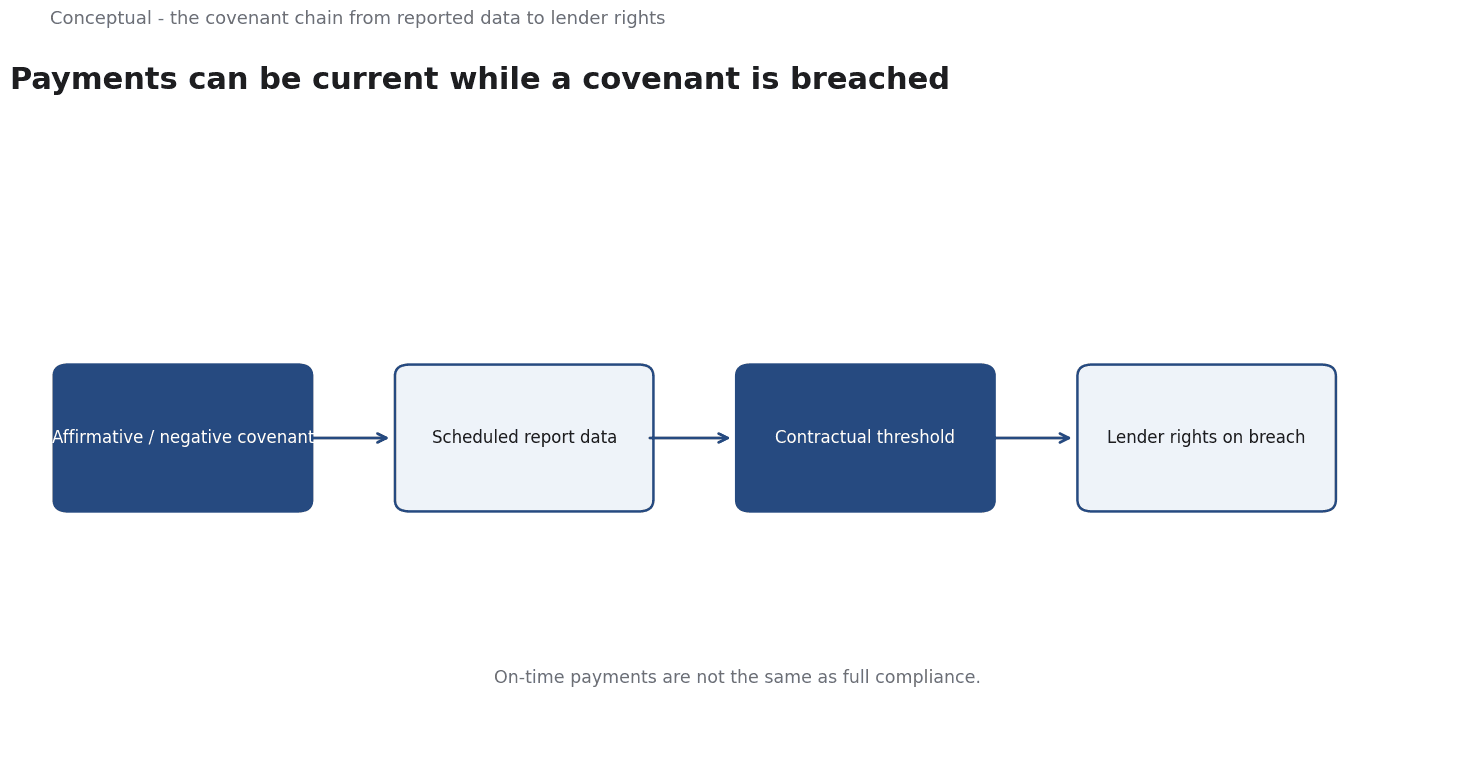
That separation matters because covenant breaches are typically defined at a point in time or over a reporting period, while loan payments are scheduled events. A covenant may be tested quarterly against a financial statement the borrower must deliver. The practical consequence is that the information needed to know whether a covenant is satisfied often arrives through a reporting obligation, so a late or missing report can become a problem in its own right. The mechanism links accounting data, contractual thresholds, and lender rights into one chain that has to be checked link by link.
The SBA funding-programs page describes access to guaranteed loan products, including 7(a), 504, and microloans. These programs sit within a lending environment where terms and conditions are set by the agreement between borrower and lender. The practical consequence is that program eligibility and loan structure are separate questions from covenant compliance: obtaining a guaranteed loan does not remove the conditions written into it. The two sources occupy different layers, one describing the instrument and one describing a channel through which such instruments become available.
A coherent reading keeps the layers distinct. The covenant entry explains what a condition is and what a breach can trigger. The SBA page explains where certain small-business loans come from. Neither, on its own, tells a particular borrower which thresholds apply. The synthesis is that covenant monitoring is a discipline of reading the contract, mapping each condition to a data source, and checking it on the schedule the agreement sets. That mapping is the practical contribution here, and it is an inference rather than a claim reported by either source.
A worked example
The following is hypothetical and illustrative. A small firm holds a guaranteed loan and believes it is in good standing because every scheduled payment has been made on time. The agreement also contains a reporting covenant requiring quarterly financial statements and a restriction on taking on additional debt without consent. Three checks decide. First, the finance lead confirms that each required statement was delivered on the date the agreement specifies, treating the reporting duty as a test in its own right. Second, the lead compares the firm's debt level against the restricted-action clause before signing a new equipment loan, checking whether consent is needed. Third, the lead reads the breach clause to see what rights the lender gains if a condition is missed. The outcome is a qualified finding: payments are current, but compliance depends on the reporting and restriction checks, and one missed statement could change the lender's options. The numbers are hypothetical; the sequence of checks is the contribution.
Evidence status
| Claim | Status | Source | Verified | Recheck when |
|---|---|---|---|---|
| Covenants are conditions requiring action or forbearance in a debt agreement | source-reported | Wikipedia, Debt covenant | 2026-11-18 | The covenant definition changes |
| Guaranteed loan programs include 7(a), 504, and microloans | source-reported | SBA, Funding programs | 2026-11-18 | Program terms or offerings change |
| Monitoring each covenant needs a mapped data source and schedule | inferred | Derived from the sources | 2026-11-18 | A specific agreement text is reviewed |
The first row is documented in the covenant entry; the second in the SBA program description. The third row is an inference from combining a definition of contractual conditions with a lending channel that sets terms. Recheck it when a specific agreement is reviewed, since thresholds and schedules are contract-specific and neither source states them for a particular borrower.
What it cannot do
A definition of covenants cannot tell a borrower whether a particular agreement is safe. The entry describes categories of conditions, but each contract sets its own thresholds, definitions, and cure periods. A covenant that looks standard can be drafted with a definition that changes how it is measured, so the label alone is not enough. The practical limit is that general knowledge of covenant types does not substitute for reading the specific text line by line.
A hidden cost of covenant monitoring is the reporting infrastructure it demands. Each condition tested against a financial figure requires a reliable, dated data source and a person responsible for producing it on schedule. That infrastructure has a cost in time and systems, and it is easy to underestimate when a loan is first arranged. The cost appears as a recurring operational burden rather than a one-time legal expense, and it grows as more conditions are added.
Borrowers often assume that making payments keeps them in good standing, while separate conditions on reporting, leverage, or restricted actions are tracked loosely.
The failure is quiet because nothing looks wrong until a statement is late or a threshold is crossed. By then the lender's rights may already be triggered, and the borrower has limited time to respond or negotiate.
The boundary of the source material is the general description of covenants and loan programs. Neither source reports the terms of any specific loan, the consequences negotiated in a particular agreement, or how a given lender exercises its rights. Claims about what will happen after a breach therefore exceed what the sources support. Those questions require the contract itself and, where appropriate, professional legal or financial advice.
These points need review whenever the agreement changes or is amended. A waiver, a new reporting requirement, or a revised threshold can alter the monitoring map, and a figure that was once relevant may no longer be. Keeping a record of each covenant, its data source, and its test date is the only way to keep a compliance view current. Without that record, a borrower may discover a breach only when the lender raises it.
The counterargument that covenant categories are too generic to guide a borrower is fair for determining specific thresholds and incomplete for building a monitoring discipline, where knowing which conditions exist is a necessary first step.
A decision test
- List every covenant in the agreement, separating affirmative duties from negative restrictions.
- Map each covenant to the data source that can test it.
- Record the test date or reporting period the agreement specifies.
- Confirm that required statements are delivered on the scheduled dates.
- Check restricted actions, such as new borrowing or large payments, before committing to them.
- Read the breach clause to learn what rights the lender gains and what cure periods apply.
- Revisit the map whenever the agreement is amended or a condition is waived.
These steps turn a contract into an operational checklist. They do not remove the need to read the agreement or to seek advice on a specific situation, but they prevent the most common error: assuming that on-time payments equal full compliance. The result is a monitoring habit tied to what a borrower can actually verify and document. For further reading, see decision memos that survive review.
References & Further Reading
- Wikipedia contributors, 2026. Credit risk - Wikipedia — Contractual conditions attached to a loan agreement.
- U.S. Small Business Administration, 2026. Access affordable 7(a), 504, and microloans — How SBA-guaranteed lending works, including Lender Match and the note that guaranteed loans generally carry rates and fees comparable to non-guaranteed ones.