Getting Started with Loyalty Mechanics
Loyalty mechanics tie retention goals to measurement. See how promoter scores and retention interact, a worked holdout example, and the limits of points-based programs.
Loyalty programs are easy to launch and hard to evaluate. Teams hand out points, watch a promoter score move, and declare the program a success without asking whether it changed behavior. The mechanics of loyalty are really a measurement problem: a company has to connect a retention goal to a signal it can trust and an incentive that earns its cost.
Direct answer: Customer retention is the outcome a loyalty effort is meant to improve, while the net promoter score is one diagnostic of customer sentiment, calculated from how likely people are to recommend a product. Loyalty mechanics connect the two by testing whether an incentive moves the diagnostic and, more importantly, retention.
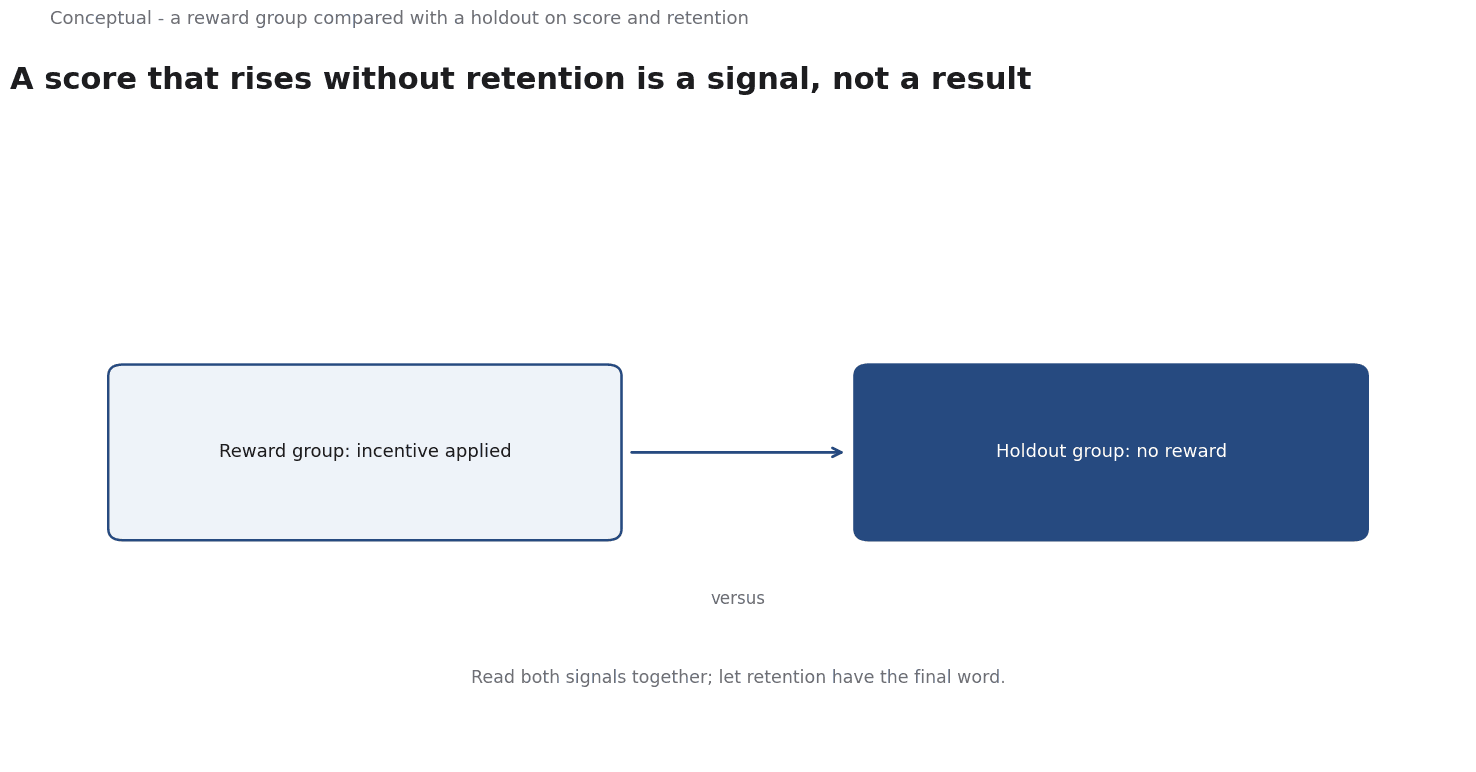
A score that rises without a retention change is a signal, not a result.
Delta: This article adds a decision framing beyond the sources: it maps loyalty signals to a concrete spend decision on incentives, with claim status explicit.
The mechanism
Customer retention is the ability of a business to keep its customers over time, and it is usually set against churn, the rate at which customers leave. It matters because the value of a customer is realized over a relationship rather than at a single transaction. That makes retention a natural home for loyalty efforts: if a company can keep more customers for longer, the economics improve without acquiring a single new buyer. The catch is that retention is an outcome that appears slowly, so a team needs signals that can be read sooner.
The net promoter score is one such signal. It is derived from a single question asking how likely a customer is to recommend the product to a friend or colleague, answered on a zero to ten scale. Responses are grouped into promoters, passives, and detractors, and the score is the percentage of promoters minus the percentage of detractors. Its appeal is simplicity: one number that can be tracked over time and compared across groups. Its weakness is the same simplicity, because a single recommendation question compresses a lot of customer experience into three buckets and says nothing directly about whether anyone stayed.
Neither measure proves that a loyalty mechanic works. Retention tells you the outcome but not which action caused it; the promoter score reflects sentiment but not behavior. The useful move is to treat the incentive as the thing being tested and the two measures as the evidence. That means defining the customer group, measuring a baseline, and comparing against a comparable group that did not receive the incentive. Without that structure, a rising score and a flat retention line are easy to explain away in whichever direction the team prefers.
The practical consequence is a division of labor. Retention sets the goal, the promoter score provides a fast but noisy read on sentiment, and a controlled comparison supplies the causal claim. Together they support a specific decision: does this incentive earn its cost? A program that lifts the score but not retention is buying goodwill that has not yet shown up in behavior, and a program that lifts neither is simply a discount. The mechanic is the test that separates the two.
A worked example
The following is hypothetical and illustrative. A subscription business wants to know whether a points reward improves retention and runs three checks. First, it records a baseline promoter score and a baseline retention rate for the current cohort before changing anything. Second, it holds out a comparable group that receives no reward, so any difference can be set against a counterfactual rather than against the team's hopes. Third, after the reward has run for a period, it compares both the score and the retention rate between the two groups. The outcome is that the reward group reports a higher promoter score, but the retention rates are close enough that the incentive does not justify its cost. The company keeps the measurement habit and drops the reward. No number here is measured data; the example only shows how the checks connect.
Evidence status
| Claim | Status | Source | Verified | Recheck when |
|---|---|---|---|---|
| Retention is the ability of a business to keep its customers | source-reported | Wikipedia: Customer retention | 2026-11-18 | Definition or measurement shifts |
| Net promoter score comes from a recommendation question | source-reported | Wikipedia: Net promoter score | 2026-11-18 | Question or scoring method changes |
| A score change is not proof of a retention change | inferred | Derived from the sources | 2026-11-18 | Evidence on score validity changes |
The source-reported rows establish what the two sources define: retention as an outcome and the promoter score as a survey-derived indicator. Neither source claims that moving one causes the other. The inferred row is this article's synthesis that a score change is weak evidence of a behavioral change, not a finding the sources state. Recheck it if research linking the score to growth or retention changes the weight it deserves.
What it cannot do
The first limit is that these sources define retention and the promoter score but do not provide a loyalty-program playbook. There is no guidance here on point values, tier design, reward economics, or redemption rules. A manager looking for a ready-made program will not find one. What the sources support is the measurement side of the question, and even that is partial, since a score is only one of several ways to read customer sentiment.
A hidden cost is the discipline required to measure retention honestly. Retention is a rate over time, so it needs cohorts, a defined observation window, and enough elapsed time to be meaningful. The promoter score is cheaper to collect but carries response bias: the people who answer surveys are not always the people who churn, and a small change in who responds can move the number. On top of that sits the direct cost of the incentive itself, which is real money spent whether or not behavior changes.
Because the promoter score is fast and visible, teams optimize it with prompts and small gestures that raise the number without improving retention.
A related failure is rewarding customers who were already loyal, so the program pays people who would have stayed anyway. Survey fatigue is another: ask too often and response quality falls, which makes the signal less useful precisely when the team is relying on it.
The boundary is where the score is informative at all. It has been criticized on the grounds that the link between a recommendation score and business growth is not established, and its three-bucket structure loses information. In low-frequency purchases, in markets with few alternatives, or where customers cannot meaningfully recommend the product, the score says little. Retention remains relevant in those settings, but the score may be noise, and building a loyalty mechanic on a noisy signal is worse than building none.
Programs also need review. Sentiment drifts with service changes and seasonality, competitors alter what loyalty means, and an incentive that works once can be copied or taken for granted. Set a trigger to revisit both measures when the reward structure changes or when cohort retention moves for unexplained reasons. Without that, the team defends a program because its score looks familiar, not because anyone has checked whether it still works.
The counterargument that a simple promoter score is good enough for a small team is fair when there is one stable product and one clear customer type, and incomplete when incentives, cohorts, and churn interact in ways a single number cannot separate.
A decision test
- Name the outcome. State the retention change the effort is meant to produce and over what window.
- Define the cohort. Specify which customers are in scope and how retention will be measured for them.
- Record a baseline. Capture the current promoter score and retention rate before any incentive.
- Build a comparison. Set up a comparable group that does not receive the incentive.
- Run the mechanic. Apply the incentive for a defined period, keeping the measurement rules fixed.
- Compare both signals. Read the score and the retention rate together against the comparison group.
- Decide and review. Keep or drop the spend, and set a trigger to revisit when conditions change.
Loyalty mechanics are a way of asking a disciplined question, not a set of rewards. The sources give an outcome and a diagnostic; the test you build between them determines whether a claim of loyalty is real. Measure both signals, keep a comparison group, and let retention have the final word.
For further reading, see Marketing Dashboards without the Hype.
References & Further Reading
- Wikipedia contributors, 2026. Customer retention - Wikipedia — Efforts to keep existing customers.
- Wikipedia contributors, 2026. Net promoter score - Wikipedia — A measure based on stated recommendation likelihood.