Getting Started with Performance Reviews
A performance review judges past work against defined expectations. Learn what O*NET and re:Work cover, a claim-status table, and where review ratings stop being reliable.
A performance review is expected to judge past work fairly and guide future work. The sources describe occupations and management practice at a general level, but neither supplies a ready-made rating form. The real problem is turning generic job information into review criteria that hold up when a rating is challenged.
Direct answer: A performance review evaluates an employee's work against expectations derived from the role and from organizational practice. O*NET documents occupational tasks, skills, and work activities; re:Work publishes guidance on managing people and feedback. The sources inform the inputs, but no rating rule follows directly from them.
Delta: This article adds a claim-status table and an occupation-to-criteria mapping beyond the sources: it maps job-task evidence to review criteria, with claim status explicit.
The mechanism
O*NET OnLine is a reference of occupational information maintained under the U.S. Department of Labor. It describes occupations in terms of tasks, work activities, skills, and the contexts in which the work happens. That makes it a structured starting point for asking what a role involves, independent of any one employer's habits. Google re:Work, by contrast, is a collection of research summaries and practical tools about managing people, including guidance on feedback and performance management. The two sources operate at different levels: one catalogs occupational content, the other offers management practice. Neither is a performance review form, and treating them as one would overstate what they provide.
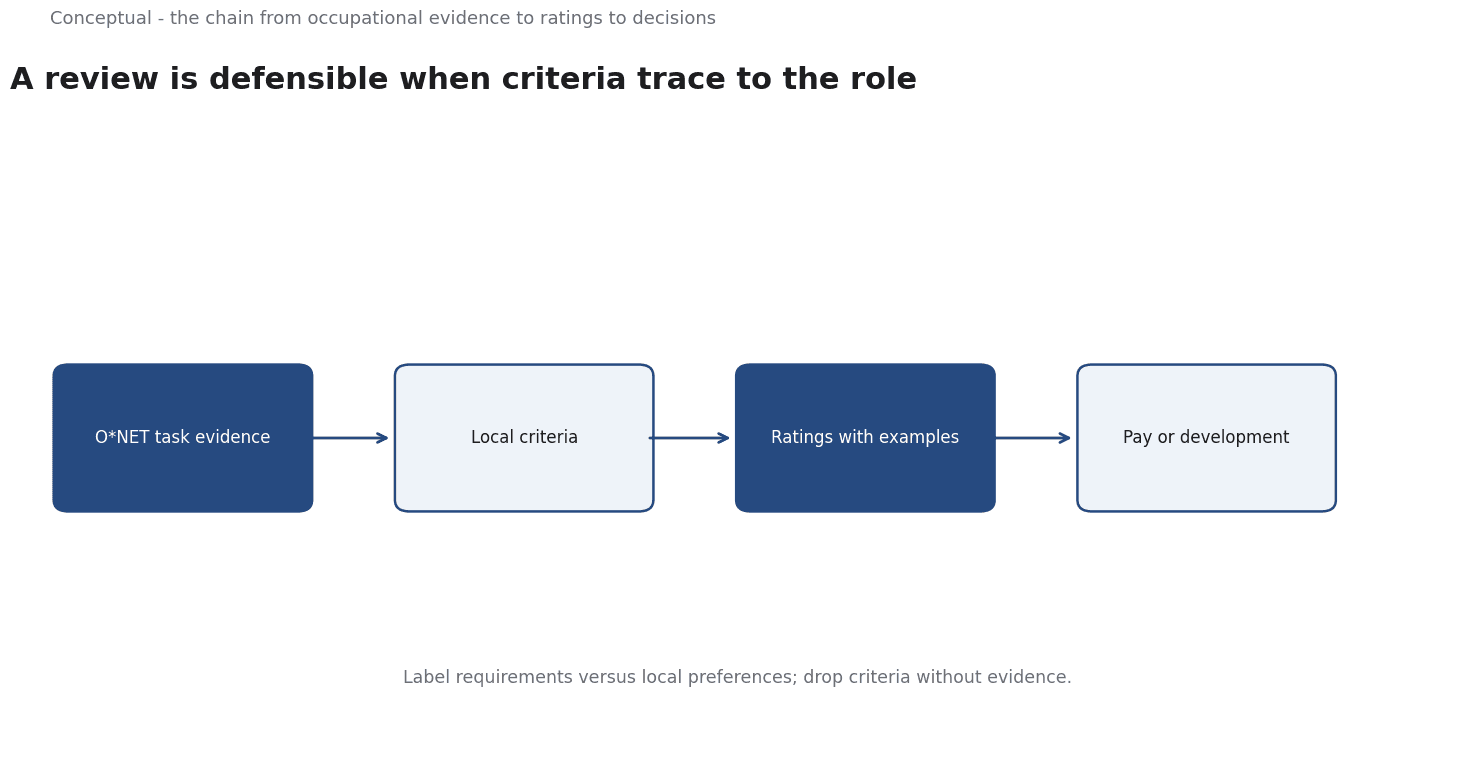
The practical consequence is that review criteria have to be built, not copied.
A manager can draw task language from O*NET to describe what the role covers, then use re:Work style feedback guidance to decide how that work should be discussed. The bridge between the two is a local choice about which tasks matter for this team and this period.
The sources can inform the vocabulary of a review but cannot settle the weighting.
A further consequence is that a review has two jobs that pull in different directions. It documents past performance for records and pay decisions, and it shapes future behavior through goals and feedback. Criteria that serve the first job well, such as clearly observable task completion, may serve the second poorly if they ignore how the work was done. re:Work style guidance treats ongoing feedback as distinct from a single evaluation, which implies that a review should not be the only place performance is discussed. The mechanism, then, is a chain: occupational evidence informs criteria, criteria inform ratings, and ratings feed decisions. Each link is an inference that a reviewer should be able to state aloud.
A worked example
The following is hypothetical and illustrative. A team lead prepares a review for an analyst role and starts from the occupational task list rather than from memory. Three checks structure the preparation. First, each proposed criterion is traced to a documented task or skill, so the review does not reward traits unrelated to the role. Second, each rating is paired with a specific observed example, since an assertion without an example cannot be examined. Third, the lead marks which statements are role requirements and which are team preferences, so preferences are not presented as facts. The review identifies two criteria with no supporting example and removes them before the meeting. The outcome is a short, defensible set of ratings, not a longer form. The numbers and events are hypothetical; the verification method is the contribution.
Evidence status
| Claim | Status | Source | Verified | Recheck when |
|---|---|---|---|---|
| O*NET documents occupational tasks, skills, and work activities | source-reported | O*NET OnLine | 2026-11-18 | Occupational taxonomy revised |
| re:Work publishes guidance on managing people and feedback | source-reported | Google re:Work | 2026-11-18 | Guidance pages updated |
| Build review criteria from occupational evidence and label preferences | inferred | Derived from the sources | 2026-11-18 | Role or review policy changes |
The first two rows describe what the sources contain and can be checked directly. The third row is a synthesis, because neither source prescribes how to construct a rating form. Recheck the source rows if the occupational database or re:Work guidance changes, and recheck the inferred row whenever the role definition or the organization's review policy changes.
What it cannot do
A performance review cannot establish the cause of a performance difference. It can record that a rating is low and point to observed examples, but neither source provides a method for separating skill, motivation, training, and circumstances. An employee may miss a target because the goal was unclear or because the role changed mid-period. A rating that treats the outcome as a verdict on the person confuses the observation with its explanation. The review is strongest as a record of what was observed and weakest as a claim about why.
The hidden cost is the time and trust spent producing ratings that are later ignored. When criteria are vague, managers spend effort writing narrative that no decision uses, and employees read the process as a formality. There is also a cost to false precision: a numeric scale implies a level of discrimination that the underlying observations rarely support. Two employees rated one point apart may not differ in any meaningful way, yet the scale invites that reading. The sources do not address these costs, so they remain inferences drawn from the gap between documented practice and local use.
The main failure mode is criterion drift. Over time, review language accumulates traits that feel important but are not tied to the role, such as visibility or style. Once such a criterion appears on the form, it starts to shape ratings even if nobody can defend it. A related failure is the halo effect, where one strong impression colors every rating. These failures are hard to see from inside the process because the form looks consistent from year to year. The consistency is the problem: a stable form can encode an outdated or biased definition of good work.
There is a boundary around what role information can settle. An occupational database describes what a role typically involves, not what this organization needs this quarter. Team norms, priorities, and constraints sit outside the sources and must be supplied locally. Likewise, management guidance describes general practice, not the specific employment or legal context of a review. A review that cites occupational language still needs a human judgment about relevance, and that judgment should be visible rather than hidden behind the appearance of an objective standard.
Because roles and priorities change, the criteria need periodic review. Each criterion should be checked against the current role definition and against the decisions the review feeds, and retired if it no longer informs either. Examples supporting ratings should be recorded near the criterion they support, with a note on who supplied them. A recheck date makes the review system auditable in a way a one-time form does not. Without that record, a new reviewer cannot tell whether a criterion reflects the role or simply survived from a previous cycle.
The counterargument that structured criteria are fair because they apply uniformly is reasonable for consistency and incomplete for accuracy, since a uniform criterion can still measure the wrong thing for a role that has changed.
A decision test
- Define the role using documented occupational tasks and skills.
- List the decisions the review will feed, such as pay or development.
- Draft criteria, each traced to a task or skill.
- Pair every rating with a specific observed example.
- Mark which statements are requirements and which are local preferences.
- Remove criteria that lack evidence or no longer fit the role.
- Record definitions, owners, and a recheck date for the criteria.
A review is defensible when its criteria can be traced to the role and its ratings to observed examples. The test makes both links visible, so a challenged rating can be examined rather than merely asserted. For further reading, see Decision Memos That Survive Review.
References & Further Reading
- U.S. Department of Labor, 2026. O*NET OnLine — The standard occupational taxonomy used to compare roles across industries.
- Google, 2026. Google re:Work — A large company's published people practices, including hiring and growth frameworks.