Getting Started with Personal Branding
A personal brand is a reputation built from evidence. Read where to start, a worked example, and why a promise without proof is noise.
Personal branding is often treated as styling a profile, which misses the substance: what you are known for and what proves it. The personal-branding entry describes how individuals build a professional reputation, as the marketing-communications entry treats messages as received, as the E-E-A-T article treats evidence and trust, as the value-proposition article argues for a specific promise, as the publication standard forbids guaranteed outcomes.
Direct answer: Start by naming a specific promise, showing first-hand evidence for it, and repeating that consistently in places your audience actually reads. Wikipedia's personal-branding entry provides the context, and marketing communications covers reception. The boundary: a brand cannot be manufactured from claims alone, which the advocacy article argues for genuine voices, as the risk article requires residual risk.
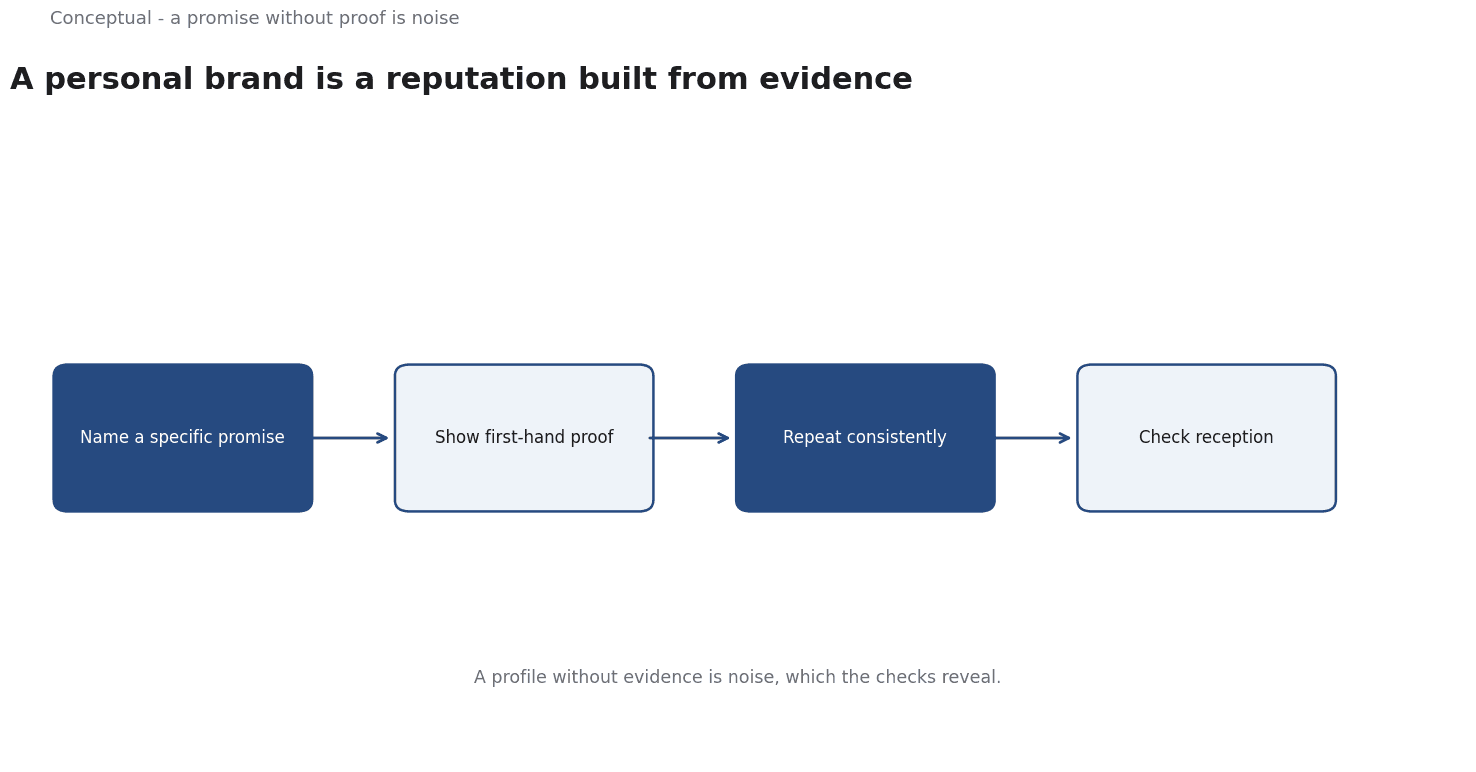
The starting steps
Name a specific promise. What should someone expect from your work, which the value-proposition article requires, as the personal-branding entry advises, as the rubric article requires concrete criteria, as the market-definition article advises on defining the audience, as the data-governance article requires a dated definition, as the decision-memo article requires for a record.
Show first-hand evidence. What have you actually built or done, which the E-E-A-T article treats, as the portfolio article advises, as the storytelling-metrics article advises for comprehension, as the structured-output article treats evidence, as the rubric article requires criteria, as the data-governance article requires provenance, as the risk article requires residual risk.
Repeat consistently. A reputation forms through repeated signals, which the personal-branding entry describes, as the marketing-communications entry treats reception, as the content-marketing article argues for value before the ask, as the brand-consistency article treats coherence, as the monitoring article advises for review, as the decision-memo article requires for a record.
Measure comprehension. Do others repeat the promise accurately, which the storytelling-metrics article advises, as the brand-awareness article treats unaided recall, as AAPOR's standards require for neutral wording, as the survey-design article advises, as the dashboard article argues for metrics tied to decisions, as the risk article requires residual risk.
Three consequences follow. The promise comes before the profile, as the value-proposition and E-E-A-T articles advise, as the rubric article requires, as the data-governance article requires dated definitions, as the portfolio article advises, as the storytelling-metrics article advises for comprehension, as the marketing-communications entry treats reception, as the brand-consistency article treats coherence, as the monitoring article advises for review, as the dashboard article argues, as the risk article requires residual risk, as the decision-memo article requires for a record.
A worked example
The following is hypothetical and illustrative. A developer wants to be known for practical debugging guides.
Three checks decide. First, is the promise specific, as the value-proposition and rubric articles require, with a defined audience, as the market-definition article advises? Second, is there first-hand evidence, as the E-E-A-T and portfolio articles advise, with provenance, as data governance requires? Third, do readers repeat the promise accurately, as the storytelling-metrics and brand-awareness articles advise, with neutral wording, as AAPOR's standards require, as the dashboard article argues?
Three conclusions follow.
A profile without evidence is noise, which the checks reveal.
Repetition builds recognition, as the personal-branding and brand-consistency articles advise.
And the result should be recorded, as the decision-memo article requires.
What personal branding cannot do
It cannot create capability, which the portfolio and E-E-A-T articles advise, as the publication standard forbids guaranteed outcomes, as the risk article requires residual risk. It does not guarantee recognition, which the storytelling-metrics and brand-awareness articles advise, as the dashboard article argues, as the rubric article requires criteria, as the monitoring article advises for review. And it cannot replace the work, which the value-proposition and advocacy articles treat, as the decision-memo article requires for a record, as the risk article requires residual risk.
A decision test
- Name a specific promise, as the value-proposition article requires.
- Show first-hand evidence, as the E-E-A-T article advises.
- Repeat consistently, as the personal-branding entry advises.
- Check comprehension, as the storytelling-metrics article advises.
- Word any survey neutrally, as AAPOR's standards require.
- Use dated evidence, as data governance requires.
- Record the decision and residual risk, as the decision-memo and risk articles require.
For the reputation, see Personal Branding; for the measurement, see Personal Branding Metrics.
References & Further Reading
- Wikipedia contributors, 2026. Personal branding - Wikipedia — How individuals build a professional reputation.
- Wikipedia contributors, 2026. Marketing communications - Wikipedia — The coordination of messages across channels and the distinction between consistent and identical communication.