Getting Started with Runway Extension
Runway extension depends on how cash actually moves. Cash flow categories and reserve logic map to specific levers, with a worked example, evidence table, and decision test.
A startup extends its runway and assumes the extra months buy safety. Often they buy only time: the same burn rate, pointed at a longer calendar, consumes the same cash faster than expected. Runway extension is useful only when it is grounded in how cash actually moves through the business.
Direct answer: Runway is the period a company can operate before its available cash runs out, given its current net burn. A cash flow statement records the actual inflows and outflows over a period, which is the evidence base for any runway claim. Extension tactics work by changing inflows, outflows, or timing, and each has a different cost and lead time.
Delta: This article adds a source-to-decision map beyond the sources: it links cash flow categories and emergency-fund logic to a specific extension choice, with claim status explicit.
The mechanism
A cash flow statement reports how cash entered and left a business over a period, grouped into operating, investing, and financing activities, and reconciles the net change to the cash balance at period end. That structure matters for runway because only cash, not accounting profit, pays salaries and invoices. A company can report a profit while still running out of cash if receivables are slow or inventory ties up funds, so the cash flow statement, not the income statement, is the right starting point.
Runway is the cash balance divided by the net rate at which cash is consumed. Because the denominator is net of inflows, anything that changes collections or payment timing changes runway even if spending is unchanged. This is where the cash flow categories become practical: operating cash flow shows whether the core business funds itself, investing cash flow shows capital demands, and financing cash flow shows how much the company depends on external money. A runway extension that ignores these distinctions can improve the headline number while making the underlying position more fragile.
The idea of an emergency fund, a reserve held to absorb unexpected expenses or income loss, translates directly to a company's liquidity buffer. Both exist to convert a shock into an inconvenience rather than a crisis. The trade-off is the same: money held in reserve is not being deployed, so a large buffer has an opportunity cost, while a small one leaves the organization exposed to a single delayed payment or a surprise bill. The right size depends on how volatile the inflows are and how quickly spending can be cut.
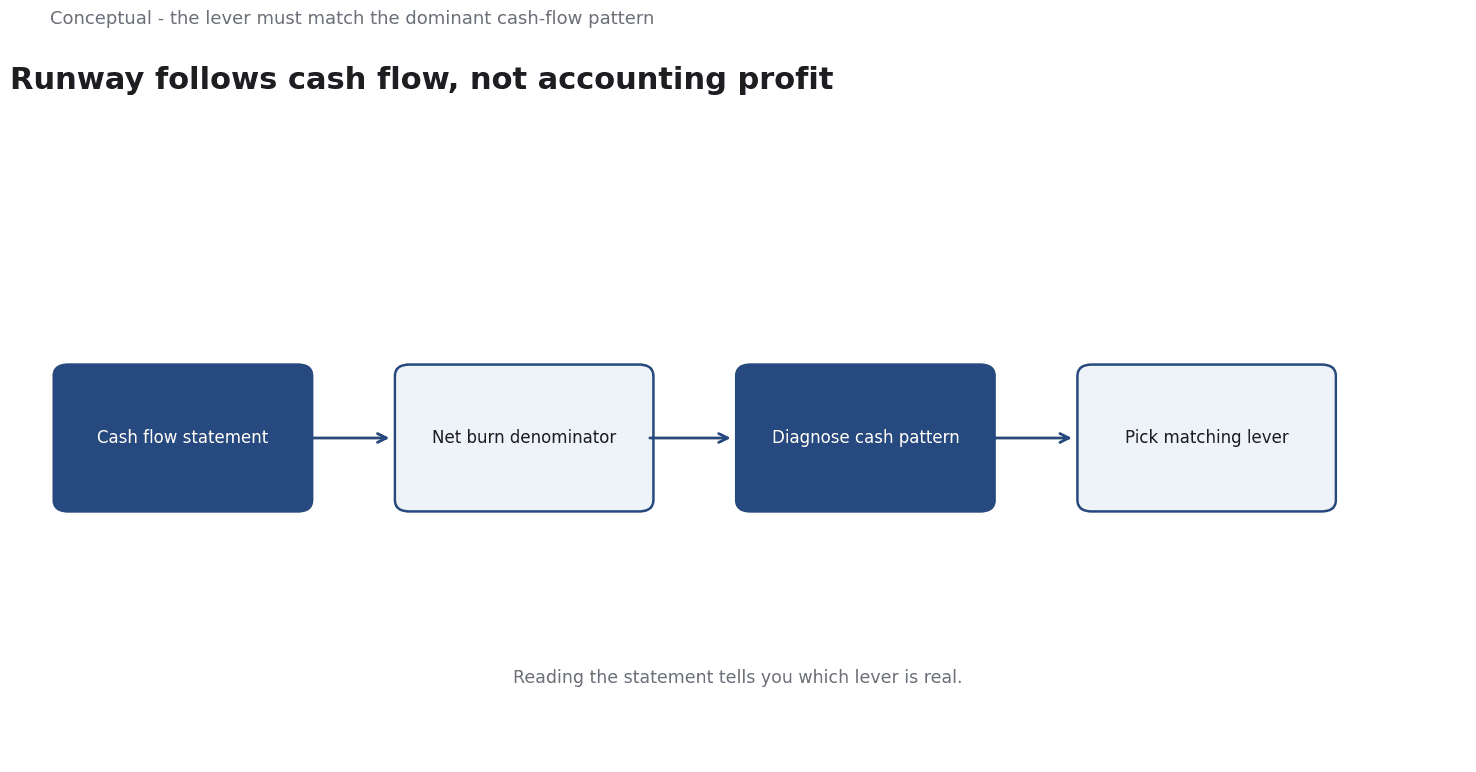
Extension levers therefore differ in more than magnitude. Cutting burn reduces the denominator permanently but may damage capacity. Accelerating receivables improves timing and can be reversible. Delaying payables shifts cash forward but strains relationships. Raising financing adds cash but introduces dilution or debt. Each lever appears somewhere in the cash flow statement, which is why reading that statement is the first step: it tells you which lever is actually available rather than which one sounds easiest.
A worked example
The following is hypothetical and illustrative. A small software company has eight months of runway and wants twelve. Rather than assume a cost cut will do it, the finance lead runs three checks against the cash flow statement. First, a composition check: operating cash flow shows that a large customer pays ninety days late, so much of the apparent burn is a timing problem, not a spending problem. Second, a buffer check: the company holds no reserve equivalent to an emergency fund, leaving it exposed to one more late payment. Third, a lever check: a ten percent cut in discretionary spend would add roughly one month, while negotiating earlier payment terms could add three. The outcome is to pursue payment terms first, hold the resulting cash as a buffer, and keep the cost cut as a backup rather than the plan.
Evidence status
| Claim | Status | Source | Verified | Recheck when |
|---|---|---|---|---|
| Cash flow statements group activity into operating, investing, and financing sections | source-reported | Wikipedia: Cash flow statement | 2026-11-18 | Accounting standard changes |
| An emergency fund is a reserve for unexpected expenses or income loss | source-reported | Wikipedia: Emergency fund | 2026-11-18 | Definition or guidance changes |
| Runway is most sensitive to the lever that matches the dominant cash-flow pattern | inferred | Derived from the sources | 2026-11-18 | Company-specific data is available |
The source-reported rows describe what the statements and reserves are; they say nothing about which extension lever a particular company should choose. The inferred row is the article's synthesis of those descriptions into a decision rule, not a sourced result. Recheck it when actual cash-flow data can replace the framework with measurement.
What it cannot do
This approach has a clear limit: the sources are explanatory, not prescriptive. They define the cash flow statement and the emergency fund but do not supply a target runway, a safe buffer size, or a ranking of extension tactics. Any specific number - twelve months, three months of reserves, a ten percent cut - is a planning assumption chosen for illustration, not a recommendation the sources support. The framework organizes a decision; it does not make it for you.
A hidden cost is that the levers are not equivalent. Reducing burn by cutting staff or delaying maintenance can raise runway this quarter and lower capacity next quarter, so the extension is partly borrowed from the future. Raising financing adds cash but carries dilution, interest, or covenants that constrain later choices. Holding a larger buffer improves resilience but leaves capital idle. A runway number that ignores these costs is like a diet measured only in weight lost, with no regard for what was lost.
The characteristic failure mode is optimizing the headline.
That is useful for a genuine timing problem and dangerous when it masks structural cash consumption. A related failure is confusing cash with profit: a profitable company with slow receivables can still run dry, while an unprofitable one with strong prepayments can last longer than its income statement suggests. Reading the cash flow statement is the defense against both errors.
The boundary is the kind of business. The framework assumes cash flows that can be categorized, measured, and forecast with reasonable confidence. Very early companies with no revenue history, or organizations with complex intercompany flows and delayed reporting, may find the categories too coarse to guide action. In those cases the first task is building reliable cash visibility, not choosing a lever, and a sophisticated extension plan built on weak data is worse than a simple one built on good data.
Runway also needs ongoing review. Inflows and outflows shift as customers, headcount, and contracts change, so the extension that made sense at the start of a quarter can drift. Set a review cadence and a few observable indicators - collection delay, cash balance versus plan, burn trend - that trigger a fresh look. Without that, runway becomes a number people quote rather than a measure they manage.
The counterargument that runway extension mainly means cutting costs is fair for companies whose burn is dominated by discretionary spending, and incomplete for those whose problem is collection timing or a missing buffer.
The right lever follows the dominant cash-flow pattern, not a default instinct.
A decision test
- Start with the cash flow statement. Separate operating, investing, and financing flows and confirm the current cash balance.
- Compute net burn. Use cash in versus cash out, not accounting profit, as the denominator.
- Diagnose the pattern. Decide whether the constraint is spending level, collection timing, or missing reserve.
- List the available levers. Map each candidate action to the flow it changes and its lead time.
- Price the cost. Record what each lever costs beyond the immediate cash benefit.
- Size a buffer. Decide how much reserve is needed given inflow volatility and how fast spending can be cut.
- Set a review trigger. Choose indicators and a date for revisiting the plan.
Runway extension is an exercise in cash mechanics, not optimism.
The cash flow statement tells you which lever is real, and the emergency-fund logic tells you how much resilience to keep. Pick the lever that matches the diagnosed pattern, write down its hidden cost, and revisit it on a fixed cadence so the extra months are real rather than arithmetic.
For further reading, see Cash Flow Forecasting: A 13-Week Operating Model.
References & Further Reading
- Wikipedia contributors, 2026. Cash flow statement - Wikipedia — Operating, investing and financing activities, and why net income and cash flow differ.
- Wikipedia contributors, 2026. Emergency fund - Wikipedia — Cash held for unexpected expenses.