Go-to-Market Strategy: How to Launch a Product
A launch is the moment a position is tested. Read how to connect the offer, the first customers, and the evidence you will collect.
Launch plans are usually measured by activity — press coverage, email sends, social posts, an event — and a launch can generate all of those and still fail. The reason is that a launch has one real job: to get the product in front of the people for whom it is obviously the answer, and to leave behind evidence about whether that was true.
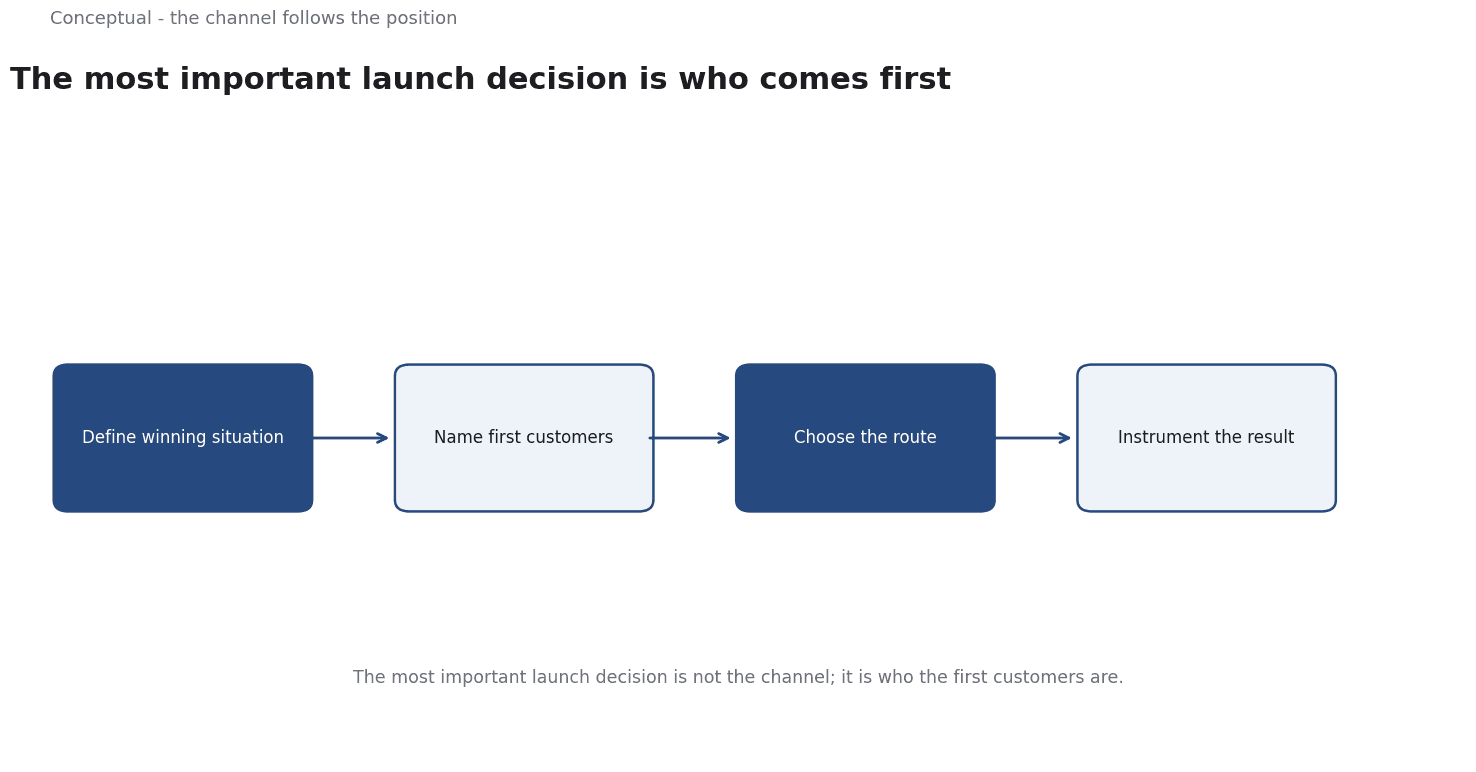
Direct answer: A go-to-market strategy connects a position to a specific first customer set and a repeatable route to them. The launch is the first measurement of whether the connection holds. The work therefore starts before any announcement: define the situation in which the product wins, identify who is in that situation, choose the route by which they will encounter it, and instrument what happens. Porter's trade-off logic applies — "a strategic position is not sustainable unless there are trade-offs with other positions" — so a launch that tries to appeal to everyone has already lost the positioning decision.
The first customer set is a strategic choice
The most important launch decision is not the channel; it is who the first customers are.
A useful first set has three properties: the problem is acute, the product already solves it convincingly, and the users are reachable through a route you can repeat.
That last property is where many launches fail.
It has found a market of that founder's acquaintances, which is different. The test is whether the same approach works when it is handed to someone else.
Choosing a narrow first set is also a trade-off in Porter's sense. It means refusing other segments, including some that look attractive, and the refusal is what makes the launch measurable — a small, coherent group produces interpretable evidence, while a broad one produces a mixture of signals you cannot attribute.
The route has to match the decision
The question "where do we launch?" is really "where does this buyer make this decision?"
For a developer tool, that may be documentation and a package registry; for a consumer product, a marketplace; for an enterprise system, a partner or a procurement process.
Distribution is part of the answer, and its importance is often under-rated relative to product quality. "Trade-offs occur when activities are incompatible", and a route choice determines which other routes you cannot take simultaneously: a partner-led launch cannot also be a fully direct one without creating the channel conflict that kills both.
This is why a launch plan must name the route explicitly, including the thing that has to exist for it to work — a listing, a relationship, a piece of documentation, a marketplace approval — and who owns it.
The message comes after the position
By launch time, the positioning work should be finished: the one-sentence description, the refusal list, and the proof points. If those are still being debated, the launch will produce a compromise message that nobody remembers.
Amazon's published company material is useful as a worked example of customer-led framing expressed in operating decisions rather than slogans. The lesson is not to imitate the language; it is that the language is downstream of something real. A launch message that has no corresponding activity behind it is a promise the product will struggle to keep, and the first customers will be the ones who notice.
Measurement is part of the launch
An event model determines what can be learned. Google Analytics defines an event as a measurable "interaction or occurrence" — a page load, a purchase, a link clicked — and the same principle applies to a launch: if the behaviour you need to evaluate was not recorded, the launch produced attention but no evidence.
Three measures matter at launch:
- Activation — how many of the people who encountered the product reached the first moment of value. This is the test of the product and the message together.
- Time to activation — how long it took. A long delay often means the product is asking the user to do the work the launch should have done.
- Quality of the first cohort — whether these are the customers you wanted, not merely the ones who were easiest to reach.
For decisions about spend, attribution is insufficient. Google Ads describes attribution models as a way to "choose how much credit each ad interaction gets for your conversions" — a rule, not a counterfactual. Where a launch operates at market level, Google's published geo-experiment work provides the alternative: "one approach that Google has successfully employed to measure advertising effectiveness is geo experiments", with a systematic design process.
A launch sequence that holds up
- Write the position and the refusal list. If the trade-offs are not decided, the message will be generic.
- Define the first customer set by acuteness of need, product fit, and repeatable reach.
- Choose the route and name the thing that has to exist for it to work.
- Prepare the evidence — the proof points, documentation, and answers to the questions that buyer will ask.
- Instrument activation and time to activation before the announcement.
- Launch to the narrow set first, and fix what the first cohort reveals.
- Expand only when the route is repeatable by someone other than the founder.
For the positioning work, see Product Marketing; for the sales-led alternative, see Founder-Led Sales.
A counterargument
A reasonable critic could argue that the article applies Porter's trade-off logic too early. That framework describes sustainable positions for established competitors, while a launch is often exactly the period when the winning segment is still unknown - and the prescription to refuse other segments assumes the "first customer set" has already been chosen correctly. A critic could add that the insistence on a route repeatable by someone other than the founder sits uneasily beside the article's own pointer to founder-led sales, where founder dependence is the point at the earliest stage. The measurement advice is similarly demanding: attribution is described as "a rule, not a counterfactual" and geo-experiments are cited, both of which need volume a narrow launch may not provide, so the discipline can push an early team to commit before it has evidence.
References & Further Reading
- Wes Bush, 2026. Product-Led Growth — The activation and engagement loop definition that PLG teams actually use.
- Colin Bryar and Bill Carr, 2019. Amazon Company News — Primary company material on how the working-backwards method is applied.
- Michael E. Porter, 1996. What Is Strategy? — The differentiation-versus-cost argument behind competitive-advantage analysis.