Product Marketing: Positioning, Messaging, and Launch Frameworks
Product marketing is the discipline that makes a position understandable at the moment of choice. Read how to build a launch that survives contact.
Product marketing is often mistaken for the function that writes launch copy. That is its most visible output, and confusing output with purpose explains why the role is frequently added too late — after the product is built and the position is fixed — and then asked to make an incoherent artefact sound compelling.
Direct answer: Product marketing exists to translate a position into the language of the buyer, and to make sure the organisation can deliver what the translation promises. That work starts before launch, at the point where product decisions are still open, and it ends after launch, when evidence about whether the message was understood has arrived.
The test of a launch is not the volume of coverage; it is whether the people who encountered the product could say, in their own words, what it is for and why they would choose it.
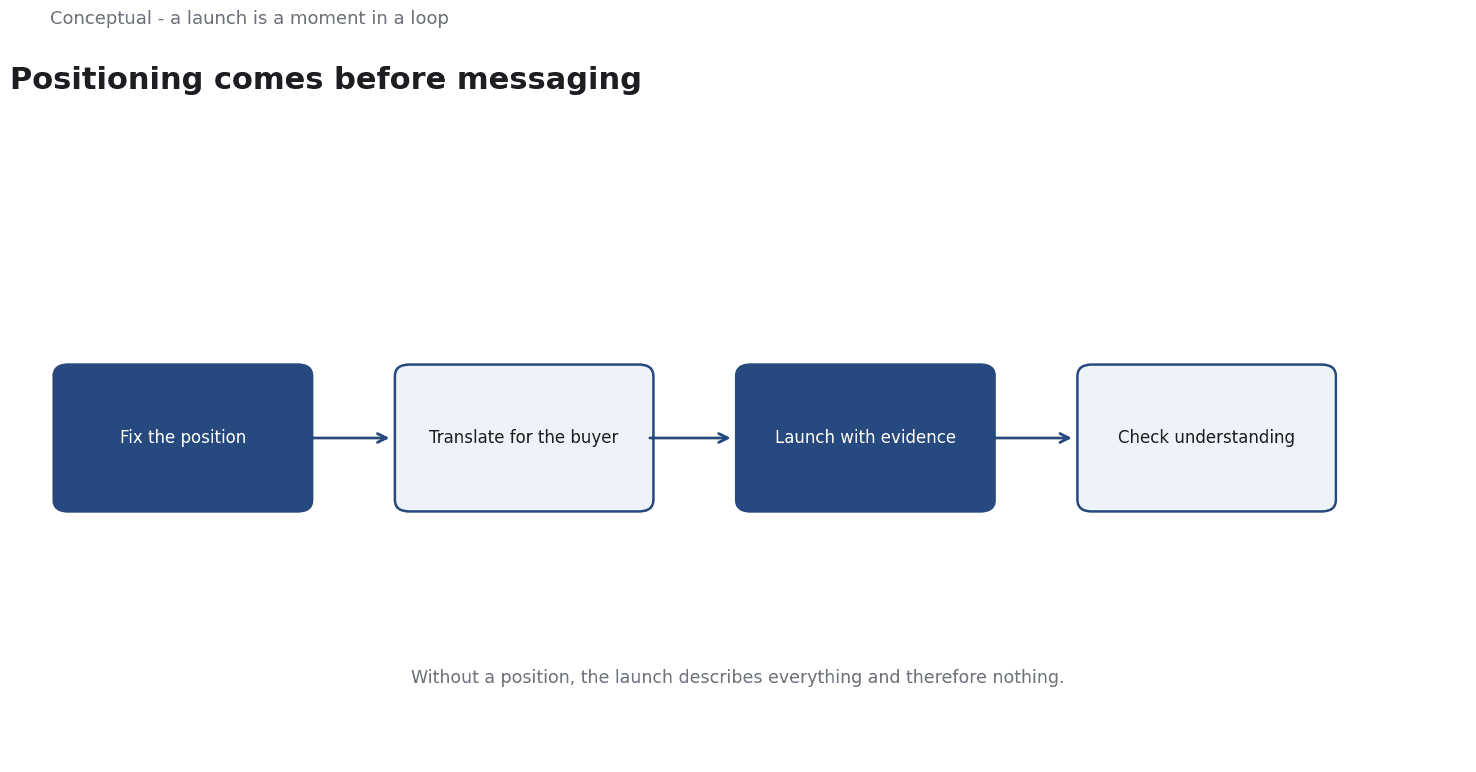
Positioning comes before messaging
Porter's argument gives the discipline its backbone. A position is defensible because of trade-offs — "a strategic position is not sustainable unless there are trade-offs with other positions" — and a message that describes a trade-off is far more useful than one that lists strengths.
A message built from strengths sounds like: "Our product is faster, easier, and more secure." Nobody can act on that, and it is true of every competitor. A message built from a position sounds like: "For teams that need X without Y, this is the option designed for that trade." The second gives the buyer a decision rule and gives the seller a boundary.
The practical implication is that product marketing cannot be handed a finished feature list and asked to produce a story. It has to be in the room when the question "what are we deliberately worse at?" is answered, because that is the decision the message will eventually express.
Messaging is a system, not a tagline
The output of product marketing is a small set of consistent statements that work at different levels of detail:
- A one-sentence position that a person can repeat after hearing it once.
- A set of proof points — facts about the product, its behaviour, and its adoption that make the sentence credible.
- Objection handling for the specific reasons a buyer says no, including the cases where the competitor genuinely wins.
- A vocabulary that product, sales, support, and documentation all use, so the buyer does not have to translate between teams.
That last item is the one most often missed, and it is why a launch can feel uncoordinated even when every individual asset is good. If the website calls it one thing, the sales deck another, and the onboarding flow a third, the buyer does not know what they bought — and a confused buyer rarely expands.
Amazon's published company material is useful here as a worked example of consistency at scale: the customer-led framing appears in how products are described and in how decisions are explained, rather than only in a marketing slogan. The lesson is not the specific language, but that the language is downstream of an operating principle.
Launch is a moment in a loop, not an event
The standard launch checklist — press, email, social, a webinar — describes activity, not outcomes. A useful launch has three phases.
Before: define the situation in which the buyer should choose the product, verify that the product actually delivers it, and ensure the internal teams can answer the same three questions in the same words. In a self-serve motion, Google Analytics' event model is the relevant check: "An event allows you to measure a specific interaction or occurrence on your website or app." If the activation event you need to measure is not recorded before launch, you cannot tell whether the launch worked, and the post-mortem will be an argument.
During: make the message available where the buyer is already deciding — which may be a marketplace, a search result, a partner's recommendation, or a product surface they already use. This is the distribution question, and a product that is excellent but absent from the decision moment loses for reasons that have nothing to do with the product.
After: measure understanding, not just attention. Can a new user say what the product is for? Do they reach the activation event? Which objection appeared most often in conversations with sales? Those are measures of the message, and they are actionable; pageviews are not.
The product-led version of this is explicit: teams organise around activation and engagement loops, and the product itself is the primary message. In that world, product marketing's job includes making the loop legible — inside the product, in the documentation, and in the launch — rather than only describing it externally.
A working sequence
- Get the position decided before the message. If trade-offs are not written, the launch cannot be honest.
- Write the one-sentence position and the refusal list together. They are the same decision seen from two sides.
- Build the proof set from real product behaviour, not from aspirations.
- Align the vocabulary across product, sales, support, and docs before the announcement.
- Instrument the decision you want the buyer to make, and confirm the event is being recorded before launch.
- Choose the surfaces where the message must appear, and check that the product is available at those moments.
- Review understanding after launch — what users repeat back, where they stall, and which objection recurs.
For the upstream strategic argument, see Brand Positioning; for the go-to-market side, see Go-to-Market Strategy.
A counterargument
A reasonable critic would note a tension between the article's two halves. It insists, on Porter's authority, that positioning must be settled before messaging, yet its launch section treats the product itself as the primary message in a product-led motion, where the story is learned from use rather than fixed in advance. The Amazon working-backwards example it cites is an iterative practice, not a one-off decision handed downstream. The proposed test of success, whether users can repeat the position in their own words, is also asserted rather than operationalised: the Google Analytics event model it invokes records interactions, not comprehension, and no instrument is offered for the thing it says matters.
The discipline the article describes is sound; the tidy sequence is more rigid than its own sources support.
References & Further Reading
- Michael E. Porter, 1996. What Is Strategy? — The differentiation-versus-cost argument behind competitive-advantage analysis.
- Colin Bryar and Bill Carr, 2019. Amazon Company News — Primary company material on how the working-backwards method is applied.
- Wes Bush, 2026. Product-Led Growth — The activation and engagement loop definition that PLG teams actually use.