Founder-Led Sales: Early-Stage GTM, Founder-Led Selling, and Hiring the First Sales Team
Founders sell early because they are the only people who can learn and adapt at the same time. Read the pipeline arithmetic and the signal for hiring.
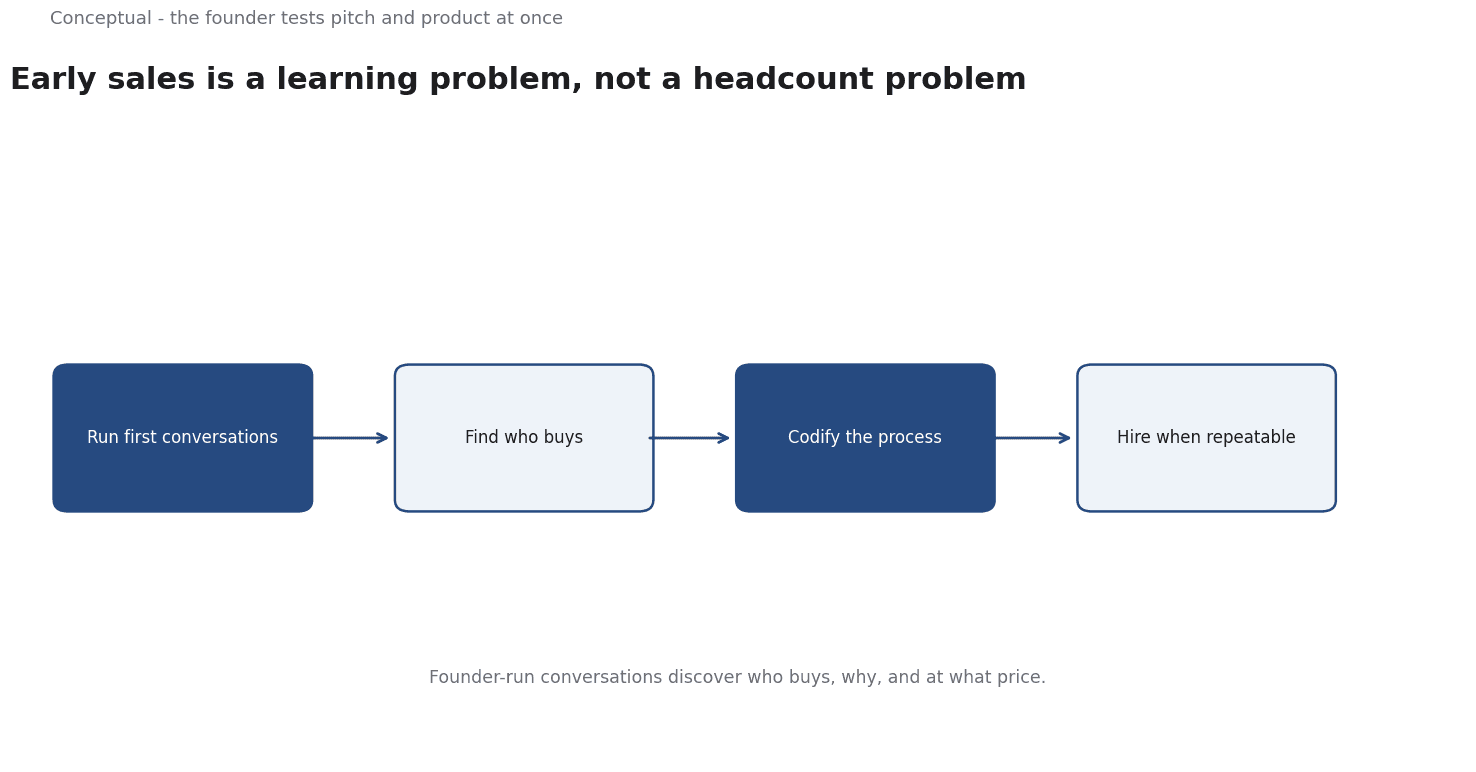
Early-stage companies often hire a sales team too early, or not at all. Both errors come from the same misunderstanding: sales at this stage is not a headcount problem but a learning problem. The founder sells because nobody else can simultaneously test the pitch, hear objections, and change the product on Monday.
Direct answer:
Founder-led sales is the practice of having the founder run the first customer conversations to discover who buys, why, and at what price, before codifying a repeatable process.
Michael Porter's warning in What Is Strategy? is relevant: "operational effectiveness is not strategy", and positioning should not be rejected as too static just because markets are dynamic. The boundary: founder-led selling is a phase, not a strategy. It ends when the motions are repeatable enough for someone else to execute.
Why the founder sells
Three reasons justify the phase, and they are all about information.
The feedback loop is short. A founder who hears an objection in the morning can change the demo in the afternoon. An employee following a script cannot, and the organisation loses the learning even if the deal closes.
The first customers are design partners. Early buyers tolerate unfinished products in exchange for influence. That exchange works only if the person with product authority is in the room.
The story is not yet codified. Before there is a repeatable pitch, the founder's understanding of the problem is the pitch. Handing it to someone else transfers an incomplete script.
Product-led growth advocates — ProductLed describes itself as helping teams "build a product that sells itself" — argue that self-serve motions can replace much of this. That is a legitimate model for products with a clear, immediate value moment. It does not remove the need to learn who the user is; it changes where the learning happens. Treat the claim as a positioning, not a law.
A worked example of pipeline arithmetic
The following numbers are hypothetical and illustrative.
Suppose a founder can spend 10 hours a week on sales. A discovery call takes 30 minutes, a demo 1 hour, and closing work averages 2 hours per opportunity. From experience in this example:
- 20 discovery calls → 8 demos (40%)
- 8 demos → 4 pilots (50%)
- 4 pilots → 2 contracts (50%)
Hours required: 20 × 0.5 = 10 for discovery, 8 × 1 = 8 for demos, 4 × 2 = 8 for closing — 26 hours, plus 6 hours of travel and follow-up. At 10 hours a week, one full cycle takes roughly three to four weeks.
Now ask whether to hire. A first sales rep with a 40-hour week could theoretically run 2.7× the founder's volume, but only if the motion is repeatable. Two tests decide it:
- Has the pitch converged? If the founder is still changing the core message every week, a rep will learn a moving target.
- Is there a conversion baseline? Without the 40%/50%/50% figures above — measured, not assumed — there is no way to set a quota or judge the rep.
A useful rule: hire when the founder can write down the process well enough that a new person could run it with coaching, and when the pipeline exceeds what the founder can personally handle. Hiring before that point outsources the learning rather than the selling.
Where the first hire usually fails
Three failure modes are common.
Hiring a closer when the work is discovery. At this stage the rep must qualify, learn, and feed the product.
No defined ICP. "Anyone with the problem" is not an ideal customer profile. The rep needs to know which signals predict a good fit and which deals to decline — which is exactly what the founder's early calls should have produced.
Expecting a ramp that does not exist. A new rep needs examples, objection handling, and a clear definition of a qualified opportunity. If these live only in the founder's head, the ramp is indefinite.
The counterargument — that founders who refuse to hire are simply control-freaks — deserves a response. Some are. But the test above distinguishes a genuine lack of repeatability from a personality problem: if the process is written and the pipeline is full and the founder still will not delegate, that is the latter.
When self-serve changes the motion
A product-led motion does not remove the founder's learning problem; it moves it. Instead of hearing objections on calls, the team observes where users stop in the product. The equivalent of the discovery call is the activation funnel, and the equivalent of the pitch is the first-run experience.
Three conditions make self-serve viable:
- The value moment is immediate. A user can reach the core benefit without a salesperson, a procurement process, or a lengthy setup.
- The price is understandable without negotiation. If every deal requires a custom discussion, the motion is sales-led whatever the website says.
- The product can observe its own failures. Instrumentation must show where users abandon, or the learning loop is broken.
Where these conditions fail, founder-led selling is not a fallback — it is the only way to gather the information the product cannot yet produce. ProductLed's framing of a product that "sells itself" is a useful goal to test against, not a description of every early-stage company.
A hybrid is common: self-serve for small accounts, founder-led for the first few large ones. The discipline is to keep the two funnels separate in the metrics, because blending them hides which motion is actually working.
What the literature can and cannot tell you
Porter's What Is Strategy? is useful for the framing, not for the tactics. Its central point — that strategy involves choosing a distinctive position and a set of activities that fit it, rather than simply doing everything better — applies directly to an early GTM decision. A startup that tries to serve every segment with one message has not chosen a position.
What Porter does not provide is a sales playbook, and neither do the other sources in the reading list. Amazon's company news and NRF press releases describe large organisations, not the first ten deals of a new product. Treat such examples as illustrations of scale, not as templates.
There is no well-supported universal sequence for GTM; the honest method is the pipeline arithmetic above, using your own measured rates.
This is also where survivorship bias bites. The famous early-sales stories are the companies that found a repeatable motion. The companies that sold founder-led for two years and never escaped are less visible.
A decision test
- Measure the funnel from discovery to contract with your own conversion rates.
- Calculate the founder's capacity in hours and compare it to the pipeline.
- Write the process down — ICP, qualification signals, objection responses, demo sequence.
- Check convergence: has the core pitch been stable for several weeks?
- Hire for the stage — discovery and learning, not just closing.
- Set a review date for the hire with explicit signals, not a vague "see how it goes".
- Keep the feedback loop from sales to product after the hire; the learning does not stop being valuable.
For the positioning question, see Product Marketing; for the strategic frame, see The Difference Between Building a Product and Building a Business.
References & Further Reading
- Wes Bush, 2026. Product-Led Growth — The activation and engagement loop definition that PLG teams actually use.
- Colin Bryar and Bill Carr, 2019. Amazon Company News — Primary company material on how the working-backwards method is applied.
- National Retail Federation, 2026. NRF Press Releases | Latest Statements & Announcements | NRF — Primary retail-sales and channel data for sell-in versus sell-out definitions.