Goal Setting Metrics that Matter
Useful goals are specific, appropriately hard, and tied to real work. Learn the source definitions, a worked review, and the limits of metric-driven goal setting.
Goal setting is often treated as a ritual: a list of aspirations written at the start of a quarter and forgotten by the end of it. The problem is not ambition but vagueness. When a goal has no clear endpoint and no yardstick, it cannot guide daily choices, and any metric attached later tends to measure activity rather than progress.
Direct answer: Write goals that are specific, measurable, and appropriately demanding, then ground them in the tasks the role actually contains. The Wikipedia entry summarizes goal-setting theory; the O*NET database describes occupational tasks and skills. Pair each goal with feedback, because difficulty without feedback is noise.
Delta: This article adds a claim-status table beyond the sources: it maps each goal metric to a concrete review decision, with claim status explicit.
The mechanism
The Wikipedia entry on goal setting describes a body of work in which specific, challenging goals lead to better performance than vague instructions to "do your best." The theory also identifies moderators: commitment, feedback, task complexity, and situational constraints. The practical consequence is that difficulty is useful only under conditions that let a person see how they are doing and believe the goal is attainable. A hard target with no feedback is not motivating; it is just opaque.
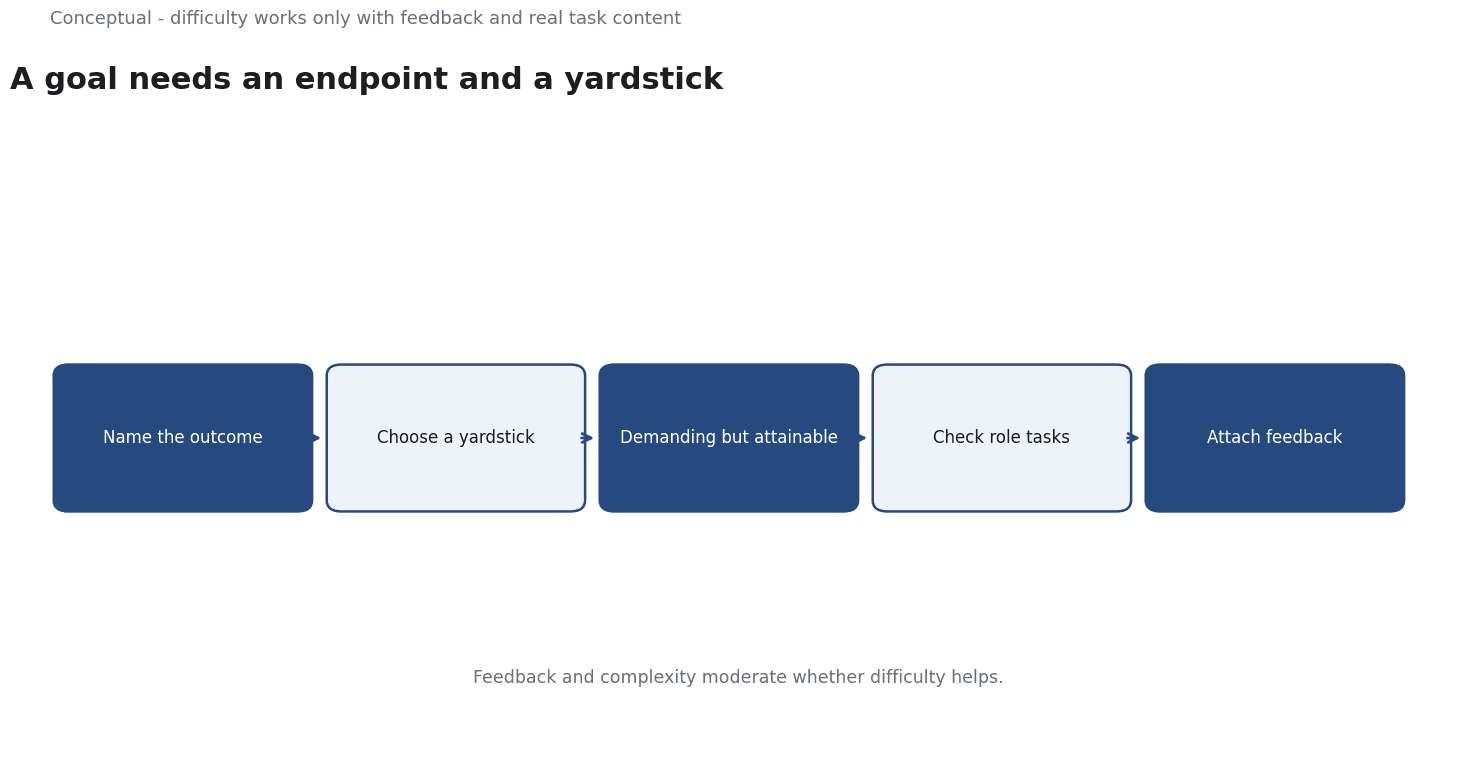
Measurability is the bridge from a vague aim to a trackable one. Specificity supplies the endpoint, and a metric supplies the yardstick that makes progress visible. The sources do not prescribe a particular framework, so the familiar acronym of smart goals is a memo device rather than a sourcing claim.
What matters is that the goal states what changes, by how much, and by when, so that two reviewers would read the same endpoint.
The ONET OnLine database, maintained by the U.S. Department of Labor, catalogs occupations in terms of tasks, skills, abilities, work activities, and contexts. Its relevance here is practical: it gives a writer a source of real job content to anchor a goal. Instead of inventing a metric, one can ask which tasks the occupation actually involves and write a goal around them. ONET is descriptive, however. It does not tell an organization what to prioritize, so using it as a relevance check is an inference, not a sourced rule.
The output is a small set of goals, each with a metric, a difficulty level, and a review cadence. The sequence is: name the outcome, choose a yardstick, set a demanding but attainable level, check it against the role's real tasks, then schedule feedback. Each step narrows the next.
A worked example
The following is hypothetical and illustrative. A support analyst wants a better performance goal than "improve customer support." Three checks reframe it. First, is there a specific endpoint, such as first-response time within a stated window? Second, is the target demanding but attainable given current staffing, so it stretches without being arbitrary? Third, does it map to tasks the role actually contains, checked against occupational descriptions? The review finds the proposed metric measures ticket closure rather than resolution quality, and that the real task is accurate diagnosis. The team rewrites the goal around resolution accuracy with a monthly review. The new goal is harder to game because it checks the outcome rather than the volume of activity. The numbers are hypothetical; the verification method is the contribution.
Evidence status
| Claim | Status | Source | Verified | Recheck when |
|---|---|---|---|---|
| Specific, challenging goals outperform vague ones | source-reported | Wikipedia, Goal setting | 2026-11-18 | Theory revised |
| O*NET catalogs occupational tasks and skills | source-reported | U.S. Dept of Labor, O*NET OnLine | 2026-11-18 | Database updated |
| Grounding goals in role tasks improves relevance | inferred | Derived from the sources | 2026-11-18 | Role changes |
The first two rows are stated by the sources. The third is an inference about how to use a descriptive database, since O*NET does not prescribe goals. Recheck the theory row when the summary changes, the database row when occupational data is updated, and the inferred row when the role itself changes.
What it cannot do
Metrics cannot decide what matters. A goal can be perfectly specific and still point at the wrong outcome. The theory describes how goals affect performance; it does not rank which goals are worth pursuing. That is a judgment about strategy and values, and it sits outside what the sources can supply.
The hidden cost is measure fixation. Once a number is attached to a goal, effort flows toward moving that number, sometimes at the expense of the unmeasured work around it. A response-time target can speed up replies while lowering answer quality; a ticket-count target can encourage closing cases early. The sources note that feedback and complexity moderate goal effects, but they do not eliminate this risk. The team must watch the unmeasured side effect and treat it as part of the goal's design, not as an afterthought discovered at review time. A goal that ignores its own side effects is incomplete on paper.
There is a motivation boundary. Heavy emphasis on external metrics can crowd out the internal reasons people do careful work, especially for complex tasks where quality is hard to specify in advance. The Wikipedia entry's moderators are relevant here: for complex tasks, a single narrow goal can be less helpful than learning-oriented guidance. A metric that works for a routine task may mislead for a hard one.
The O*NET source has its own limit. It describes occupations in general terms and lags the way real roles evolve. A fast-changing job may not match its catalog entry, so grounding goals in it is a starting check, not a final authority. The writer must still look at the actual work, because a role that combines several occupations will not fit any single catalog entry neatly. The database is a prompt for questions, not a source of answers.
Goals also go stale. Priorities shift, staffing changes, and a target that was once demanding becomes routine. Each goal therefore needs a recheck condition and a date, so a reviewer can tell whether the metric still reflects the work. Without that record, the quarterly ritual resumes.
The counterargument that metrics are fair for routine work is incomplete when the task is complex and quality resists a number.
A decision test
- State the outcome the goal is meant to change.
- Choose a yardstick two reviewers would read the same way.
- Set a demanding but attainable level.
- Check the goal against the tasks the role actually contains.
- Attach feedback at a defined cadence.
- Name the likely side effect the metric could encourage.
- Record a recheck date and the condition that would invalidate the goal.
The test converts a slogan into a small set of inspectable choices. Its value is not the metric itself but the record of why that metric was chosen and when it must be revisited. For further reading, see Decision Memos That Survive Review.
References & Further Reading
- Wikipedia contributors, 2026. Goal setting - Wikipedia — Process of defining objectives and measures.
- U.S. Department of Labor, 2026. O*NET OnLine — The standard occupational taxonomy used to compare roles across industries.