Gold Markets in Practice
Gold is priced by supply, demand, and real rates. Read the source definitions, a worked example, and why volatility limits what a position can prove.
Gold is often presented as a simple safe haven, but the term hides the question of what actually moves its price. The Wikipedia gold-as-an-investment entry describes the ways investors hold gold, and the volatility entry describes dispersion of returns. The real problem is that a gold position is routinely justified by a story rather than by a stated exposure and a measured tolerance for price variation.
Direct answer: Gold is priced through supply, demand, and macro conditions such as real rates, and its returns vary over time. The sources describe investment forms and volatility; the rule that a position needs a stated exposure and a volatility budget is a synthesis. A safe-haven label alone does not specify either.
Delta: This article adds a claim-status table and an exposure-first test beyond the sources: it maps gold's role to the portfolio decision it can support, with claim status explicit.
The mechanism
The gold-as-an-investment entry describes several ways to hold the metal, including physical bullion, coins, exchange-traded products, and mining shares. These forms differ in custody, liquidity, and what they actually track. Physical gold is the asset itself, while a mining share is a claim on a company whose returns also reflect operating decisions. The practical consequence is that gold exposure is not one thing. A decision about gold has to name the instrument first, because the risk of a fund and the risk of a mine are not the same risk.
The volatility entry describes dispersion of returns around an average, usually measured from historical prices. For gold, this means the asset can move sharply even when its long-run story is calm. A low stated correlation with other assets does not imply low movement; it only implies a relationship. The practical consequence is that position size matters more than narrative. The same allocation can be prudent at one size and destabilising at another, because the variation scales with the amount held.
Macro conditions link the two. Gold pays no cash flow, so its price is sensitive to real interest rates and to demand for stores of value. When real rates rise, the opportunity cost of holding a non-yielding asset increases. The sources do not provide a forecast, and none is implied here. What they support is a method: state the condition under which the position is expected to help, and check whether that condition still holds rather than relying on the asset's reputation.
The sources describe investment forms and volatility; they do not say how much gold a particular portfolio should hold. Sizing and rebalancing are inferred, not source-reported.
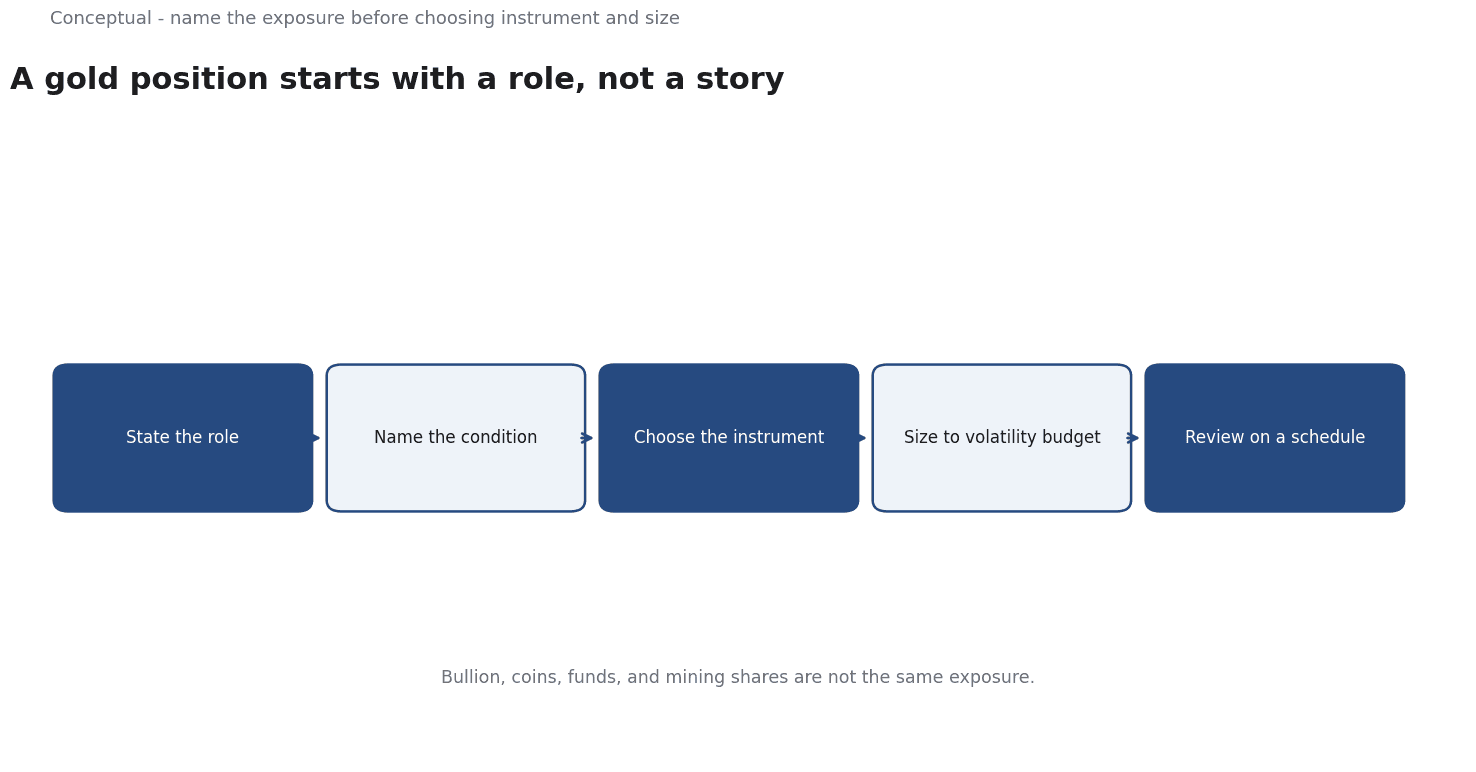
A useful discipline is to write the role - hedge, diversifier, or store of value - and then choose the instrument and size that fit it.
That prevents a label from doing the work of a decision.
A worked example
The following is hypothetical and illustrative. An allocator considers adding gold to a balanced portfolio and must choose between bullion and a gold fund. Three checks decide. First, what is the role - a diversifier for equity shocks, not a return forecast. Second, which instrument tracks that role, given custody costs and how closely it follows the metal? Third, what volatility budget can the portfolio absorb before the position is reduced? The allocator finds the fund tracks the metal closely enough for the role while bullion adds custody friction, and sets a size that keeps the position within the budget. Rebalancing bands are recorded. The numbers are hypothetical; the verification method is the contribution.
Evidence status
| Claim | Status | Source | Verified | Recheck when |
|---|---|---|---|---|
| Gold can be held as bullion, coins, funds, or mining shares | source-reported | Wikipedia, Gold as an investment | 2026-11-18 | Investment forms revised |
| Volatility measures dispersion of returns around an average | source-reported | Wikipedia, Volatility | 2026-11-18 | Definition revised |
| Name the gold role before choosing instrument and size | inferred | Derived from the sources | 2026-11-18 | Portfolio role changes |
The first two rows restate descriptions in the sources. The third row is a synthesis, since neither source prescribes portfolio construction. Recheck the definitions if the source entries change, and recheck the inferred claim when the portfolio's role for gold or its risk budget changes.
What it cannot do
Gold cannot be relied on to deliver income. It produces no cash flow, so a position depends on price change rather than distributions. The gold-as-an-investment entry describes holding forms; it does not promise a return. A holder who needs yield from the position is relying on a property the asset does not have. That gap is easy to miss when the position is described only by its reputation.
The hidden cost is carry and tracking. Physical gold involves storage and insurance, and funds charge fees that accumulate over time. Mining shares add business risk that has little to do with the metal's price. These costs are small in a single period but compound across a long holding. Because the sources describe forms rather than costs in detail, the cost of a chosen form must be read from the specific product rather than assumed.
A sharp market event can send gold higher, but the same asset can fall when real rates move against it. A position entered on a narrative has no stated condition for being wrong, so there is nothing to check when the narrative fades. This is an inference from the gap between an asset's reputation and a defined exposure; the sources do not discuss entry discipline.
There is a boundary around what volatility describes. It summarises past dispersion; it does not set a future loss limit. A historically calm period can understate the movement that occurs under stress, and a volatility figure computed over one window may differ from another. The volatility entry describes the measure, not a guarantee about tails. A position must therefore have an absolute loss tolerance that does not depend on a single statistic.
Because roles and conditions change, a gold position needs periodic review. The stated role, instrument, size, and volatility budget should be checked together, and the position trimmed when one no longer fits. The rationale and a recheck date should be recorded at entry. Without that record, a holder cannot distinguish a deliberate hedge from an unexamined habit.
The counterargument that gold's long history justifies a standing allocation is fair for a durable store-of-value role and incomplete when the position is meant to hedge a specific, changing risk.
A decision test
- State the role gold is meant to play.
- Name the condition that would make the position help.
- Choose the instrument that tracks that role.
- Set a size within a volatility budget.
- Check custody, fees, and tracking differences.
- Record the rationale and a loss tolerance.
- Review role, size, and budget on a schedule.
Gold is best treated as a role to be specified, not a reputation to be inherited. The test forces the role, instrument, and size into one record so a reviewer can see what the position is for and when it should be revisited. For further reading, see Cash Flow Forecasting: A 13-Week Operating Model.
References & Further Reading
- Wikipedia contributors, 2026. Gold as an investment - Wikipedia — Gold held as a store of value and investment.
- Wikipedia contributors, 2026. Volatility (finance) - Wikipedia — The degree of variation in prices over time.