Hiring Trade-Offs
Every hire is a bet on a role and a team. Read the trade-offs, a worked decision, and why a headcount is not a solution by itself.
Hiring is often treated as the answer to overload, which skips the question of whether the work is defined. A new person added to an unclear role inherits the confusion, which the re:Work hiring material treats hiring as a practice to examine, as O*NET's task descriptions help define what the role actually does, as Engineering Management: Hiring, Culture, Metrics, and Career Ladders treats capacity as a set of decisions, as the technical-debt article warns about complexity that outgrows its purpose.
Direct answer:
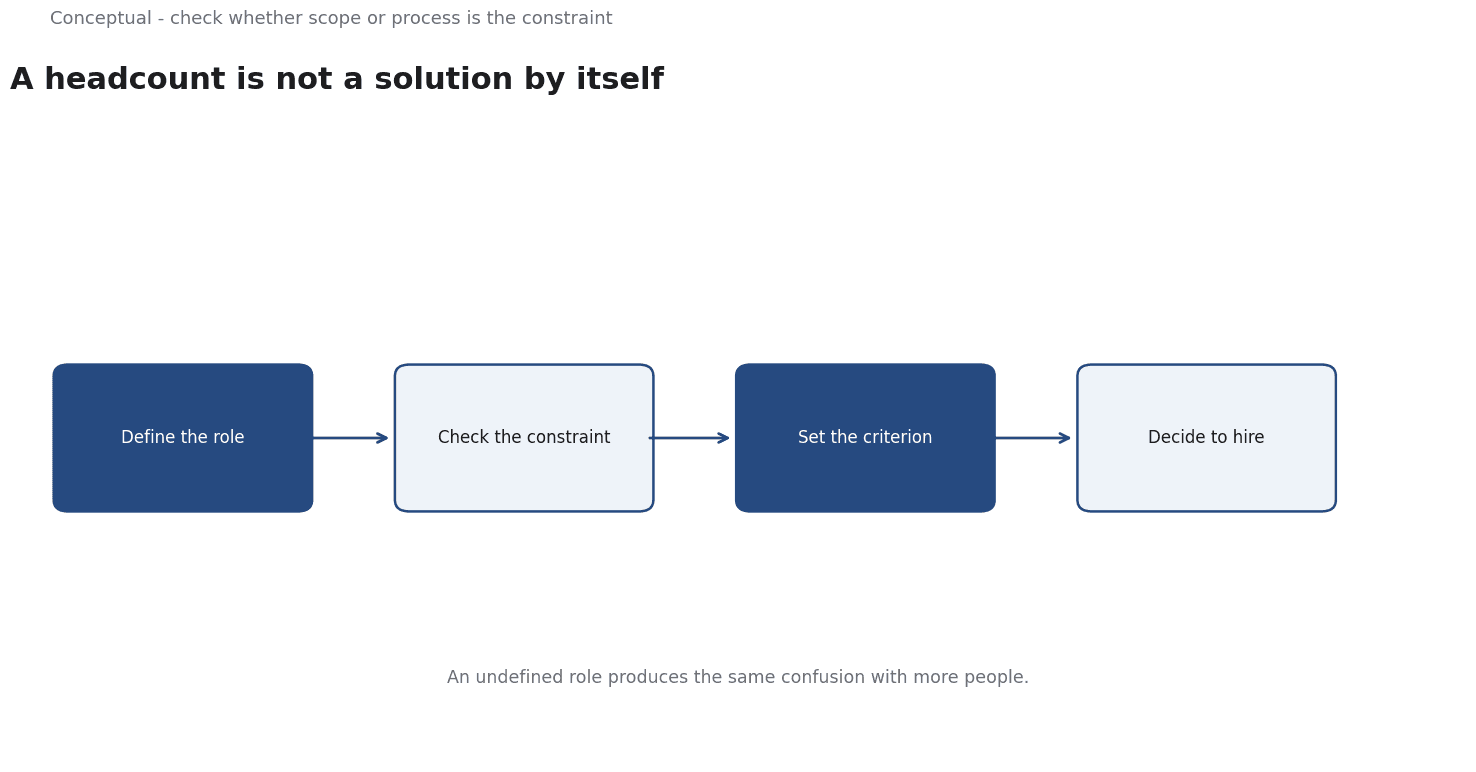
Decide whether hiring is the right response by defining the role's tasks, checking whether process or scope is the real constraint, and setting a criterion for the hire.
Google re:Work provides hiring practice, and O*NET provides role definitions. The boundary: this is educational orientation, not legal or HR advice — employment obligations are jurisdiction-specific, as the AI HR screening article treats formal duties, as the publication standard forbids guaranteed outcomes.
The trade-offs
Capacity versus clarity. A hire adds hands, not definition, which the O*NET-style task descriptions help with, as the value-proposition article treats clarity as prior, as the decision-memo article requires a specific question.
Speed versus fit. Hiring quickly to relieve pressure can lower the bar, which the hiring-checklist article treats as a set of deliberate steps, as the behavioral-interview article advises for evidence, as the evaluation-rubric article requires for concrete criteria.
Cost versus contribution. A salary is a recurring cost, which the unit-economics article requires for contribution, as the cash-flow-forecasting article treats as a committed expense, as the marketing-budget article advises on allocation. The hire should be justified against the work, as the decision-memo article requires.
Generalist versus specialist. A specialist solves a narrow problem well; a generalist covers more ground, which the T-shaped-professional article treats as a combination, as the O*NET-style task descriptions help define the need, as Engineering Management: Hiring, Culture, Metrics, and Career Ladders advises on career ladders.
Three consequences follow. The role should be defined before the search, as O*NET-style task descriptions support, as Hiring Checklist advises. The decision should use a criterion, as the rubric article requires, as the behavioral-interview article advises for evidence. And the result should be reviewed, as the monitoring article treats as a trigger, as the decision-memo article requires for a record.
A worked decision
The following is hypothetical and illustrative. A team is overloaded and considers hiring a project manager.
Three checks decide. First, is the overload a capacity problem or a scope problem, as the engineering-management and value-proposition articles ask, with the tasks defined, as O*NET-style descriptions support? Second, does a new person with a defined role change the constraint, as Hiring Checklist advises, with a criterion for success, as the rubric article requires? Third, can the recurring cost be justified, as the unit-economics and cash-flow articles require, with the decision recorded, as the decision-memo article requires?
Three conclusions follow. If scope is the problem, a hire will not fix it, which the first check reveals. A defined role with a criterion is testable, as the rubric article requires. And the decision should be recorded with assumption, as the decision-memo article requires.
What hiring cannot do
It cannot fix an unclear strategy, which the value-proposition and positioning articles treat as prior, as the decision-memo article requires. It does not guarantee a good outcome, which the publication standard forbids claiming, as the risk-assessment article requires residual risk. And it cannot remove legal obligations, which the HR and legal articles treat as formal, as the governance checklist requires an accountable owner.
The counterargument that more people always help is fair when the work is defined and the constraint is capacity and incomplete when scope is the problem, which the worked decision shows, as Engineering Management: Hiring, Culture, Metrics, and Career Ladders advises.
A decision test
- Define the role's tasks, as O*NET-style descriptions support.
- Check whether scope or capacity is the constraint, as Engineering Management: Hiring, Culture, Metrics, and Career Ladders advises.
- Use a criterion for the hire, as the rubric article requires.
- Gather evidence, as the behavioral-interview article advises.
- Justify the recurring cost, as the unit-economics article requires.
- Check current legal obligations, as the HR article advises.
- Record the decision and review, as the decision-memo article requires.
For the practice, see Hiring Checklist; for the role context, see Engineering Management.
References & Further Reading
- Google re:Work, 2026. Google re:Work - Hiring — Research-based guidance on job requirements, interviews and structured hiring practices.
- U.S. Department of Labor, 2026. O*NET OnLine — The standard occupational taxonomy used to compare roles across industries.