Hospitality at Scale
Hospitality is delivered person to person, even at scale. Read how it works, a worked example, and why consistency is the real challenge.
Hospitality at scale is often confused with standardisation, which misses that the product is an experience delivered by people. The tourism entry describes the scale of the industry, and the customer-experience entry covers perception across interactions. The challenge is consistency without losing the human element.
Direct answer:
Scale hospitality by defining the experience, training to a clear standard, and measuring whether the experience holds across locations.
The sources describe the industry; the method is a synthesis.
Delta: This article adds a claim-status table and a worked example, separating documented industry facts from local choices about standards.
The mechanism
Three points matter:
- The experience is the product. The customer-experience entry describes perception formed across interactions. A single poor interaction can define the whole stay.
- Scale multiplies inconsistency. The tourism entry describes a large industry. A standard that holds in one location may not hold in another.
- Standards need evidence. A written standard is a claim until it is observed. Measurement is what shows whether it is real.
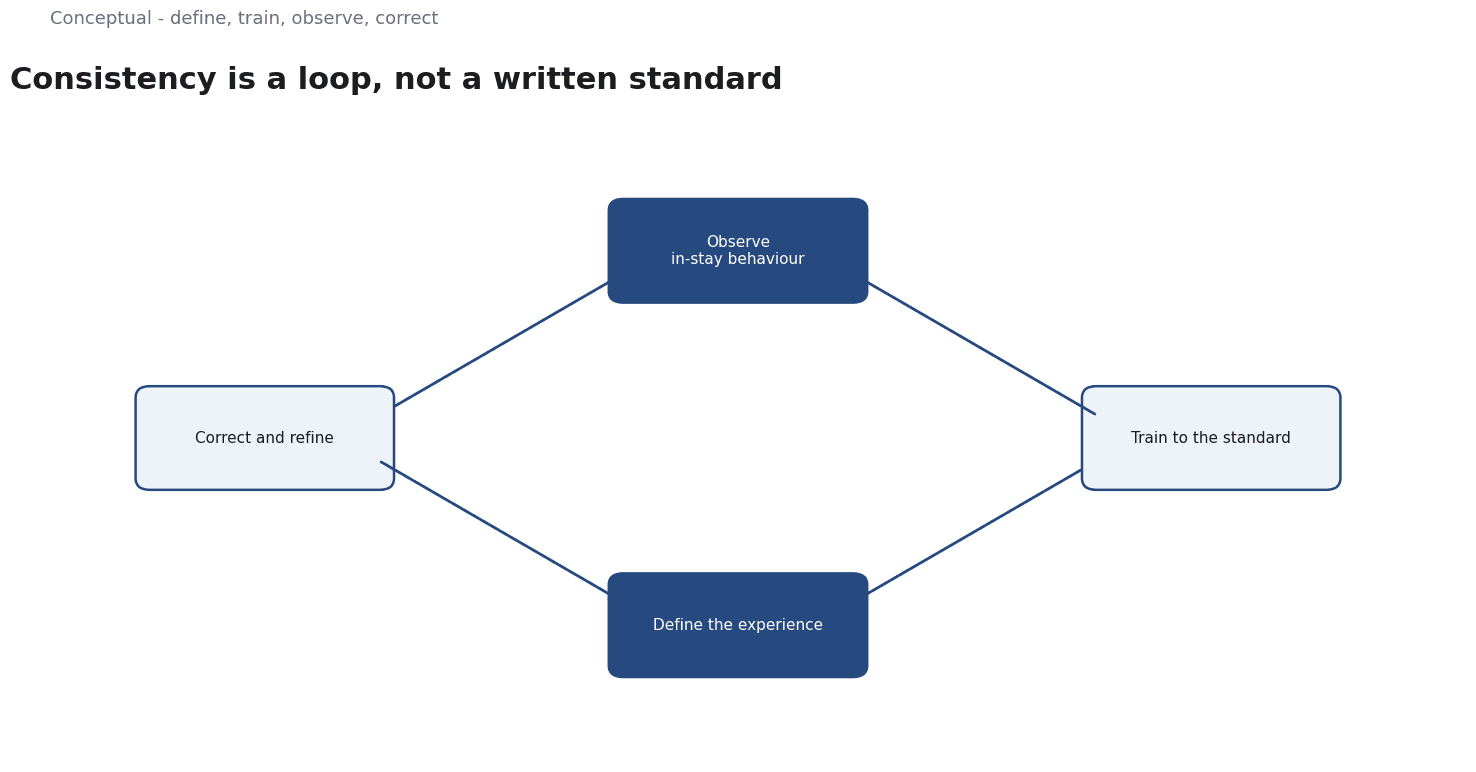
The sequence is: define the experience, train to it, observe it, then correct. The definition is local judgement, so it is inferred; the industry is source-reported.
A worked example
Illustrative. A hotel group expands from one property to five and notices falling review scores.
Three checks decide. First, which interaction is failing, using reviews by stage rather than an overall score? Second, does the failing stage have a clear standard that every property applies? Third, is the cause a training gap, a staffing gap, or a difference in local conditions?
The outcome is a targeted standard and training change. The scenario is hypothetical; the method is the contribution.
Why reviews are a lagging signal
A review appears after the experience, which means the cause has already affected the guest. Reading reviews by stage narrows the search, but behaviour observed during the stay is an earlier signal. Using both gives a faster feedback loop.
Why standards have to be observable
A standard that says a welcome should be warm cannot be checked. A standard that describes observable actions can be trained and measured. The translation from value to behaviour is the work that makes consistency possible at several locations.
Evidence status
| Claim | Status | Source | Verified | Recheck when |
|---|---|---|---|---|
| Tourism operates at large scale | source-reported | Wikipedia, Tourism | 2026-11-18 | Data changes |
| Experience forms across interactions | source-reported | Wikipedia, Customer experience | 2026-11-18 | Definition revised |
| Measure standards across locations | inferred | Derived from the industry context | 2026-11-18 | Properties change |
Why consistency is the challenge
A single location can rely on the founder's attention. Several locations cannot. The transition from personal attention to a system is where quality usually drops, and it is the point where a written standard becomes necessary.
Consistency cannot remove the need for local judgement. A guest with an unusual need is not served by a rule, and staff need room to respond.
The expansion should also be staged. Opening several properties at once multiplies the chance that a standard is misunderstood, while a slower sequence lets each location be checked before the next begins.
A standard should be written where staff can use it, not in a document that describes the brand in abstract terms.
A final constraint is that the brand promise must match what operations can deliver.
Reviewing the promise alongside the standard is therefore part of scaling. It is better to promise less and deliver it consistently than to define an experience that only the best property can achieve.
The review should include the staff who deliver the experience, since they see where the standard and reality diverge first.
A standard that cannot be observed cannot be coached, which is why the translation from value to behaviour is the real work of scaling.
The standard should be tested in every property before it is applied to all of them, since local conditions reveal different failures.
The outcome should be reviewed by property, since an average can hide a single failing location.
A standard that only the strongest property can meet is a brand promise that the group cannot honour.
What it cannot do
It cannot guarantee a good experience in every interaction. It does not remove the need for local judgement. And it cannot fix a property with insufficient staffing.
The counterargument that standardisation removes the human element is fair when standards are rigid and incomplete when they define the basics that free staff to be human.
A decision test
- Define the experience by stage.
- Set a standard for each stage.
- Train to the standard.
- Measure across locations.
- Correct the failing stage.
- Record the decision and recheck date.
For the measurement, see Customer Experience.
References & Further Reading
- Wikipedia contributors, 2026. Tourism - Wikipedia — The structure and economics of travel and tourism.
- Wikipedia contributors, 2026. Customer experience - Wikipedia — The overall perception customers form across interactions.