Engineering Management: Hiring, Culture, Metrics, and Career Ladders
Managing engineers is a different job from engineering. Read the mechanism, the time budget, and what Google re:Work's research actually supports.
The transition from engineer to manager is often described as a promotion. In practice it is a change of profession: the deliverable stops being code you wrote and becomes the capacity of people you support. That shift breaks the intuitions that made the engineer successful, because the useful work is now indirect and its results are delayed.
Direct answer: Engineering management is the practice of building a team's capacity through hiring, clear expectations, feedback, and removal of obstacles. Google's re:Work programme frames this as "proven practices, real examples, and research" for a "people-first approach", organised around hiring and onboarding, learning and development, organisational management, and manager effectiveness. The boundary: these practices are research-informed starting points, not a guarantee, and a manager cannot outsource judgement about a specific team to a framework.
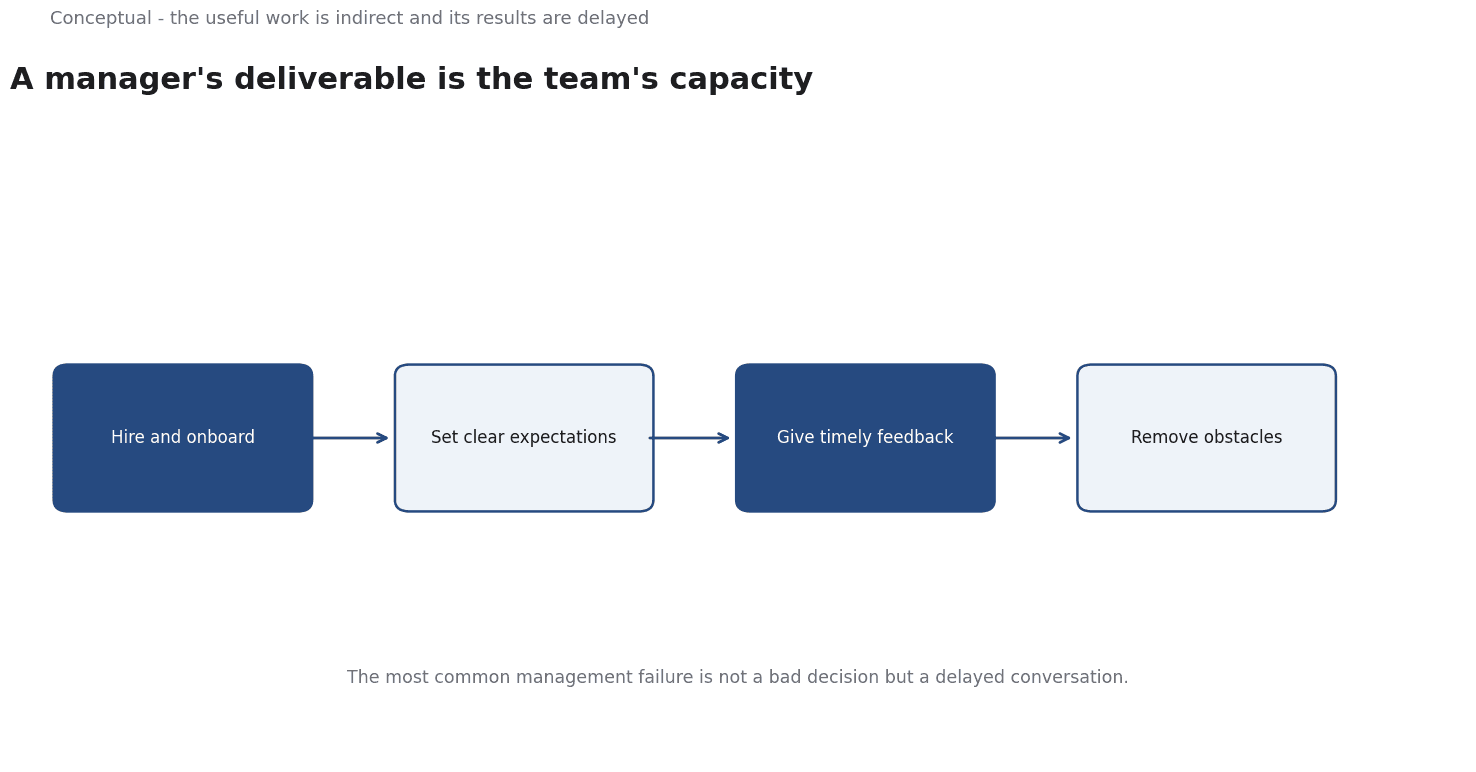
What changes in the job
Four things change at the transition.
The unit of output. An engineer's work is visible in a diff or a deployed service. A manager's output appears in other people's performance, which is real but harder to attribute.
The source of leverage. An engineer scales by writing better code or automating a task. A manager scales by improving how several people work — hiring well, clarifying priorities, and removing blockers.
The nature of feedback. Technical work gives fast, objective signals. People work gives delayed and ambiguous ones, which makes it tempting to manage by visible activity rather than outcome.
The ethical weight. Decisions about hiring, promotion, and workload affect people's livelihoods. That is not a side effect of the role; it is the role.
re:Work's framing is useful because it treats management as a set of practices that can be examined rather than a personality trait. One of its published conclusions is pointed: "Your team doesn't need an all-knowing leader."
The manager's job is not to have every answer but to make the team effective at finding them.
The time budget is the first constraint
A new manager usually underestimates how much calendar time the role consumes. The arithmetic is simple and often decisive.
Suppose you have eight direct reports and commit to a 30-minute weekly one-to-one with each. That is 4 hours a week. Add a weekly team meeting of 1 hour, hiring loops averaging 3 hours a week while recruiting, and 2 hours of cross-functional coordination. The total is 10 hours — a quarter of a 40-hour week — before any individual work.
Now add an ninth report and a second open role: the one-to-ones rise to 4.5 hours and hiring to perhaps 6 hours, pushing the total past 12. Something has to give, and if it is not made explicit, it will be the one-to-ones — the very activity most likely to surface problems early.
The practical conclusion is that management is a capacity planning problem.
Span of control, meeting cadence, and hiring load have to be budgeted like any other resource. A manager with fifteen reports and three open roles cannot do meaningful one-to-ones, whatever their intentions.
Hiring and onboarding are the highest-leverage moments
re:Work's topic structure puts "Hiring & Onboarding" first and describes effective hiring as "laying a strong foundation to ensure you recruit the right people", with a separate article on "a data-driven approach to optimizing employee onboarding" published August 2025. The emphasis is justified: a hiring decision determines the work of the team for years, and onboarding determines how quickly a new person contributes.
Three practices make this concrete:
- Define the role by outcomes before interviewing. A list of tools is a weak proxy for what the person must achieve.
- Use structured interviews with the same questions and a written rubric. Unstructured conversations feel better and predict worse.
- Treat onboarding as a process with a defined first-week and first-month outcome, not an informal introduction.
The limitation is that none of this eliminates uncertainty. A structured process improves the quality of the decision; it does not make a candidate's future performance knowable.
Metrics, career ladders, and their failures
Two instruments cause disproportionate trouble when used badly.
Metrics. Measuring activity — commits, tickets closed, hours online — is easy and misleading, because it rewards visible motion over valuable outcomes. re:Work's emphasis on People Analytics is better understood as a way to test hypotheses about the team (where onboarding stalls, where attrition clusters) than as a dashboard of individual productivity. A metric that a person can game will eventually be gamed.
Career ladders. A ladder makes progression legible, which is useful, but it can push strong individual contributors into management because that is the only visible way to advance. A healthy structure gives senior engineers a path that increases scope and compensation without requiring them to manage people. The relevant question for any ladder is: does it reward the contribution you actually want, or merely the next rung?
Feedback is a system, not an event
A problem noticed in March and raised in the September review has cost six months of avoidable friction, and the employee is surprised by feedback they could have acted on.
A workable system has three properties:
Regularity. A weekly one-to-one is not a status meeting; it is a reserved space for the things that do not fit in a stand-up. Cancelling it repeatedly tells the team that their problems are lower priority than the manager's calendar.
Specificity. "Do better on communication" gives the employee nothing to change. "The handoff note was missing the decision, so the next team rebuilt it from scratch" names an observable behaviour and its consequence.
Both directions. A manager who only gives feedback never learns what is blocking the team. Asking "what is making your work harder than it needs to be?" produces more useful information than a satisfaction score collected once a year.
The limitation is that none of this is comfortable. A manager who avoids a difficult conversation because it is unpleasant is making a choice — to defer the cost to the employee and the team. re:Work's emphasis on manager effectiveness is a recognition that this part of the role can be learned, not that it is easy.
What the research cannot tell a manager
Three qualifications keep the framework honest.
Practices are context-dependent. A technique that works in one organisation may fail in another with different incentives, power distance, or regulatory constraints. re:Work presents practices and examples, not universal laws, and that qualification should be preserved.
Management is not a personality type. The idea that a good manager must be charismatic or endlessly available is both unsupported and costly. A predictable, fair manager who runs a good hiring process is more useful than an inspiring one who avoids difficult conversations.
You will be measured on outcomes you do not control. Market conditions, product decisions, and other teams affect your team's results. A fair evaluation separates what the manager influenced from what happened around them — which is also how a manager should evaluate their own team.
The counterargument to all of this — that management is mostly common sense — is partly right. The practices are not exotic. What is rare is doing them consistently under pressure, which is why making them explicit and budgeted matters.
A decision test
- Budget the calendar before accepting more reports or open roles.
- Define roles by outcomes and interview against a written rubric.
- Protect the one-to-one as the earliest signal of a problem.
- Use metrics for team diagnosis, not individual surveillance.
- Check that the career ladder rewards technical depth as well as management.
- Make one explicit change per quarter and observe whether it helps this team.
- Ask what you would stop doing when adding a responsibility.
For the technical side of the role, see How to Think Like an Engineer; for the team's operating model, see DevOps.
A worked example
The following is hypothetical and illustrative. A new manager inherits a team of eight engineers and two open roles and sketches a week on paper. Check one, calendar arithmetic: eight weekly one-to-ones at 30 minutes is 4 hours, a 1-hour team meeting, and hiring loops averaging 3 hours bring the total past 8 before individual work; adding a ninth report pushes it higher. Check two, hiring quality: the manager defines each role by outcomes and interviews against a shared written rubric, since re:Work presents hiring and onboarding as a foundation and structured interviews as the practice that improves the decision, not unstructured conversation. Check three, feedback system: one-to-ones are protected, feedback names an observable behaviour and its consequence, and a question about what is making work harder replaces an annual score. The bounded outcome is a team where the highest-leverage activities survive the calendar; the manager cannot promise that a framework makes a specific hire succeed, only that the process was sound and problems surfaced early.
References & Further Reading
- Google, 2026. Google re:Work — A large company's published people practices, including hiring and growth frameworks.
- U.S. Department of Labor, 2026. O*NET OnLine — The standard occupational taxonomy used to compare roles across industries.