How to Build Wealth on a Middle Income
Wealth building is mostly a sequence: control spending, automate saving, keep costs low, and hold a diversified portfolio. Read the arithmetic.
Advice for building wealth on a middle income often focuses on small sacrifices — skip the coffee, save the difference. That framing misses the mechanism. The decisive variables are the savings rate, the time the money stays invested, and the costs and taxes that reduce returns. A higher income helps, but a high income with a low savings rate does not compound.
Direct answer: Build wealth by automating a savings rate, keeping investment costs and taxes low, holding a diversified portfolio for a long horizon, and avoiding high-cost debt. Investor.gov's guidance emphasises that all investments involve risk and that returns are not guaranteed. The boundary: this is general education, not personalised advice — the right sequence depends on your debts, jurisdiction, and household, and the result is probabilistic.
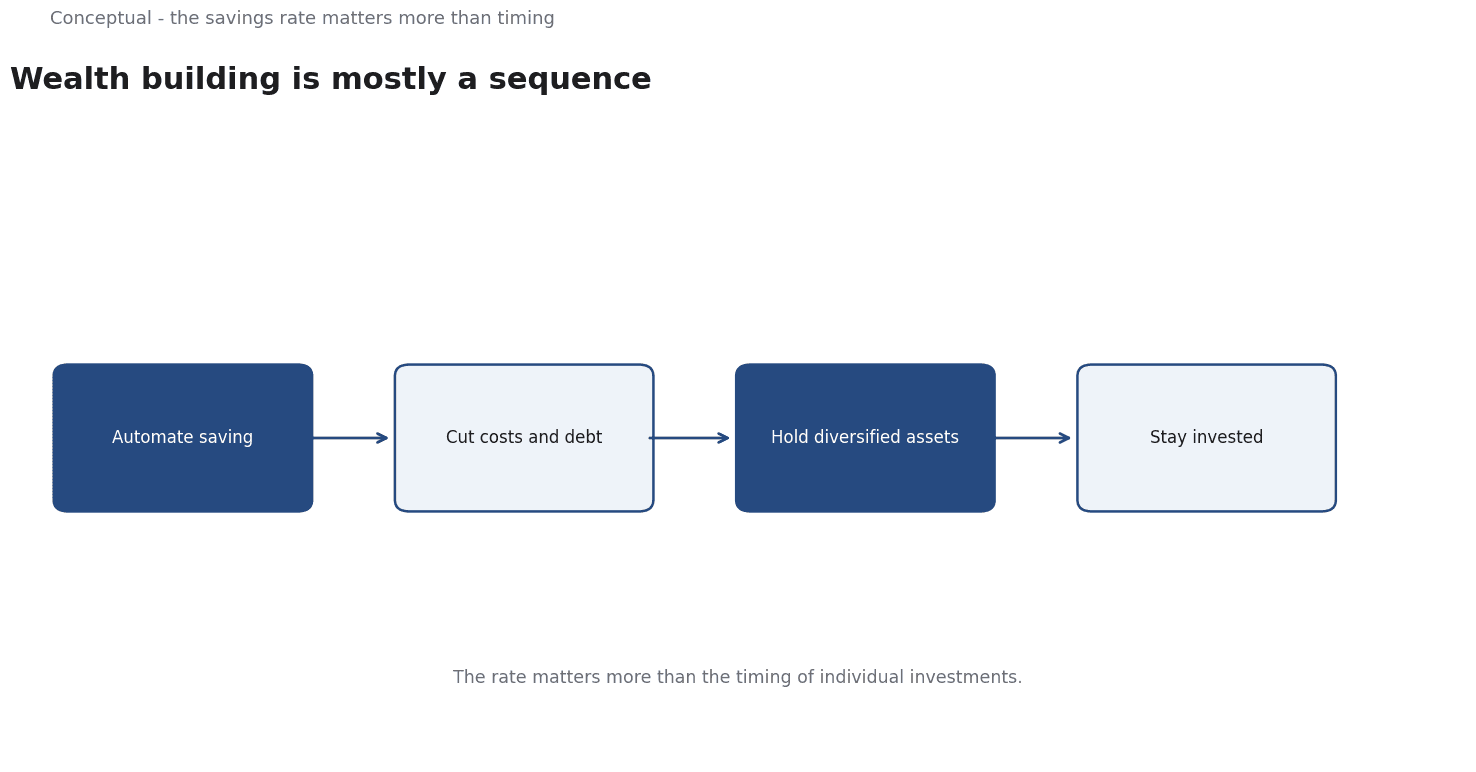
The sequence
1. Cover the near-term risks. An emergency fund and high-cost debt come first. A credit card balance at 20% interest is a guaranteed negative return that no investment should be expected to beat.
2. Automate the savings rate. Transfer a fixed amount when income arrives, before discretionary spending.
The rate matters more than the timing of individual investments.
3. Use tax-advantaged accounts where available. The rules differ by jurisdiction, so the specific accounts must be checked locally. The principle is that a lower tax drag improves the effective compounding rate.
4. Hold a diversified portfolio. Diversification does not guarantee a gain; it reduces the risk that one failure dominates. The long-horizon article covers the role of equities and the meaning of a historical return estimate.
5. Minimise costs. Fees are certain; excess returns are not. The compound-interest article shows how a 1% fee changes a 30-year outcome.
6. Increase the rate as income grows.
Committing a fixed share of each increase raises it without a corresponding increase in perceived sacrifice.
A worked example
The following numbers are hypothetical and illustrative, using a constant 6% real annual return.
A household saves 500 a month for 20 years:
- Contributions: 120,000.
- Ending value at 6% real: roughly 231,000.
Now increase the monthly savings by 200 as income grows:
- Contributions: 168,000.
- Ending value: roughly 323,000.
An extra 48,000 of contributions produces about 92,000 more in real ending value, because the additional money also compounds. Three readings follow:
- The rate is the lever. A 40% increase in monthly savings produced a 40% increase in ending value, plus compounding on the difference.
- Time is the multiplier. Starting ten years later with the same monthly amount would produce roughly half the ending value.
- The return assumption matters but is not the main decision. At 4% real, the first scenario ends near 184,000; at 8%, near 294,000. The range is wide, but the savings rate and time are more controllable.
The role of income growth
A savings rate applied to a stagnant income has a ceiling. Over a career, the largest increases in absolute savings usually come from earning more, not from cutting further. Three ways to act on that:
Negotiate and change roles deliberately. A raise absorbed into lifestyle leaves the savings rate unchanged. Committing a fixed share of each increase raises it without requiring a new sacrifice, which makes the change easier to sustain.
Invest in skills with a visible labour-market return. Not every course or credential pays, so the test is whether the skill appears in roles you want and whether employers reward it. Occupational data and job postings are more useful evidence than a provider's marketing.
Protect the margin you already have. A period of unemployment or a long-term health issue can undo years of accumulation. Insurance and an emergency reserve are part of wealth building, not a distraction from it.
These points are less tidy than a budgeting rule, but they explain why two households with similar incomes can end in very different positions. The savings habit matters; so does the trajectory of the income it is applied to.
What the sequence cannot do
It cannot eliminate risk. A diversified portfolio can fall, and a long horizon does not guarantee a positive outcome at the exact date you need the money.
It cannot remove uncertainty about tax rules. Tax treatment changes with jurisdiction and policy. Check current rules rather than assuming a structure from another country.
It cannot substitute for earning more. At a low income with high fixed costs, the savings rate may be constrained. Increasing income — through skills, negotiation, or a change of work — is a legitimate part of the strategy, which the future-of-work article discusses.
The counterargument — that investing is only for the wealthy — is wrong at the level of mechanism and fair at the level of cash flow.
The method works at small amounts; the room to save may genuinely be absent.
Addressing the cash-flow constraint is the honest first step.
A decision test
- Clear high-cost debt before investing beyond an emergency reserve.
- Set a savings rate and automate it at income receipt.
- Use local tax-advantaged accounts with current rules checked.
- Diversify and state the basis of your return assumption.
- Minimise fees as a certain saving.
- Raise the rate with income rather than absorbing every raise.
- Review on change — employment, household, or goals.
For the foundational plan, see Personal Finance for Professionals; for the compounding arithmetic, see Compound Interest Examples.
References & Further Reading
- U.S. Securities and Exchange Commission (Investor.gov), 2026. Introduction to Investing — Primary regulator guidance on market mechanics and investor protection.
- Wikipedia contributors, 2026. Inflation - Wikipedia — The definition of inflation, its measurement and its effect on nominal versus real quantities; secondary reference.