How to Evaluate AI Voice Agents
A voice agent fails across listening, reasoning, and speaking. Read the evaluation layers, a worked call, and why transcript accuracy is not enough.
A voice agent is often evaluated by whether it produced a transcript, which covers only one layer. The system must hear correctly, decide correctly, and speak understandably, which the voice-user-interface entry describes for the interaction, as the speech-recognition entry explains the listening stage, as the evaluation-rubric article requires for concrete criteria, as the agent-evaluation article treats the trajectory as the unit of evaluation.
Direct answer:
Evaluate voice agents at each layer — transcription, decision, and response — on a fixed call set with a fallback rule.
The voice-user-interface entry provides the interaction context, and speech recognition covers the listening layer. The boundary: a lab call set does not cover every accent, noise condition, or intent, which the benchmarks article warns about broad claims, as the publication standard forbids guaranteed outcomes, as the risk-assessment article requires residual risk.
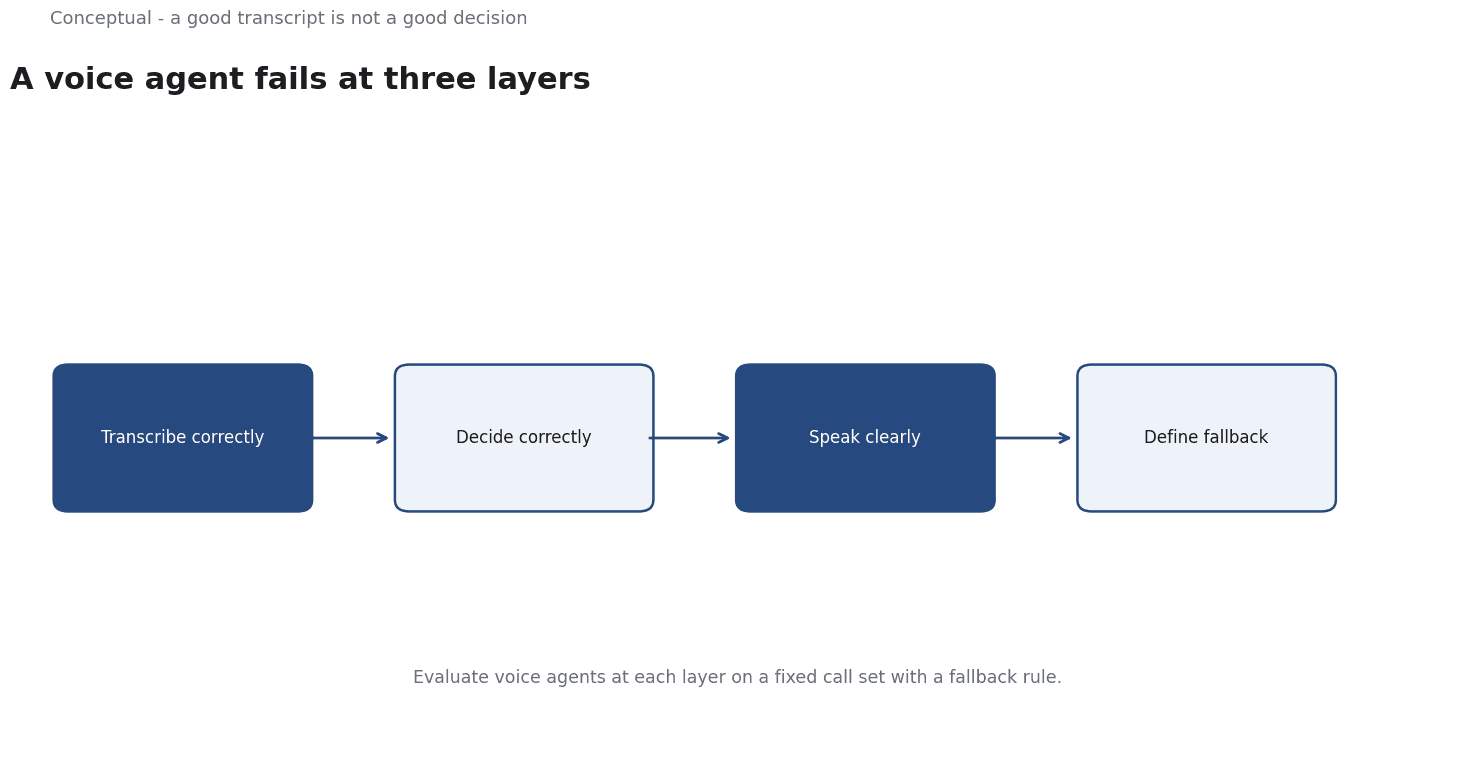
The layers
Listening. Does the system transcribe the caller's intent correctly in the conditions tested, which the speech-recognition entry explains, with a fixed call set, as the rubric article requires, as the benchmarks article warns about conditions, as the data-governance article requires for dated data.
Deciding. Does the agent choose the right action, including escalation, which the agent-evaluation article treats as the trajectory, as the approval-gates article places a boundary on high-impact actions, as the human-in-the-loop article argues for meaningful review, as the decision-memo article requires for a record.
Speaking. Is the reply understandable and appropriately timed, which the voice-user-interface entry treats as interaction, as the accessibility article requires that interfaces remain usable, as the customer-experience article treats experience as the outcome, as the rubric article requires concrete criteria.
Fallback. What happens when the system is unsure, as Getting Started with AI Approval Gates advises, as the escalation path in the incident article requires, as the risk article requires residual risk, as the monitoring article advises for review.
Three consequences follow. The call set should be fixed and representative, as the rubric article requires, as the benchmarks article warns, as AAPOR's standards apply to any survey used, as the survey-design article advises. Layers should be scored separately, as the agent-evaluation article advises, as the evaluation-rubric article requires, as the dashboard article argues for metrics tied to decisions. And the result should be recorded with residual risk, as the decision-memo and risk articles require.
A worked call set
The following is hypothetical and illustrative. A team tests a voice agent on fifty calls across intents and noise conditions.
Three checks decide. First, is transcription accurate under the conditions tested, as the speech-recognition entry and rubric article require, with dated data, as data governance requires? Second, did the agent choose the right action and escalate when unsure, as the agent-evaluation and approval-gates articles require, with a record, as the decision-memo article requires? Third, was the reply understandable, as the voice-user-interface and accessibility articles require, with a fallback, as the risk article requires, as the monitoring article advises?
Three conclusions follow.
Escalation is a design requirement, as Getting Started with AI Approval Gates advises. And the result should be recorded with residual risk, as the decision-memo and risk articles require.
What voice evaluation cannot do
It cannot cover every accent or noise condition, which the benchmarks article warns about, as the data-governance article requires for dated data, as the publication standard forbids guaranteed outcomes. It does not guarantee a good experience, which the customer-experience article treats as the outcome, as the accessibility article requires, as the risk article requires residual risk. And it cannot remove the need for a fallback, which the approval-gates article advises, as the escalation path in the incident article requires.
The counterargument that transcript accuracy is the main metric is fair for the listening layer and incomplete for the decision and response layers, which the worked call set shows, as the agent-evaluation and rubric articles advise.
A decision test
- Build a fixed and representative call set, as the rubric article requires.
- Score transcription, decision, and response separately, as the agent-evaluation article advises.
- Check escalation behaviour, as Getting Started with AI Approval Gates requires.
- Use dated data, as data governance requires.
- Verify accessibility of the interaction, as the accessibility article requires.
- State residual risk, as the risk article requires.
- Record the decision and review, as the decision-memo article requires.
For the interaction, see AI Voice Agents: Common Questions; for the boundary, see AI Approval Gates.
References & Further Reading
- Wikipedia contributors, 2026. Voice user interface - Wikipedia — The design of voice-based interfaces and interactions.
- Wikipedia contributors, 2026. Speech recognition - Wikipedia — The mechanisms of automatic speech recognition.