How to Evaluate Behavioral Interviews
Behavioral interviews are judgments under uncertainty. Learn how O*NET task data and decision-making structure can make interview evaluation explicit, with a worked test.
Interview panels often convert a conversation into a hiring decision without recording what the judgment was based on. O*NET OnLine provides structured descriptions of occupational tasks and skills, while the decision-making entry describes choosing among alternatives against criteria. The real problem is that a confident interview impression is not the same as a defensible evaluation.
Direct answer:
Evaluate a behavioral interview by mapping each question to a job-relevant criterion, scoring the evidence against that criterion, and recording the decision rule before the interview.
O*NET supplies candidate criteria; decision-making supplies the structure for weighing them. Neither supplies a pass mark for a specific role.
Delta: This article adds a criterion-to-evidence map beyond the sources: it maps an occupational task to the interview question that tests it and the decision it supports, with claim status explicit.
The mechanism
O*NET OnLine is a database of worker attributes and job characteristics maintained by the U.S. Department of Labor. It describes occupations in terms of tasks, skills, abilities, and work activities rather than in terms of one company's needs. The practical consequence is that interview criteria can be drawn from a structured occupational description instead of from an interviewer's intuition. A panel that starts from the task list has a shared reference for what the role involves, and that reference can be cited when the decision is later questioned. It is a starting point, not a complete specification of a particular team.
The decision-making entry describes a cognitive process of selecting a course of action among alternatives. It covers identifying the problem, establishing criteria, weighing those criteria, generating options, and evaluating them. The practical consequence is that an interview can be treated as a decision process with identifiable inputs rather than as a conversation whose outcome is a matter of feel. Once criteria and weights are written down, two candidates can be compared against the same standard, and the comparison can be reconstructed later.
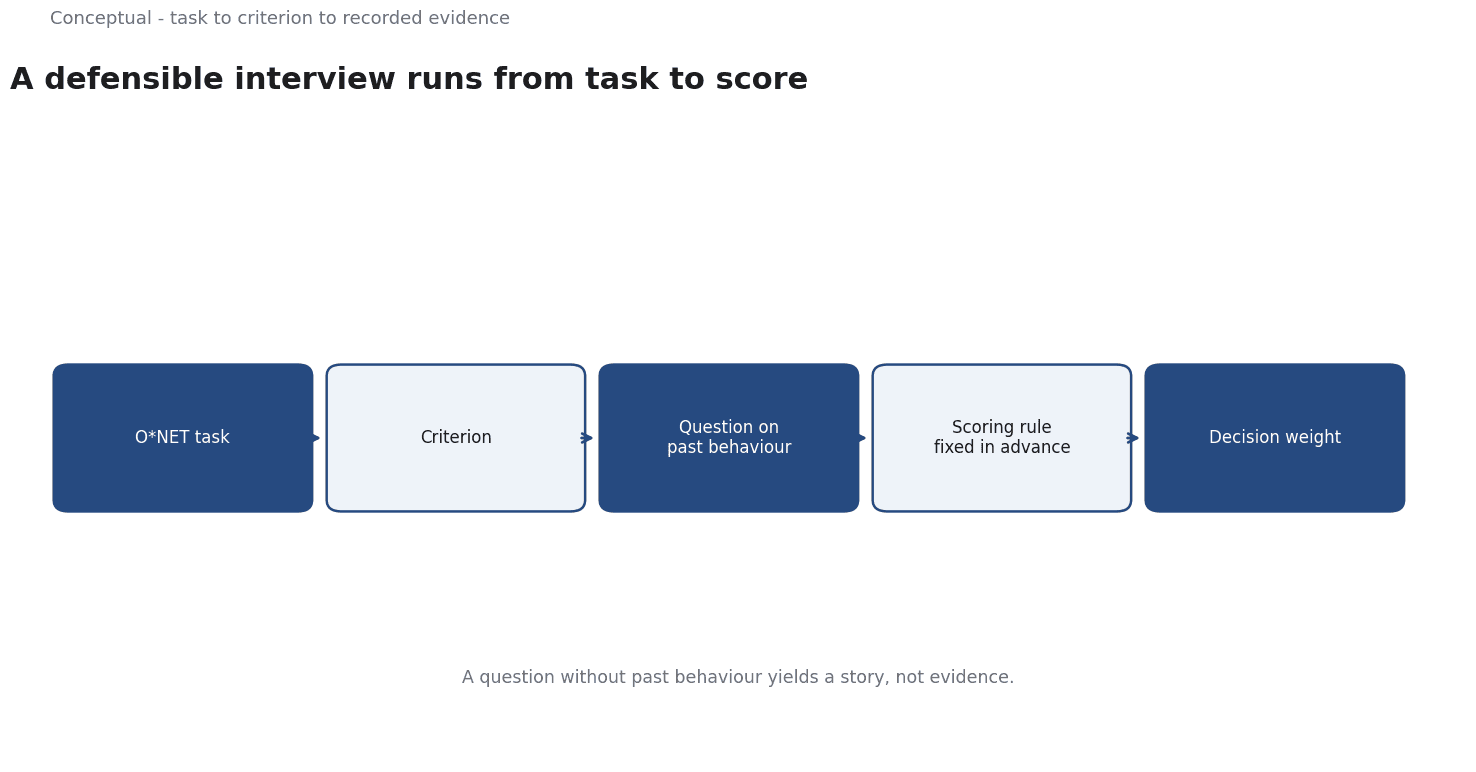
The two sources connect at a point neither states directly. O*NET describes what an occupation involves; decision-making describes how a choice among options can be structured. Neither says how to turn a task into a question or how to score an answer. That step is local work. It matters because a question that does not elicit past behavior tied to the criterion produces a story, not evidence. The defensible chain runs from a documented task to a criterion, from the criterion to a question, and from the question to a score recorded before the panel compares candidates.
The output is a mapping from each task to a question, a scoring rule, and a decision weight. That mapping is the decision instrument: it shows which part of the interview is grounded in the role and which part depends on judgment, so a reviewer can see where the line was drawn.
A worked example
The following is hypothetical and illustrative. A panel interviews two candidates for a customer-facing role whose occupational description includes resolving difficult client concerns. Three checks decide the evaluation. First, is that task present in the occupational description and turned into an explicit criterion? Second, does the question ask for a specific past incident with the candidate's own actions and outcome? Third, was the scoring rule and its weight fixed before either interview? The review finds that one answer gives a concrete example while the other gives a general intention, and the recorded rule distinguishes them. The outcome is a decision that can be explained from the criterion rather than from overall impression. The numbers are hypothetical; the verification method is the contribution.
Evidence status
| Claim | Status | Source | Verified | Recheck when |
|---|---|---|---|---|
| O*NET documents occupational tasks and skills | source-reported | U.S. Department of Labor, O*NET | 2026-11-18 | Database updated |
| Decision-making involves selecting among alternatives against criteria | source-reported | Wikipedia, Decision-making | 2026-11-18 | Entry revised |
| Map each interview question to an O*NET-derived criterion | inferred | Derived from the sources | 2026-11-18 | Role definition changes |
The first two rows summarise the sources: occupational attributes in O*NET and criteria-based choice in decision-making. The third is inferred because neither source prescribes how to build an interview question. Recheck the occupational row when the database is updated, the decision row when the entry is revised, and the inferred row when the role definition changes.
What it cannot do
An evaluation framework does not produce the right hire. It structures a judgment, but the judgment still depends on the criteria chosen and the evidence a candidate provides. O*NET describes occupations in general terms, not the specific needs of one team, and decision-making describes a process, not a correct answer. A structured interview can therefore be consistently wrong if its criteria are wrong. Consistency is a property of the process; validity is a separate question the sources do not settle. A panel should treat the output as a record of reasoning, not as a prediction.
The hidden cost is preparation. Deriving criteria from an occupational description, writing questions that elicit past behavior, and fixing a scoring rule before interviews all take time. Panels often prefer to improvise because the cost is immediate and the benefit appears only when two candidates are compared fairly. There is also a cost in constraining the conversation: a rigid rubric can miss a strength the role genuinely needs but the criteria did not anticipate. The design has to leave room for a recorded exception.
A vivid answer can feel persuasive while containing little that maps to the criterion, and a quiet answer can understate real competence. Another failure is changing the rubric after seeing the candidates, which makes comparisons meaningless. Because neither source defines a scoring scale, the scale is local and should be fixed in advance. A reviewer should be able to trace each score to a specific criterion and a specific piece of the answer, and to see when the rule was set.
The scope is limited to evaluation structure. It does not cover legal limits on interview questions, assessment of protected characteristics, or the many job-relevant abilities that an occupational database may not capture. It does not remove bias from the people applying the rubric; it only makes their reasoning visible. It is not a validated selection test and does not predict performance on its own. Teams needing those guarantees must look to other methods and, where appropriate, specialist review.
Both sources evolve: the occupational database is updated and the decision-making entry is revised. A criterion set should therefore carry a recheck condition tied to a role change or a database update. Each interview decision should record the criteria version and the scoring rule used, so a later review can reconstruct it. Without that record, a hiring decision cannot be examined for fairness after the fact, and the organisation loses the chance to learn which questions actually distinguished candidates.
The counterargument that a structured rubric is fair for comparing candidates is incomplete when the criteria themselves encode an outdated view of the role.
A decision test
- Identify the role and its source occupation.
- Extract relevant tasks and skills from O*NET.
- Turn each task into a criterion with a scoring rule.
- Write questions that ask for past behavior tied to those criteria.
- Fix weights and the decision rule before interviewing.
- Score each answer against the criterion and record the evidence.
- Review the decision against the recorded rule and set a recheck condition.
A behavioral interview is defensible when the path from job task to question to score is visible. The test does not make the decision for the panel; it makes the basis of the decision reviewable. That matters most when two candidates are close, because only a recorded rule can show why one was preferred. For further reading, see Decision Memos.
References & Further Reading
- U.S. Department of Labor, 2026. O*NET OnLine — The standard occupational taxonomy used to compare roles across industries.
- Wikipedia contributors, 2026. Decision-making - Wikipedia — Overview of decision processes, trade-offs and the distinction between the decision and its outcome; secondary reference.