How to Evaluate Employer Branding
Employer branding needs evaluation, not slogans. Read the mechanism, a worked review, a claim-status table, and the limits of brand metrics as evidence.
Employer branding is often reduced to perks, recruiting copy, and a careers page refresh. The Wikipedia entries on employer branding and brand management frame it differently: it is an accumulated perception of an organisation as a place to work, and perceptions are shaped by more than what a company says about itself. The real problem is deciding whether that perception is strong, accurate, and useful for hiring and retention.
Direct answer:
Evaluate employer branding by asking what perception it creates among current and prospective employees and whether that perception matches the employee value proposition.
Brand management supplies the frame of awareness, associations, and equity. A brand that is well known but contradicts daily experience is not working.
Delta: This article adds a perception-versus-proposition test beyond the sources: it maps employer-brand signals to a hiring and retention decision, with claim status explicit.
The mechanism
Wikipedia describes employer branding as the process by which an organisation promotes itself as a good place to work. It is distinct from recruitment marketing: the brand is the accumulated perception, while a campaign is a tactic designed to communicate it. The mechanism is perception formation. Candidates and employees build an image from many signals, including what the company publishes, what managers say, and what employees report about their own experience. The practical consequence is that the brand cannot be owned entirely by the people who write the recruitment copy.
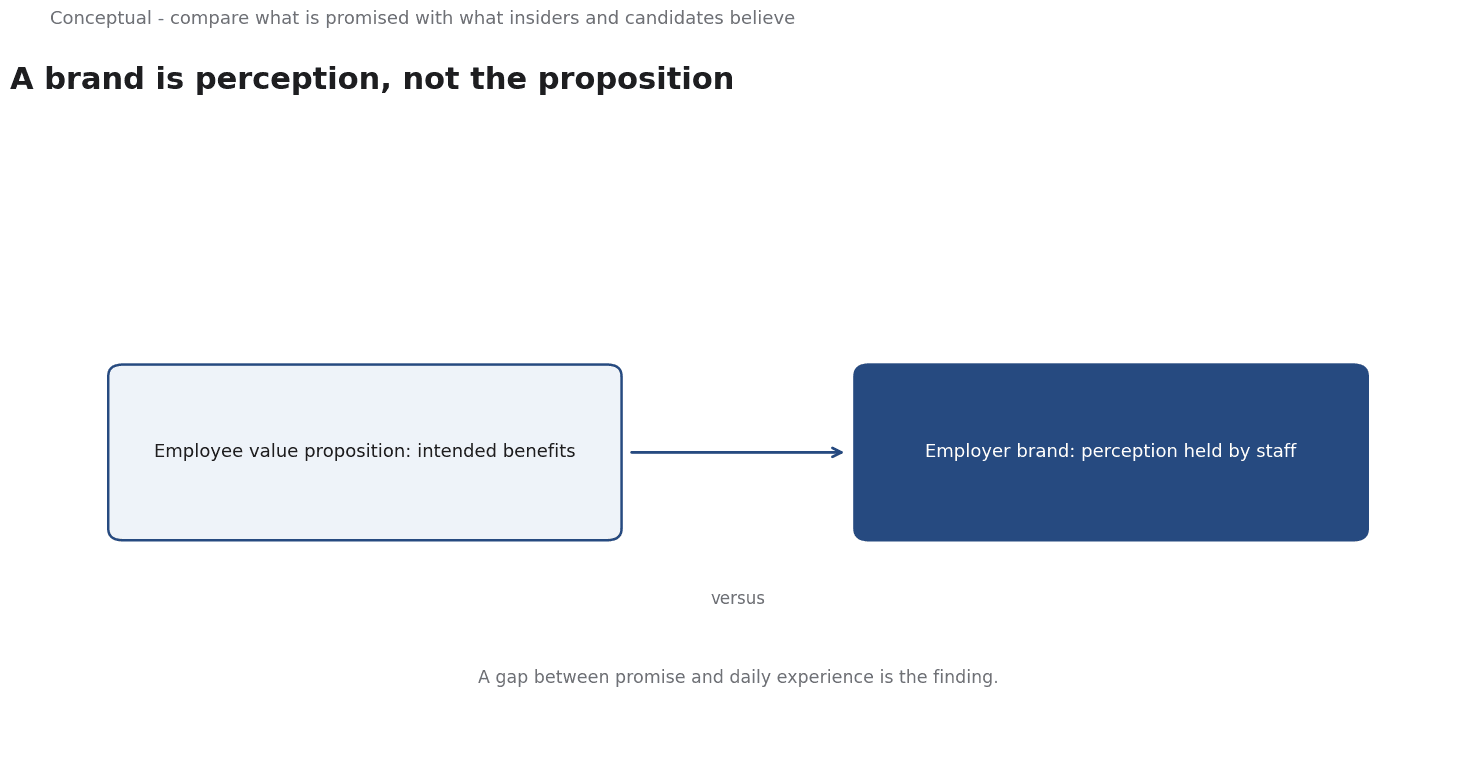
Brand management, the second source, treats a brand as an asset whose value comes from how it is perceived in the market. The entry discusses brand equity, the associations and awareness that make a brand valuable beyond the functional product. Applied to employment, an employer brand has equity when the people a company wants to hire and keep recognise it and hold specific, favourable associations about it. The employee value proposition, the set of functional, economic, and psychological benefits on offer, is what the organisation intends; the brand is the degree to which that offer is understood and believed.
The two audiences test the brand differently. Current employees compare it against daily experience, and a visible gap between promise and reality erodes trust in the message. Prospective candidates have no direct experience, so they rely on reputation, word of mouth, and the clarity of the proposition. Evaluation therefore has to look in both directions: what insiders believe and what the talent pool believes. A single survey of one group gives an incomplete picture.
The synthesis is to treat employer brand evaluation as a perception-versus-proposition check. Mapping the resulting signals to a hiring or retention decision is a judgement about how to use the two sources, not a claim either source makes directly. Marking that inference explicitly keeps a practical method from being reported as a research finding, and it makes the point where the method could fail easier to see.
A worked example
The following is hypothetical and illustrative. A company claims a collaborative culture in its recruiting materials and wants to know whether the claim holds. The first check is the proposition: does the employee value proposition state specific, verifiable benefits rather than abstractions such as "great people"? The second check is internal perception: do current employees describe autonomy and collaboration in ways that match the claim, and where do the responses diverge? The third check is external perception: do candidates' descriptions of the company move toward the claimed attributes after contact with it? The outcome is that the claim survives on paper but employee feedback diverges sharply on autonomy, so the team revises the proposition instead of the slogan. The scenario is invented; the concepts come from the sources.
Evidence status
| Claim | Status | Source | Verified | Recheck when |
|---|---|---|---|---|
| Employer branding promotes an organisation as a good place to work | source-reported | Employer branding (Wikipedia) | 2026-11-18 | Entry is substantively revised |
| Brand management treats perception and equity as sources of value | source-reported | Brand management (Wikipedia) | 2026-11-18 | Entry is substantively revised |
| A perception-versus-proposition gap is a usable evaluation metric | inferred | Derived from the sources | 2026-11-18 | Workforce or market context changes |
The first two rows are claims the sources make. The third is a method built from them, not a finding of either entry, so it is marked inferred. Its usefulness depends on the labour market and the workforce being measured, and it should be rechecked when either changes. The table exists to keep that dependence from being lost between reviews.
What it cannot do
Employer brand evaluation cannot prove that a company is a good employer, or that a given person will accept an offer. It measures perception, and perception is not the same as the underlying experience. A well-known brand can coexist with high turnover if the awareness is not matched by what employees actually encounter. Treating a favourable perception score as proof of a healthy workplace confuses the signal with the thing it is meant to represent, and the stronger the brand, the more tempting that confusion becomes.
The hidden cost is that a strong brand can attract applicants who are a poor fit for the role. Clear, attractive associations draw a wider field, which increases screening work and can raise early attrition when reality disappoints new hires. The brand-management source is concerned with building value through perception; it does not promise that the resulting inflow is efficient. An organisation that invests only in the message and not in the selection process may find that its employer brand raises costs as well as application volume.
When recruitment copy overstates autonomy, flexibility, or progression, employees notice the mismatch and share it, often in public. Because perception is formed from many voices, a single official channel cannot correct a claim that daily experience contradicts. The source on employer branding treats the brand as a perception held by people, which means it can be damaged by the very employees it is supposed to attract. Evaluation that ignores insider perception will miss this failure until it shows up in retention data.
The boundary is between the brand, recruitment marketing, and employee experience. The brand is the perception, recruitment marketing is the set of communications, and employee experience is the reality those communications describe. Brand management offers concepts for the first, not a method for fixing the third. An evaluation that blames the brand team for an operational problem, or that expects a campaign to repair a poor workplace, has crossed that boundary. Keeping the three separate makes the source of a problem easier to identify.
Perceptions also decay. What candidates associate with an employer shifts with the labour market, public events, and the experiences of people who leave. A brand that was accurate at one point is not automatically accurate later, so evaluation needs an owner and a review condition. The sources describe what employer branding and brand equity are, but they do not set a review schedule. Establishing one locally is what turns a one-off measurement into a maintained input to hiring and retention decisions.
Counterargument:
"The counterargument that employer branding is just marketing is fair for a single hiring campaign with a narrow audience and incomplete where long-term perception and employee experience shape who applies and who stays."
A decision test
- Name the hiring or retention decision the evaluation is meant to support.
- Write the employee value proposition in specific, verifiable terms.
- Measure perception among current employees against that proposition.
- Measure perception among the relevant candidate population.
- Compare the two and locate the largest gaps.
- Check whether recruitment communications match the lived experience.
- Assign an owner and a review date, and recheck after major workforce changes.
The test turns an abstract brand into a set of checkable comparisons. Each step asks whether a perception is specific enough to guide a decision, and the final steps keep the measurement current. A passing evaluation is not proof of a good workplace; it is evidence that the gap between promise and experience was examined and made visible to the people accountable for it.
For further reading, see Voice of Customer: Turning Feedback into Decisions.
References & Further Reading
- Wikipedia contributors, 2026. Employer branding - Wikipedia — How organisations are portrayed as places to work.
- Wikipedia contributors, 2026. Brand management - Wikipedia — The discipline of maintaining a brand across touchpoints; secondary reference used for channel consistency.